The difference between speakers and studio monitors lies in their design philosophy and intended use. While regular speakers color sound to make it pleasing, studio monitors provide neutral, accurate audio reproduction for professional mixing and production. Understanding these differences is crucial for choosing the right audio equipment whether you’re setting up a home studio or upgrading your entertainment system.
What Are Studio Monitors vs Regular Speakers
Studio monitors are professional audio speakers designed specifically for critical listening and audio production work. Unlike consumer speakers that enhance certain frequencies to sound more appealing, monitors provide flat frequency response for accurate sound reproduction. This neutral presentation allows producers and engineers to hear exactly what’s in their recordings without coloration.
Regular speakers, also called hi-fi speakers or consumer speakers, are engineered to make music sound enjoyable for casual listening. They typically boost bass frequencies and add warmth to the midrange to create a more exciting listening experience. These speakers for home audio prioritize entertainment value over analytical accuracy.
Active vs Passive Design Differences
Most studio monitors feature active designs with built-in amplifiers, allowing precise control over each driver. This integration eliminates the need for external amplifiers and ensures optimal matching between the amp and drivers. Active monitors also include sophisticated crossover networks and DSP processing for enhanced accuracy.
Frequency Response Characteristics
Professional monitors aim for flat frequency response across the entire audible spectrum, typically measuring within ±3dB from 20Hz to 20kHz. Consumer speakers often feature V-shaped frequency curves that emphasize bass and treble while reducing midrange presence, creating a more exciting but less accurate sound signature.
Should I Get Studio Monitors or Speakers for My Setup
Choose studio monitors if you’re involved in music production, podcasting, or content creation where accurate audio reproduction is essential. Monitors excel in revealing mix problems, allowing you to make better EQ decisions, and ensuring your productions translate well across different playback systems. They’re ideal for near-field listening in treated acoustic environments.
Opt for regular speakers if your primary goal is entertainment and casual music listening. Consumer speakers provide more forgiving sound that remains enjoyable even with poorly mixed recordings. They work better in typical living room environments and offer more flexibility for different music genres and listening preferences.
Home Studio Considerations
For home studios, studio monitors paired with acoustic treatment deliver superior results for mixing and mastering. Position monitors at ear level, forming an equilateral triangle with your listening position. The typical setup distance ranges from 3-8 feet depending on monitor size and room acoustics.
Living Room Audio Setup
Consumer speakers integrate better into living spaces where acoustic treatment isn’t practical. They perform well at various listening distances and angles, making them suitable for family entertainment systems. Floor-standing speakers or bookshelf speakers with subwoofers create immersive experiences for movies and music.
Understanding the 83% and 38% Rules for Audio
The 83% rule for speakers refers to the optimal listening distance calculation where you sit at 83% of the distance between your two speakers. If your speakers are 8 feet apart, position yourself approximately 6.6 feet back to achieve proper stereo imaging and soundstage width.
The 38% rule for studio monitors relates to room placement, where monitors should be positioned 38% into the room’s length from the front wall. This placement minimizes problematic room reflections and standing waves that can color the sound. Combined with proper acoustic treatment, this positioning enhances monitor accuracy.
Can You Use Regular Speakers as Studio Monitors
While technically possible, using regular speakers as studio monitors isn’t recommended for professional work. Consumer speakers’ colored frequency response can lead to mixing decisions that don’t translate well to other playback systems. Your mixes might sound bass-heavy or lack clarity when played on different speakers.
However, high-quality bookshelf speakers can serve as reference monitors for casual production work or as secondary monitoring options. Some audiophile speakers offer relatively flat response that can provide useful perspectives during the mixing process, though they shouldn’t be your primary mixing reference.
Workaround Solutions for Budget Studios
If budget constraints limit you to regular speakers, choose models known for neutral response like certain bookshelf designs from reputable manufacturers. Use reference tracks extensively and check your mixes on multiple playback systems to compensate for any frequency coloration.
Professional Workflow Considerations
Professional studios often use multiple monitor systems including near-field monitors for detail work and larger monitors for overall balance. This multi-monitor approach ensures mixes translate across various listening environments from car stereos to high-end home audio systems.
Studio Monitors vs Bookshelf Speakers Comparison
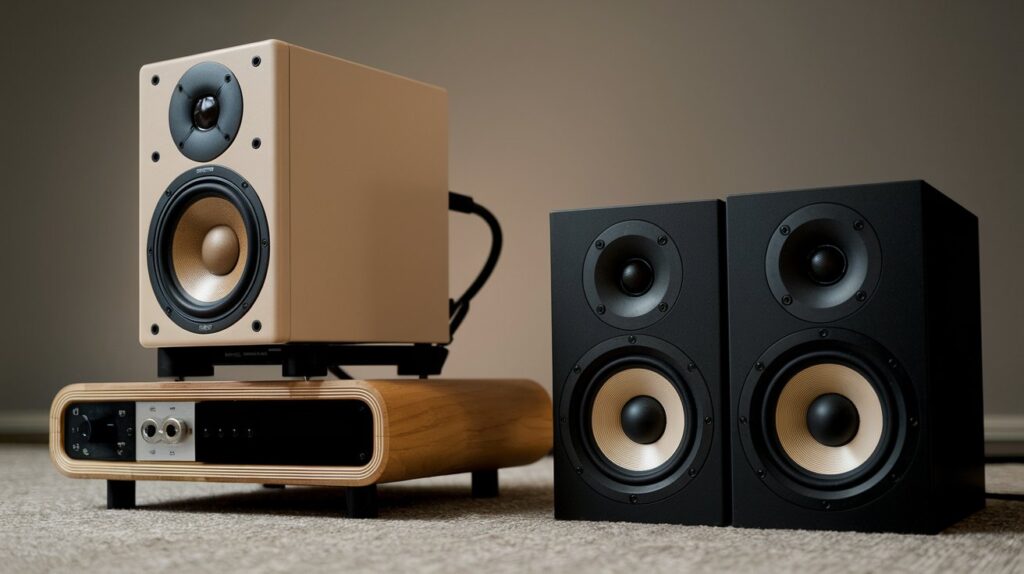
Studio monitors prioritize accuracy over aesthetics, featuring utilitarian designs focused on optimal driver placement and cabinet construction. Most use compact near-field designs suitable for desktop use in home studios. Active monitors eliminate external amplifier requirements while providing precise driver control.
Bookshelf speakers emphasize visual appeal and room integration alongside sound quality. They typically require external amplification but offer more flexibility in system building. Premium bookshelf speakers can approach monitor-level accuracy while maintaining more engaging sound for casual listening.
Gaming Applications: Studio Monitors vs Speakers
For competitive gaming, studio monitors provide superior positional audio accuracy, helping identify enemy locations through precise soundstage imaging. Their neutral response reveals subtle audio cues that enhanced consumer speakers might mask or exaggerate.
Casual gamers often prefer regular speakers that add excitement to gaming soundtracks and effects. Enhanced bass response and wider soundstage create more immersive experiences for single-player games where accuracy is less critical than entertainment value.
Streaming and Content Creation
Content creators benefit from studio monitors when editing videos or producing podcasts. Accurate monitoring helps identify audio issues like background noise, inconsistent levels, or poor recording quality that might be missed on consumer speakers with enhanced frequency response.
Immersive Gaming Experience
For immersive single-player gaming, consumer speakers with enhanced dynamics and bass response create more engaging experiences. Subwoofer integration adds impact to explosions and environmental effects, while slightly colored midrange enhances dialogue clarity in complex gaming soundtracks.
Popular Monitor Brands and Models in 2026
Yamaha Studio monitors continue leading the market with their HS series offering excellent value and reliability. The HS5, HS7, and HS8 models provide scalable options for different room sizes and applications. Yamaha’s reputation for neutral response and build quality makes them standard choices in many professional studios.
Other leading monitor manufacturers include Adam Audio with their ribbon tweeter technology, KRK with enhanced low-frequency response, and Focal for high-end precision monitoring. Each brand offers distinct sonic characteristics while maintaining professional accuracy standards.
What Monitor Speakers Are Used for on Stage
Stage monitor speakers serve a completely different purpose than studio monitors, providing performers with their own mix during live performances. These wedge-shaped speakers face the musicians, allowing them to hear their instruments and vocals clearly above the main PA system and ambient stage noise.
Professional stage monitors feature robust construction to withstand touring conditions, high power handling for cutting through stage volume, and focused dispersion patterns. Modern systems often use in-ear monitors for cleaner stage appearance and better isolation, though traditional wedge monitors remain popular for many applications.
Related video about difference between speakers and studio monitors
This video complements the article information with a practical visual demonstration.
Important things to know about difference between speakers and studio monitors
Should I get studio monitors or speakers for music production?
Choose studio monitors for music production. They provide accurate, uncolored sound reproduction essential for making proper mixing decisions. Studio monitors reveal details and problems in your recordings that consumer speakers might mask, ensuring your productions translate well across different playback systems.
What is the 83% rule for speakers?
The 83% rule suggests positioning yourself at 83% of the distance between your two speakers for optimal stereo imaging. If speakers are 8 feet apart, sit approximately 6.6 feet back. This creates proper soundstage width and accurate stereo positioning for the best listening experience.
What is the 38% rule for studio monitors?
The 38% rule recommends placing studio monitors 38% into your room’s length from the front wall. This positioning minimizes problematic room reflections and standing waves that can color your monitoring. Combined with acoustic treatment, this placement enhances monitor accuracy and mix translation.
Can you use regular speakers as studio monitors?
While possible, regular speakers aren’t ideal for professional mixing due to their colored frequency response. Consumer speakers can mislead mixing decisions, resulting in productions that don’t translate well. High-quality bookshelf speakers can work for casual production, but dedicated studio monitors are recommended for serious work.
Are studio monitors better than bookshelf speakers for home studios?
Studio monitors are superior for home studio applications requiring accurate monitoring. They provide flat frequency response, built-in amplification, and optimized driver integration. Bookshelf speakers work better for casual listening where entertainment value matters more than analytical accuracy.
What’s the difference between studio monitors and speakers for gaming?
Studio monitors excel at competitive gaming where positional audio accuracy matters most. Regular speakers provide more exciting gaming experiences with enhanced bass and dynamics for immersive single-player games. Choose based on whether you prioritize accuracy or entertainment value in your gaming setup.
| Feature | Studio Monitors | Regular Speakers |
|---|---|---|
| Frequency Response | Flat, neutral (±3dB) | Enhanced, V-shaped |
| Primary Use | Professional audio production | Entertainment listening |
| Amplification | Usually active (built-in) | Typically passive |
| Best Application | Mixing, mastering, critical listening | Music enjoyment, movies, gaming |