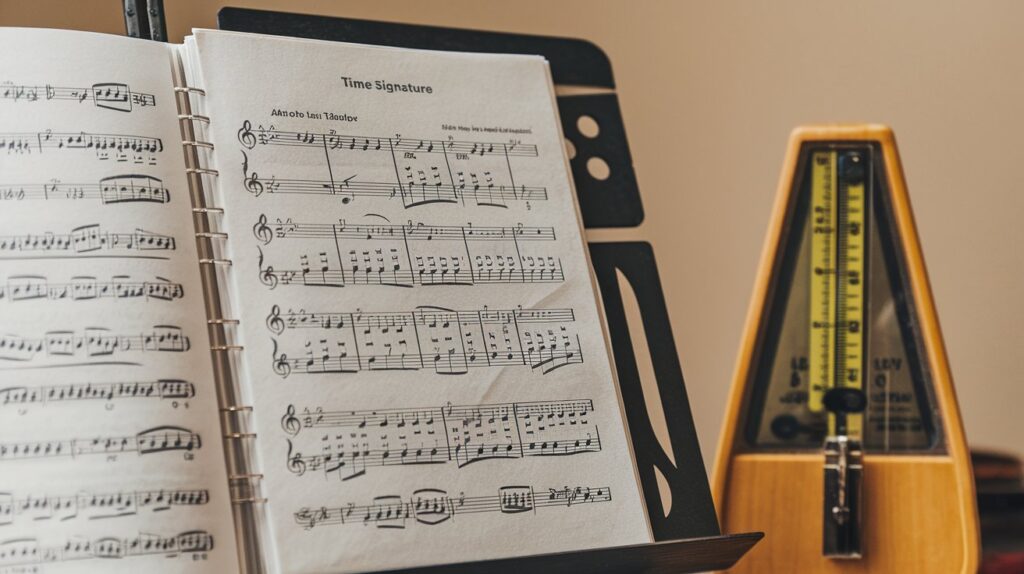
A time signature in music is a notation that tells musicians how to count beats and organize rhythm within each measure. Located at the beginning of a musical staff after the clef and key signature, it consists of two numbers stacked vertically that define the rhythmic framework for the entire piece.
Understanding Time Signatures: The Basics
The time signature appears as a fraction-like symbol with two numbers. The top number indicates how many beats are in each measure, while the bottom number shows what type of note gets one beat. For example, in 4/4 time signature, there are four quarter-note beats per measure, making it the most common time signature in Western music.
Musicians rely on time signatures to maintain consistent rhythm and coordinate with other performers. This musical notation system standardizes how we interpret and perform rhythmic patterns across different genres, from classical symphonies to contemporary pop songs in 2026.
How to Read a Time Signature
Reading a time signature requires understanding both numbers and their relationship. The numerator (top number) can range from 1 to 12 or more, indicating the number of beats per measure. Common top numbers include 2, 3, 4, 6, 9, and 12. The denominator (bottom number) represents the note value that receives one beat, typically 2 (half note), 4 (quarter note), 8 (eighth note), or 16 (sixteenth note).
When you see 3/4 time signature, you count three quarter-note beats per measure, creating the characteristic waltz rhythm. The time signature chart shows that this creates a strong-weak-weak pattern that defines much of classical and folk music throughout American musical tradition.
Types of Time Signatures with Examples
Music theory categorizes time signatures into three main types: simple, compound, and irregular. Each type creates distinct rhythmic feels and is commonly used in different musical genres across the United States music scene in 2026.
Simple Time Signatures
Simple time signatures have top numbers of 2, 3, or 4, where each beat subdivides into two equal parts. The most popular 4/4 time signature appears in rock, pop, country, and hip-hop music. Examples include “Sweet Caroline” by Neil Diamond and “Billie Jean” by Michael Jackson. The 2/4 time signature creates march-like rhythms, while 3/4 produces the classic waltz feel found in “The Tennessee Waltz.”
Compound Time Signatures
Compound time signatures feature top numbers of 6, 9, or 12, where each main beat subdivides into three equal parts. The 6/8 time signature creates a lilting, flowing rhythm heard in ballads like “Nothing Else Matters” by Metallica. Understanding the difference between 3/4 and 6/8 is crucial: 3/4 has three quarter-note beats, while 6/8 has two dotted quarter-note beats, each containing three eighth notes.
Common Time Signature Examples in Popular Music
American popular music heavily favors certain time signatures, with 4/4 dominating approximately 85% of Billboard Hot 100 songs in 2026. This common time signature provides a steady, predictable foundation that listeners find comfortable and danceable.
4/4 Time Signature Songs
The 4/4 time signature, also called common time, appears in countless hits including “Shake It Off” by Taylor Swift, “Uptown Funk” by Bruno Mars, and “Someone Like You” by Adele. This signature allows for easy clapping along and creates the steady pulse that drives most rock, pop, and country music across American radio stations.
3/4 Time Signature Songs
The 3/4 time signature creates the distinctive waltz rhythm found in “My Favorite Things” from The Sound of Music and “The Blue Danube” waltz. Contemporary examples include “Maneater” by Nelly Furtado and portions of “Nothing Else Matters” by Metallica, showing how this classical signature adapts to modern genres.
Irregular and Complex Time Signatures
Irregular time signatures include any signatures that don’t fit simple or compound categories, such as 5/4, 7/8, or 11/4. These create asymmetrical rhythms that challenge both performers and listeners. Progressive rock, jazz fusion, and experimental music frequently explore these complex rhythmic territories.
Famous examples include “Take Five” by Dave Brubeck in 5/4 time and “Money” by Pink Floyd in 7/4. These signatures require careful counting and often use time signature metronome practice to master the unusual beat patterns that define avant-garde American music composition.
Time Signature Changes and Modern Applications
Contemporary music increasingly features time signature changes within single songs, creating dynamic rhythmic interest. Artists like Tool, Dream Theater, and Radiohead regularly incorporate multiple signatures, requiring musicians to adapt their counting and phrasing throughout performances.
Digital music production in 2026 has made complex time signatures more accessible through software that handles calculations automatically. However, understanding the theory remains essential for composers and performers working in professional American music industries.
Practicing with Time Signatures
Effective time signature practice begins with using a metronome to internalize steady beats. Start with simple 4/4 time signature exercises, clapping or tapping quarter notes while counting “1-2-3-4.” Graduate to more complex patterns by practicing eighth notes, triplets, and syncopated rhythms within the same framework.
For compound time signatures like 6/8, practice feeling the music in groups of three eighth notes while maintaining the overall two-beat pulse. Many music educators recommend using time signature charts and visualization techniques to help students grasp these rhythmic concepts more effectively.
Time Signatures in Different Musical Genres
Different musical genres show distinct preferences for specific time signatures. Country music heavily favors 4/4 and 2/4, creating the steady rhythms perfect for line dancing and two-stepping. Jazz explores complex signatures including 5/4 and 7/8, while classical music uses the full range from simple 2/4 marches to intricate mixed-meter compositions.
Hip-hop and electronic dance music predominantly use 4/4 time signatures to maintain consistent beats for sampling and looping. Rock music occasionally ventures into 3/4 for ballads or 6/8 for power ballads, but returns to 4/4 for maximum rhythmic drive and audience engagement in live performances.
Related video about what is a time signature in music
This video complements the article information with a practical visual demonstration.
Important things to know about what is a time signature in music
What does the time signature in music mean?
A time signature in music indicates how many beats are in each measure and what type of note gets one beat. The top number shows the beats per measure, while the bottom number represents the note value that receives one beat, creating the rhythmic framework for the entire piece.
What does 4/4 time signature mean?
The 4/4 time signature means there are four quarter-note beats in each measure. It’s also called “common time” because it’s the most frequently used time signature in popular music, rock, country, and pop songs, providing a steady, predictable rhythm that’s easy to follow.
How do you know if it’s 3/4 or 6/8 time?
The key difference is in how you feel the beats: 3/4 has three distinct quarter-note beats (strong-weak-weak), while 6/8 has two main beats, each containing three eighth notes. Listen for whether the music feels like “ONE-two-three, ONE-two-three” (3/4) or “ONE-two-three-FOUR-five-six” (6/8).
How do you explain time signature to a beginner?
Explain time signature like a musical recipe: the top number tells you how many beats to count in each measure, and the bottom number tells you what kind of note gets one beat. Start with 4/4 time by having them clap four steady beats and count “1-2-3-4” repeatedly while listening to familiar songs.
What are the most common time signatures in music?
The most common time signatures are 4/4 (used in about 85% of popular music), 3/4 (waltz time), 2/4 (march time), and 6/8 (compound time with a lilting feel). These signatures cover the vast majority of Western music across all genres from classical to contemporary.
Can a song change time signatures?
Yes, songs can change time signatures multiple times. Progressive rock, jazz, and classical music frequently use time signature changes to create musical interest and complexity. Modern artists like Tool and Dream Theater are known for incorporating multiple time signatures within single compositions.
| Time Signature Type | Common Examples | Musical Application |
|---|---|---|
| Simple (4/4, 3/4, 2/4) | Pop, Rock, Country, Classical | Easy to follow, danceable rhythms |
| Compound (6/8, 9/8, 12/8) | Ballads, Folk, Some Classical | Flowing, lilting rhythmic feel |
| Irregular (5/4, 7/8, 11/4) | Progressive Rock, Jazz, Experimental | Complex, challenging rhythmic interest |