Today I’ll actually look at something from the 21st Century for once and also have a look at what, in general, stands as the final recorded track of one of death metal’s most legendary acts.
Bolt Thrower got their start in England in 1986. From then to 2015 the band cut a blistering course through extreme metal with eight albums entirely centered around the concept of war. In 2005 the band released Those Once Loyal, which stands as Bolt Thrower’s final album, though at the time the band’s demise was not at all known.
Many extreme metal acts don’t sell enough to be concerned about charts and certifications. But this album did crack the German 100, coming it at 76.
When Cannons Fade is the final track on Those Once Loyal. There are some versions of the album with a bonus track, but in most cases this standard edition would be considered the definitive tracklisting, so we’ll just go ahead and call this Bolt Thrower’s final song. That’s of course purely a matter of sequencing and may not reflect how the album was recorded at all, but it is our listening experience when the album is played in order so it’s fair to go with this concept.
Today’s song is mid-paced though perhaps on the quicker end, with a consistent and grinding rhythm throughout. We get some flashy guitar work in spots, as is common with death metal. Lyrically the song is very much about its title – the artillery rains down and then is done, leaving a scorched earth behind. The memories of the insane shell pounding remain long after the battle’s close, as is narrated in the final verse.
In the song’s final minutes the rhythm switches up as we outro to a very fitting fade out. This is a long one and the final thing that can be heard is the drumming of Martin Kearns. It would prove to be tragically fitting that Kearns would ring out Bolt Thrower’s recorded career.
Again, the end of Bolt Thrower was not right after this album or planned at all. The band made the call in 2008 to hold of on recording music but did continue to tour in occasional fashion. The band were rehearsing for an Australian tour in September 2015 when Martin Kearns died unexpectedly at age 38. This would be the end of Bolt Thrower, as a year later the remaining members announced they would lay the band to rest. The group did consider doing something in terms of a reunion show or release in tribute to Kearns but nothing has ever come about.
In the years since Kearns’ death and Bolt Thrower’s demise, the band has remained at the forefront of death metal. A new generation of bands and fans have come into the scene, and a renaissance of “old-school” death metal modeled on the early 1990’s heyday has emerged in the 2020’s. Bolt Thrower has remained a prime influence among both new fans and old heads, often the subject of discussion, memes and the like. It’s possible that their status has even improved since the end of their playing days, though of course such things are difficult to rate.
No matter the specifics, Bolt Thrower remain one of death metal’s biggest forces, even a decade past their end. When Cannons Fade serves as a fitting and perhaps eerie end to their run.
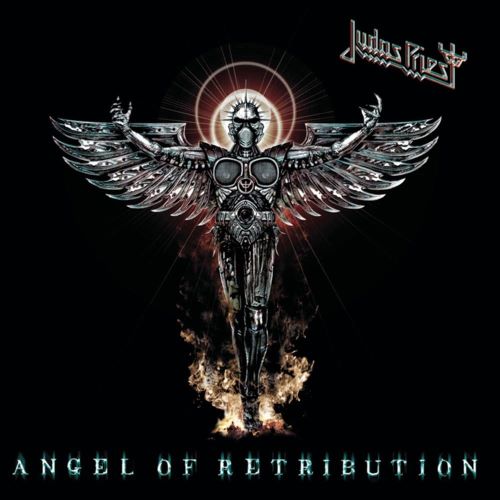
Today it’s time to have a look under the hood of a milestone album in the Judas Priest catalog – this was the studio return of Rob Halford to the band after having been gone since 1992. Big things were expected, especially on the heels of England’s other huge heavy metal band having a very successful reunion with their legendary singer, so Priest was on the clock here to deliver.
Judas Priest – Angel Of Retribution
Released February 23, 2005 via Epic Records
My Favorite Tracks – Judas Rising, Revolution, Deal With The Devil
Judas Priest were busy touring after Halford’s return so it would take a little bit to get a new album out. The band worked with producer Roy Z on the effort. Roy had worked with Halford on his last few solo albums and was also instrumental in Bruce Dickinson’s acclaimed solo material. The band’s line-up was unchanged beyond Rob Halford – Glenn Tipton and K.K. Downing on guitars, Ian Hill on bass and Scott Travis on the drums.
One thing about the lyrics that I’m going to get out of the way now so I don’t have to bring it up every song – this is absolutely loaded with references to earlier Judas Priest songs. Soem stick out like sore thumbs, like nods to Stained Class and The Sentinel in Eulogy, while others are a bit subtle. I recall music critics pointing this out a lot and not always in a flattering way when this was released. I personally don’t mind but I’ll admit that it’s a lot.
The CD was originally released in one of two configurations – a two-disc set with an accompanying DVD documentary, and a DualDisc version with the DVD portion on the back of the music CD. Technology was really offering it up just before CDs became obsolete. The album is 10 tracks that clock in at 52:37, though a look at the final track’s runtime reveals the rest of the album is pretty lean.
Judas Rising
The album opens with a heavy track that re-establishes the band pretty well. This one maintains a bit of the heavy feel of the 1990’s, when Priest were a notch or two heavier. There is a lot of lightning and fighting with the fate of the world in the balance kind of stuff here, or usual fare for Judas Priest. This was a good way to kick things off.
Deal With The Devil
This more fast-paced track looks at the band’s early days, when they rehearsed in a school building next to a church. This has some nice solo work from Tipton and Downing and the song feels like it slots in well with the overall Priest catalog.
Revolution
This is more of a hard rocker than a metal track, it has a simpler structure. This was the album’s only single. This one works pretty well, even if it’s a bit outside the box for Priest. The sort of southern riff is very effective and the song’s beat pulls you in. The lyrics are about the heavy metal revolution, which Priest were a huge part of and heavy metal was on the way up again in the early 00’s when this song came around.
Worth Fighting For
This song has a feel of something off of Point Of Entry and that is apparently by design, as this is a companion of sorts to the song Desert Plains from that album. It’s about someone wandering the desert, looking for their lost love. While the song comes off as light compared to other material, it really brings out Priest’s “softer” side pretty well and is a good compliment to the era it recalls.
Demonizer
The intensity picks up here on this all out metal assault. It’s another all out war among celestial forces in this one, even the famed Painkiller makes another appearance here. This song doesn’t quite go as hard as Painkiller but this is still a worthy slab of metal.
Wheels Of Fire
Here the song keeps a middling pace but slams in with some very heavy guitar tone. This is another callback to Priest’s long flirtation with motorcycle culture, this is all about being out on the open road and the freedom of the journey itself. It’s not their best song and not even their best song on that topic, but it’s a pretty good listen.
Angel
It’s ballad time and this one is very forlorn and sad. This is very minimal and quiet, very slowly adding elements to get a power ballad feel in the song’s final minute or so. It is a nicely done song though also not one I or many others were expecting from Priest. Given that this album is a mixed bag anyway, it leads to an appreciation for this one. And curiously, this song is by far the most-streamed track from this album, dwarfing the other songs with over 21 million plays.
Hellrider
Another attempted scorcher, though this one feels like it could use more pace to really open it up. It’s another one about giant robot monsters fighting each other, Megatron is even mentioned by name here. Overall it’s pretty good but I’d like a faster beat to this one, all of these mid-paced bangers get a bit plodding all on the same album.
Eulogy
Here we have a more quiet interlude sort of thing. It’s pretty short and to the point, with a quiet piano bit and Rob keeping things on the quiet end of his delivery. It maintains its form throughout, with no big build-up to anything more powerful. It’s a nice piece but who knows what this is a eulogy to.
Lochness
The album closes with something no one had on their Judas Priest bingo cards – a 13 minute long song about the famed Loch Ness Monster.
This is slow and plodding, and I mean if someone could take a picture of this song, it should be in the dictionary next to the definition of plodding. I guess a song about a mythical creature that may or may not (and probably does not) exist doesn’t need to be a metal barnburner, but man I’ve heard doom bands play faster than this.
This song was brutally reviewed when the album first came out. In years since a bit of an appreciation society has formed for it. I am not a member of that group, I think this is pretty awful. If the song were like half the length or even shorter I wouldn’t mind it at all, but this does not justify its use of 13:29 at all. This song is an anchor on the album, that is for sure. I could even call it an albatross around the album’s neck…
Have at it, if you have time to spare
Angel Of Retribution was welcomed by a listening audience ready for Rob Halford’s return and also well into a revival of the traditional heavy metal sound of the 1980’s. The album charted at 13 in the US, 39 in the UK and 2 on the UK Rock and Metal chart, as well as placing on at least 17 other music charts worldwide. No certification info is available so it’s tough to gauge any actual sales numbers.
This album is somewhat uneven and a very mixed bag. It has some metal, it has some more rock-oriented stuff that calls back to other points of Judas Priests’ fairly diverse catalog. There aren’t any massive triumphs here but there are songs worth a listen for sure. And of course it was nice to hear Rob Halford back at the band’s helm after a very long absence.
Judas Priest would go on to continue adding to their legacy and find more solid footing for future albums, though not without massive band drama. But a group has to start again somewhere, and Angel Of Retribution is as good a starting again point as any. It’s rather unheralded in their catalog overall but not “bad” by any stretch, save for what you might think about that thing at the end.
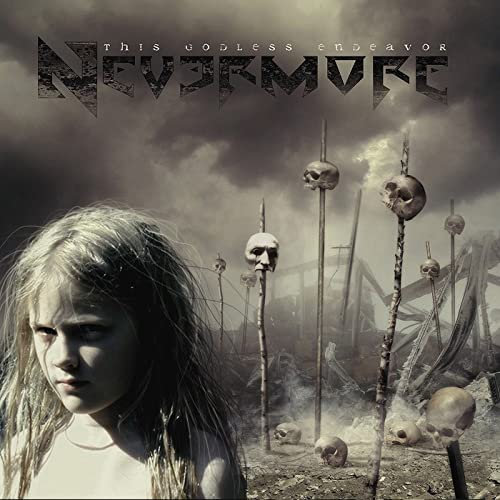
This week it’s time to have a look at one of metal’s now-bygone bands. They were heralded yet quite underrated, always noticed but never quite breaking through to the heights many thought they ought to achieve. The album in question would be recognized by many as one of the best (if not the best) they have done.
Nevermore – This Godless Endeavor
Released July 26, 2005 via Century Media Records
My Favorite Tracks – Medicated Nation, The Psalm Of Lydia, Sentient 6
The album marked the band’s sixth effort. The core lineup of vocalist Warrel Dane, guitarist Jeff Loomis, bassist Jim Sheppard and drummer Van Williams would remain. They would be joined on guitar by Steve Smyth, formerly of Testament.
The band would continue plying their trade in a straightforward metal sound that often defied categorization. While they “fit in” with the power metal scene, they were not power metal. Elements of thrash would appear but Nevermore certainly were not a thrash act. I don’t think they ever got properly sub-categorized in the whole of their 20 year history, though no such sub-category may exist.
The album runs 11 tracks in just under an hour, and with one being a very short instrumental. I’ll get it out of the way now so I don’t have to mention it on every song – the guitar work is absolutely out of this world. Jeff Loomis is a world-class guitarist and he was complemented well by Steve Smyth. The guitars are always high points of Nevermore albums.
Born
The opener goes hard and heavy, kicked up a notch even for Nevermore. The song is an indictment of the stagnant pool of beliefs that keep society pinned down from progress.
Final Product
Another brutal number in both music and verse. More about the negative aspects of the world and how they are dragging everything down. Pretty spot on and very much unimproved from the 17 years since this song first hit.
My Acid Words
Yet again with the caustic and harsh assessments, the band does not relent via instruments and Warrel Dane goes even harder with the lyrics. It is a cold and ultimately heartless conclusion rendered in the song. I had thought that Dane had said this song had to do with his brother but I imagine that would have been an interview from a print magazine and I can’t find it to confirm. I do believe my recollection is correct, though. It was obviously a tragic story.
Bittersweet Feast
A song that several cite as their least-favorite from the record but one I enjoy. There are two distinct lyrics being delivered in the pre-chorus, which takes a moment to get used to and can easily be missed. The song is a dirge about the fat and happy minions feasting on the remains of a dying society.
Sentient 6
The music turns down a notch to deliver a quasi-ballad. Of course the ballad is not typical fare lyrically – this song is about some sort of artificial intelligence being that struggles with the questions of humanity, tries to become like humans, then ultimately decides to destroy humans. All of the songs have happy endings on this album.
Also catch the Jimi Hendrix tribute, paid lyrically in the first verse.
Medicated Nation
Another of the album’s highlights for me and a track with possibly dual meanings. The literal interpretation of society being over-medicated is very real and very well discussed here. But many speculate that the intent goes beyond that and into the media, belief systems and various ways people figuratively medicate themselves from the realities of life and civilization.
The Holocaust Of Thought
A brief instrumental at not quite 1.5 minutes long. It features solo work from guest James Murphy, a metal guitar luminary who has logged work with Death, Obituary, Cancer and Testament, among many others.
A bit of an aside – in the mid 2000’s I was on a few message boards and on one of them, some guy complained endlessly about this song being on the album. Like, it’s not even two minutes long and you probably have it on CD anyway, just skip it dude. It just cracked me up because he complained about it at every possible opportunity, like maybe he was getting a dollar per complaint from someone, I don’t know. I just wanted to make sure I have that noted for posterity’s sake.
Sell My Heart For Stones
This song does stand out in a few ways. It is another quasi-ballad, so it gives a bit of a breather. It is also has a far, far more positive outlook than what has been playing so far. It’s honestly a breath of fresh air to actually have something philosophically positive for once.
The Psalm Of Lydia
This song picks the pace back up and goes into a bit of fantasy territory, at least a shade. Lydia seems to be a mythical, prophetic figure who winds up “slaying the demons.” Perhaps Lydia is slaying the metaphorical demons being chased throughout the first part of the album, there is lyrical evidence to make that conclusion. And also this song is guitar solo after guitar solo, just a magnificent work. No clue who Lydia actually is or what this song’s true composition is about, but it gets the job done.
A Future Uncertain
Heading towards the album’s close is this ponderous affair that offers a bit more introspection and hope than the savage beginning half. The song doesn’t quite arrive at its own lyrical conclusions but that’s probably surmised by the title.
This Godless Endeavor
We close on an epic, nearly nine-minute movement that questions the meaning of life and searches for answers in the void. The song does not waste its time, rather it keeps moving with more philosophical lyrical fare and, of course, more guitar.
This Godless Endeavor was a significant work for Nevermore, the work was praised by critics and the band toured with several acts during the cycle – they would open for old friend Dave Mustaine and Megadeth and would even get a support slot with Disturbed in 2006. In hindsight it is considered one of their best two albums and is often found at number one on a lot of lists. Even back in late 2009 when I was blogging elsewhere I named it one of my top five albums of the decade of the 2000’s.
Nevermore would not get to realize much greater promise from their masterpiece. Health problems beset, well, the entire band save Jeff Loomis in 2006-07. The group would record one more album in 2010, then split up. Loomis would link up with Michael Amott in Arch Enemy, while Warrel Dane would resurrect the pre-Nevermore outfit Sanctuary. Reunion talk began in the mid 2010’s but was ended when Warrel Dane died of a heart attack in 2017.
I have always felt Nevermore was a band that was kept a bit too far under the radar. A lot of people knew them and were into them, yet they didn’t latch on in a wider fashion. Their sound was heavy but not alienating to many listeners like extreme metal often is. And the sometimes very heavy lyrical matter is dressed in a higher vocabulary that keeps it from being just some noisy ranting about the world. Maybe the really were “just” a metal band without a way to further sub-categorize them, but they certainly were not “just” a metal band.
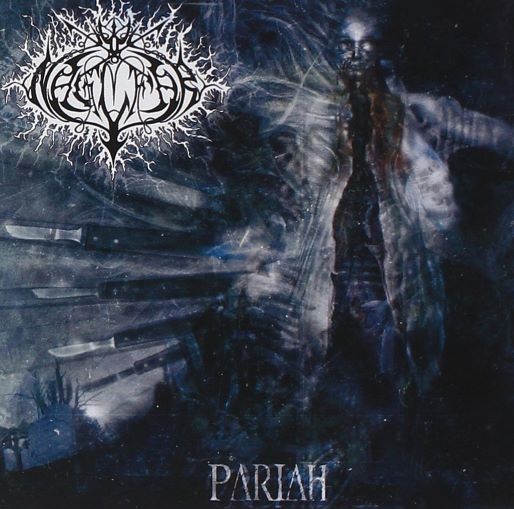
Last week was fun, going back through hair metal and all the stuff that happened in 1991. This week is back to absolutely no fun. I’m going back to 2005 and grabbing one of my favorite “no fun, people suck and everything is awful” black metal albums.
Naglfar – Pariah
Released June 30, 2005 via Century Media Records
My Favorite Tracks – And The World Shall Be Your Grave, A Swarm Of Plagues, Revelations Carved In Flesh
Naglfar underwent major change before the release of Pariah. The band’s founding vocalist Jens Rydén left the group after their prior effort Sheol, leaving bassist Kristoffer Olivius to helm the group. Naglfar had just gained a fair bit of momentum from Sheol and would be tested to provide a worthy follow-up.
Pariah sees an exploration of misanthropic themes, the album’s songs connected in an evisceration of the human experience. This is a level beyond being upset that Karen can’t put her shopping cart back in the proper place at the store – this album calls for the nuclear destruction of humankind in multiple songs. It moves past the need to express angst as a way to let off some steam and enters the territory of condemning civilization as a whole. We are far past the point of breaking stuff, this is all out war.
I will visit each of the 8 proper songs track-by-track, leaving off the brief intro Proclamation.
A Swarm Of Plagues
The album begins with a mission statement focusing on the destruction of humanity. It is pure textbook misanthropy – due to the wayward nature of humanity, it should perish in nuclear flames. The destruction is judgment rather than an accident. Sonically the song flies along at a frenetic pace until a mid-section interlude that offers one of the album’s few moments of subtlety.
Spoken Words Of Venom
This song embraces hatred, whether it’s of an individual or humanity as whole is unclear. The music does not let up off the accelerator through the track, while lyrically Olivius mows down his target with every negative word in the thesaurus. It is an unsettling way to dismiss the whole of someone’s existence.
The Murder Manifesto
Here the band turn the tempo down just a hair as the song’s narrator stalks his prey. There seems to be a theme of a dark cult confronting its more holy adversaries in this song rather than simply someone killing for the sake of doing so. It is a targeted, focused effort in the album’s setting of the end times of civilization.
Revelations Carved In Flesh
Another track about murder, though this time it seems this death cult is recruiting willing sacrificial lambs for its slaughter. This song stands out a bit for its melody and creativity amongst the ever-present backdrop of misanthropy. The lyrics do quite explicitly spell out the ritual murder and are in line with a fair bit of death metal fare. The grotesque final verse is especially something as easily found on a Cannibal Corpse album as opposed to black metal.
None Shall Be Spared
This song returns to the worldwide scope of things, declaring a war against the Abarahmic faiths. It is not openly stated though the lyric’s targeted aim of “2,000 years of lies” offers up the theme well enough. It is the ceremony of opposites in its final form, bringing about the end rather than existing in a perpetual state of debate.
And The World Shall Be Your Grave
It is again time to visit the ultimate expression of misanthropic leanings – the end times. Here the world perishes by way of nuclear war. The lyrics, of course, celebrate this outcome. Nothing could justify a misanthropic perspective more than humanity dooming itself with its own creation. Misanthropy is sometimes, like nihilism, a warning rather than an outlook, but on Pariah it is the perspective and the all-consuming nuclear end is the goal. It all leads to the same end regardless of what lenses one looks through things with.
The Perpetual Horrors
Heading toward the album’s close, this song begins to turn the concept of external hatred on its head a bit. Any expression of this kind of negativity will inevitably lead one to look in the mirror, and this song is a glimpse into the themes present on Naglfar’s next album. Humanity is still suffering and dying here, but the cause is looking at his own hollow, rotten core this time.
Carnal Scorn And Spiritual Malice
Perhaps conceptually, the album ends with all of the hatred and spite being turned on the album’s “protagonist.” Finding existence pointless, he brings about his own end in disturbing and explicit fashion. Still railing against the tenants of the world that irk him, mainly religion, our humble hater goes out on his own terms rather than the nuclear war prophesied throughout the rest of the album. The album’s final sound brings the point home.
Pariah is an album executed with ferocity and a fanatical railing against humanity. It does not often contain nuance and its lyrical offerings are explicit and profane. Naglfar’s sound does recall their renowned countrymen Dissection in both music and theme but is not purely an exercise in worship of that band. While Naglfar are on a prominent record label in Century Media and have had their name discussed in many circles over the years, they remain something of an underground proposition even within the structure of black metal.
I do hold that Pariah is my favorite album from the band, though there is stiff competition in the albums both proceeding and following this. Both Sheol and especially Harvest will get time here in the future. I by no means claim to espouse the intense level of misanthropy found here but I do “get” it just the same. My time not long after this album’s release was rather dark and music like this was a release. And now from what I’ve seen of humanity in the past several years I can’t help but wonder about those nuclear fires from this record. It is scary when society starts to catch up to the dark fantasy.

 The Crooked Wanderer