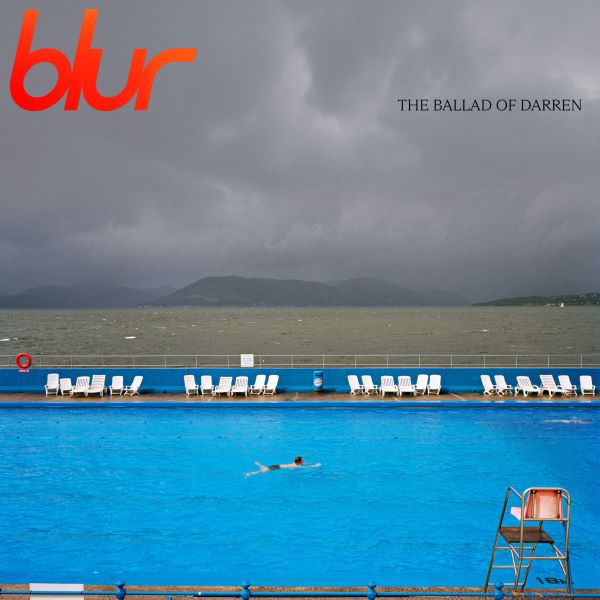
Yesterday on May 18, Blur announced a new album and their first studio effort in 8 years. The Ballad Of Darren will be released on July 21 and will contain 10 new tracks. The album announcement was a bit unexpected, though Blur had already announced a series of concerts for 2023 so new activity isn’t altogether surprising. And since I just talked a fair bit about Blur the other day, I figured I’d give the new song a spin and see what’s up.
First though, I absolutely love this album cover. Someone swimming in a pool against the backdrop of a massively bad looking stormy sky? This is just great stuff. I don’t collect much Blur but this cover alone is making me want to have this on vinyl, or hell even a poster.
Along with the album announcement, Blur also revealed the album’s first singe, The Narcissist. The song is a pretty chill one that doesn’t really ask a lot of the listener. It’s not a massive banger of a song but it’s also pretty quietly compelling and I’ve been getting more into it on subsequent listens, it has a nice mood music vibe to it. It does make me interested in what they’ll get up to on the rest of the album.
That will do it for what has to be one of my shortest posts ever. Enjoy the weekend.
Last week I was trying and failing to find something to watch across streaming services when I landed on a series called This Is Pop! This was a short series filmed in 2021 by the Canadian crew Banger Films, responsible for Metal Evolution, originally Metal: A Headbanger’s Journey and many other quality documentaries.
I did not watch the whole series and I probably won’t, but one was really interesting to me – Hail Britpop! This recounts that brief but lovely time in British music when a bunch of different forces converged to reshape the English music scene, and at least one act broke out internationally. So I figured I’d go over the episode a bit and also run down the Battle of Britpop, which was discussed in some detail on the show.
The show depicted Britpop as a movement of rather different music interests, ranging from alt-rock to shoegaze and other forms, that would fit together to express a uniquely English musical identity in the early 1990’s. While Suede is generally credited with the birth of Britpop, the show paints Blur as the main culprits. Alex James and David Rowntree of Blur both give pretty insightful interviews for the episode.
The consensus is that Blur were on tour in America and were lamenting the lack of English identity in music, which at the time was very much under the thumb of American grunge. Blur returned from the tour and recorded their seminal Parklife album, which celebrated British culture and made them superstars. The fact that some of Parklife was a sneer at that same British culture rather than a celebration was left out of the show.
Once Blur went over, it was open season for the British music press for anything Britpop. The show does a great job of painting the music press as the actual main purveyor of Britpop – this wasn’t a codified music scene with a common sound and characteristics, this was a bunch of different bands grouped together because they sounded British and were generally more cheery than the alt-rock of the day. Members from bands like Lush and Echobelly give interviews to this effect.
The show does make what I assume is a joke, that one day a heavy metal band changed their attire and “became” a Britpop band. I don’t know of any such act who actually did that, if one did I’d be happy to know who it was. But even if the show made the point in exaggerating fashion, it was true that there was a hop on the press-driven bandwagon of Britpop.
While Blur were the early winners of the Britpop phenomenon and it was largely a London-based scene, most everyone who was alive at the time knows what eventually happened – a group of sneering lads from Manchester came along and stole the spotlight.
The part of Oasis in the episode is represented by Alan McGee, the head of Creation Records and the man responsible for signing Oasis to their record deal. The introduction of Oasis also brings about the North-South divide in England – the south being more posh and the north more working class and perhaps grim. Blur would come to represent the south aesthetic while Oasis would carry the torch for the working people of the north. While this depiction is true to some degree, it’s also a media invention that would fuel the Battle of Britpop in 1995.
The Battle of Britpop was pretty simple – both Blur and Oasis released singles from their new albums on the same day – August 14, 1995. It was billed as a titanic heavyweight fight in the British press, extending far beyond just the music rags. The show offers arguments from both Food Records and Creation Records label heads as well as Blur band members about the choice to release on the same day, note that Blur’s band and record exec stories directly contradict one another on the show.
Blur would come out winners of the Battle of Britpop, as their single Country House outsold the Oasis offering Roll With It. While this temporarily went in Blur’s favor, the show quickly pivots to the runaway success of Wonderwall and the massive sales Oasis would see of their second album (What’s The Story) Morning Glory? Oasis would trounce Blur in full album sales and, while this wasn’t mentioned on the show that I recall, music press even changed reviews of Blur’s The Great Escape after Oasis mania truly took hold.
Just as quickly as Britpop took hold, it would fizzle out. A bit of Oasis’ triumphant Knebworth gigs in 1996 are touched on, this was likely the zenith of Britpop. Oasis’ third album Be Here Now did well out of the gate but landed pretty hard in critical reviews and tends to signal the end of Britpop. Blur also changed tack, actually embracing the American music they’d forsaken years ago and had their big international hit with their self-titled album and especially Song 2.
This wraps up the episode of Hail Britpop! I felt the episode was good, though it did move quick and leave a lot of Britpop out. It nailed the central points of being a press movement and it got the rise of Oasis and the posh/working class clash of the Battle of Britpop right, but a lot of Britpop’s other history was left unaired. Suede, Pulp and Elastica all played big roles in the Britpop phenomenon but were relegated to pictures and small mentions in the show. I don’t intend this to be a huge criticism of the show as I understand the makers were going over the main points in their 45-minute airtime, but I do admit to being more of an admirer of comprehensive coverage.
Overall though, I do think this episode was really good and it’s a nice primer to the main aspects of Britpop for those unfamiliar. I had a good time watching it and reliving a small but very important part of my music listening history. It is a good place to go for those maybe not as vested in the finer points of the Britpop movement but who want an easy to digest version of what all the fuss was about from England in the mid 1990’s.
Since I’ve been writing about Britpop, I figured I would take a moment to link back to some old posts of mine on the subject. I covered Oasis extensively in this site’s early days and I have a few more here and there about the subject so I’ll link up to some relevant stuff below for your further reading pleasure.
This post was part of a series that I called S-Tier Songs. I later decided to abandon the series in favor of a simpler Song of the Week format. I am keeping these posts as I wrote them but removing the old page that linked to the list of S-Tier Songs, so that is why these posts might look a bit odd. Enjoy.
Today’s song is very well-known, in many cases it’s the band’s only known song in America. Many people know the song without knowing who the group is at all. It’s only two minutes long, it’s the second song off the album and my only blogging regret is not making it the second entry in this series.
Blur – Song 2
Blur entered 1997 in a curious position. They’d been crowned kings of Britpop in 1994 after their triumphant Parklife record and tour. In 1995 they seemed poised to build momentum with The Great Escape and their initial single Country House, but then the British press went mad for Oasis and left Blur in the dust, even going so far as to change reviews of the album. Oasis went on to become the biggest band in the world for awhile as Blur sat at home wondering what happened.
By 1997 Blur were ready to get back at it, and this time they were leaving behind the Britpop elements they had previously worked so hard to be known for. The group convened around more lo-fi and grunge sensibilities and released their self-titled album to a new world that was about to move on from the Britpop scene.
While Blur would become internationally celebrated for the self-titled album as a whole, it was Song 2 that would take on a life of its own and become the band’s most recognizable hit. And, of course, as the story goes with many of these hit songs, the whole thing was a joke and an accident.
The above video outlines the origin story of Song 2 as told by Blur guitarist Graham Coxon. The song began as an acoustic piece on Damon Albarn’s guitar, featuring whistling in place of the song’s now-immortal “woo hoo” bit. Coxon suggested adding a bunch of noise to the tune and actually playing it for the record company as a gag. Albarn obliged and the band turned in the fully-formed, distorted as all hell Song 2 to the record company. Instead of being met with a sour reaction, the label execs loved the tune and Blur were off the to the post-Britpop races.
Song 2 was a well-received hit in Blur’s native UK and it also did something the band had been previously unable to do – it broke in the rest of the world. Song 2 charted on the higher end in many countries and became a staple of college and modern rock radio in the United States. Britpop as a whole hadn’t fared massively well on American shores, save for Elastica and Oasis. But now Blur arrived with a grunged-up tune just in time for the post-grunge era to truly take over rock radio. The song has been a part of sporting events, video games and other media ever since its release 25 years ago.
Background and reception are all well and good, but what really is Song 2 on about? Well, it’s a two minute song full of lyrical nonsense. The most noteworthy lyric is “woo hoo,” it’s the signature part of the song and the one many folks know the tune by. A fair few people couldn’t tell you who Blur is or the name of the song but they know “the woo-hoo song” by heart. And nobody, including the people who wrote it, can tell you what any of it means.
And that’s the beauty of music – not everything has to have a pinned-down, easy to digest meaning. Song 2 is a total lark through the English language and its only memorable words aren’t even really words. The whole thing from lyrics to instruments is just noise being made and it all works splendidly together. That’s not to say no thought went into it – as Graham Coxon outlines in the interview video, he was looking for specific sounds. And he got far more than he bargained for, with the song often cited as his greatest work.
Why is this an S-Tier song?
Song 2 is a monument to absurdity and noise and it tackles its premise extremely well. The song was a huge hit for a band reeling in an identity crisis after the events of 1995. Their response was to shrug off the sounds of their given genre and explore new areas, which led to a new legacy for the group that would far outshine the Britpop movement. It’s a simple song with no comprehensible theme and it’s just a bunch of noise, but it captured the attention of people all across the world.
Sometimes I know well ahead of time what the AOTW is going to be. Other times, like this current edition, I don’t really decide until I sit down to write. For some totally unknown reason not all related to last week’s music news cycle I’ve had Blur on the brain so now I’m going to visit one of the high points of their eclectic discography.
Blur – Parklife
Released April 25, 1994 via Food Records
My Favorite Tracks – Parklife, End Of A Century
Parklife represents the second of a trilogy of Blur records that would come to shape and define the emerging term Britpop. In fact, if one were to wonder why the term was called Britpop as opposed to the seemingly more suitable Britrock, Blur and Parklife would be the signpost for why.
The album is a collection of varied styles that examine the British life through many different lenses. While it is a musical hodgepodge, they exploration of styles does well to convey the mostly sardonic look at typical British life and style. Everything from dance beats to jangly riffs can be found as the record plows it course through England.
The album opens with a dance party on the hit single Girls And Boys. The song has a simple point – Damon Albarn was inspired to write it after watching people get drunk and hook up in night clubs. The song is not praise or criticism of the practice, rather just observation. I’d see the scenes described in the song play out a few year later when I was in Europe as part of the US military. And yeah, Girls And Boys pretty well nails it on the head.
While the musical stylings of Parklife are overwhelmingly upbeat in nature, the topical fare isn’t always a party. London Loves and Jubilee both take aim at the corrosion of substance in culture. The chill vibe of Badhead belies the heavier subject matter of falling away from a loved one. Tracy Jenks observes a man’s midlife crisis, while Trouble In The Message Center handles the inevitable hangover after a night of partying.
While the 16-track album is a wonderful listen in whole, I find my two personal favorite tracks toward the record’s beginning. The third song End Of A Century is a guitar-driven roll through the “late stage” phase of long-term relationships as well as a nod to the winding down of the 20th Century. The song hits at the mundane nature of life while also looking toward the new millennium. It’s a very identifiable vibe and also makes me want to scream at them to stay put and avoid 2020 especially. The refrain “it’s nothing special” truly defines the song’s context.
For all of the contemplation of British life and culture to be found through the album, nothing hit the nail on the head like the album’s title track. Parklife became the defining song from the album and its cultural significance rings true still nearly 30 years after its release. Blur recruited actor Phil Daniels to deliver the song’s verses in spoken-word fashion while Albarn handled the sung chorus. The bright and cheery tune masked a bit the absolutely sarcastic sneer at British park life.
The song hasn’t lost its touch in the decades since release. Left and right it’s easy to find people who still point to Parklife as the “ultimate British song.” It’s become a celebration of that aspect of Britain even while many can acknowledge the sneering intent behind the track.
Parklife the album would be a huge success for Blur. They sold a few million copies of the record in the UK and across the European continent. The band would line up for awards left and right, basking in the newfound acclaim as the “it” band in British rock. Their more artistic approach won out among the populist masses.
At least for one album.
Blur would get about a year to enjoy the accolades brought forth from the success of Parklife. The “Battle of Britpop” was just on the horizon, and while Blur won that battle, the downslide just after when the British music press turned on them would mark another uncertain chapter for the group, one ended when the band jettisoned the concept of Britpop and embraced alternative and garage rock instead.
None of that is the story of Parklife, however. The album remains a high water point for the Britpop movement and marked the point where Blur shook off their early failures and became a successful, noticed band. While the group weren’t working class stiffs themselves, they were able to offer up a view of British life that connected with a wide audience. Both the record and the title song are offerings whose significance outweighs even their successful record sales and awards. The album peered into British life and as a result became a foundation for Britpop to continue building on.
On Wednesday I’ll get into the Damon Albarn versus Taylor Swift thing that happened last week and dominated the news cycle until Neil Young came along.


 The Crooked Wanderer