The Saga of the Hidden CD Track

It’s time to go back to the 1990’s, which I’m known to do a hell of a lot. Today I’m going to look at one now-lost aspect of album releases specific to the CD format – the hidden track.

The hidden track came into life when the CD became the dominant format in music. It was really easy to tack some extra, unlisted crap on to an album. This could happen before the CD of course, but it really became a thing in the early ’90’s. Sometimes these were bonus songs, other times they were epilogues or outro pieces that weren’t “proper” songs. And in some cases it was simply goofing off.

It honestly was pretty easy to identify an album with hidden tracks – many albums inserted several tracks of silence and put the bonus track at a later number, like 69 (nice) or 99. If you put a CD in and the player said there were 99 tracks, you knew there was mischief to be found. Not everyone did this, though – sometimes these tracks were just added on at the end, but would still display 15 as opposed to the listed 14.

Today I’m going to visit a handful of hidden tracks that I specifically remember. I’m not going to do a deep dive on the matter as a whole – there are a ton of albums with this kind of thing. Check out the Wikipedia list for a not-even complete accounting of hidden tracks. Just be aware that the streaming era has essentially “unhidden” these songs, and that different CD reissues have also exposed them on track listings or even removed them in some cases.

Ozzy Osbourne – Hero

This first example comes from 1988 and was honestly just a straightforward bonus track, unlisted but added to the CD and tape copies of No Rest For The Wicked. It is a full-on song that was unlisted for reasons unclear to me. It was written by the same group that wrote the rest of the album so this wasn’t Sharon trying to hide money from people as she loves to do. The song is pretty good, I don’t necessarily get why they did it this way but I guess it came off as a nice bonus when you played the album the first time.

Danzig – Mother

Mother was originally a song on Danzig’s first solo album but it would come back to prominence several years later on the Thrall-Demonsweatlive EP. This version launched Danzig into a brief period of MTV fame in 1993. There is a live version of Mother that is the EP’s last listed song. Then, on certain CD pressings, many tracks of silence played until track 93, where a re-recorded version of Mother appeared.

This one is interesting as this hidden track is actually the version used as the single. The song played on the famous video isn’t the live cut, it’s this re-recorded studio track. I’m not sure how subsequent CD pressings may have handled this odd bit of sequencing.

Danzig would use the hidden track trick on his next album IV – there is an invocation tacked on at track 66.

For more about this EP, check out my past review of it here (oddly, one of my most popular posts).

Sepultura – Clenched Fist

Clenched Fist isn’t the hidden track here – it’s the final song on Chaos A.D. After a quick moment of silence, a hidden gag pops up that is the band members laughing manically. Hearing it for the first time was massively unsettling and it is a vivid memory even over 30 years removed. There were a lot of these hidden tracks that were goof off type stuff, this one was pretty funny and somewhat disturbing.

I have previously covered Chaos A.D. in full.

Marilyn Manson – Empty Sounds Of Hate

I know Marilyn Manson can be a heated topic of discussion but today I’m confining the topic to this hidden track, which I believe is significant to this topic. This is another track buried by silence, this is track 99, while tracks 17 through 98 are varying lengths of quiet. This is found on Manson’s 1996 album Antichrist Superstar, which is a concept album and also part of a conceptual trilogy.

This piece is a brief one that serves as both an outro and intro – it opens with an extension of the album’s final track Man That You Fear, then goes into a minute or so of distorted speaking and ambient noise. At the track’s conclusion, it goes into a different spoken sequence that ties back into the beginning of the album with Irresponsible Hate Anthem. It’s not essential by any means to the album’s story but it does provide a nice bit of spice and lore to things, essentially looping everything back around.

Note that this one sometimes bears the title Empty Sound Of Hate and other times, such as on streaming services, is listed as Untitled.

Overkill – Rehearsal Jam

On their 1994 album W.F.O., Overkill tacked on a neat little bonus. And this one is actually a bit of a chore to get to. The album proper is 11 tracks, while tracks 12 through 95 are each a few seconds of silence. Track 96 is also silent but runs for nearly 3 minutes. Then track 97 really screws with you – it’s a whopping 9 minutes of nothing. I don’t know the reasoning behind that, but it’s kind of a baffling thing. It’s not just a hidden track, this stuff is buried in silence.

Track 98 is where the action is. After yet another minute of nothing, we get a rehearsal clip featuring bits of a few cover songs. We get bits of Black Sabbath’s Heaven and Hell, Judas Priest’s The Ripper and Voodoo Child from Jimi Hendrix.

After this little informal jam, we get the real main event – track 99 with another 4 seconds of silence. Then the album is finally over.

This one is more of an idle curiosity and more so for the bizarre sequencing rather than the actual jam. The rehearsal is fine, there’s nothing special about it and I guess it’s a nice little easter egg. But the mind boggles at how this was laid out.

Nine Inch Nails – Physical and Suck

We get a few hidden tracks on an EP here, that being the hallowed 1992 Broken set which was a molten slab of industrial metal. In keeping with Nine Inch Nails, the circumstances on these are, of course, weird.

There are two hidden tracks that are both cover songs. Physical is a cover of an Adam And The Ants song and is straightforward, nothing weird to discuss here. The other track is a cover of the song Suck by Pigface. This one is a bit odd, as Trent Reznor was once a writing partner for Pigface and was a primary songwriter of the track. There were different versions of the song around, one pre-dating Reznor’s involvement with Pigface, and the inclusion of the song on Broken coupled with Reznor’s writing credit caused some issues.

The really weird part of this is that you get wildly different versions of the album depending on what you buy. If you get this on vinyl, you get the hidden tracks as a separate 7-inch record. On cassette, the tracks are simply listed and aren’t really “hidden.” On CD is where it gets really screwy – first versions of the EP put the hidden tracks on a separate three-inch disc, while later issues put the songs on as hidden tracks with many tracks of silence between them and the EP proper. Some versions of the EP also don’t list the last “real” song Gave Up and it sort of becomes a hidden track on only those oddball copies. And there are other track list discrepancies across different formats that I won’t get into here. It’s kind of a collector’s landmine getting into this one – honestly, just find a version and go with it.

I discussed this EP not long into starting this blog, this blurb I did today is almost as long as my full review earlier. Probably not a good thing but I’m not keeping track.

Cracker – Euro-Trash Girl

Our final entry is easily the most significant of these tracks. On their 1993 album Kerosene Hat, alt-rockers Cracker offered up no less than three hidden tracks. There was an actual reason for this – the record label was concerned about having too many songs on the album, so Cracker chose to do their remaining material unlisted. The song I Ride My Bike is a pretty cool song, then the final bit is a snippet of the title track in acoustic fashion.

But the star of the show is the first hidden track, Euro-Trash Girl. It’s a twangy track about a guy who is over in Europe trying to find his dream girl, but winds up in a bunch of crappy situations instead. This unfortunate story goes on for over 8 minutes and the guy never gets his girl.

Euro-Trash Girl quickly became hot among the fanbase and the song wound up released as a single. It is today Cracker’s third most-played live song, just behind their two singles Low and Teen Angst.

This one is also kind of funny since both Euro-Trash Girl and I Ride My Bike were previously released on an EP the year before. But it took being included as hidden cuts on the album with their biggest hit to get real traction, then one song becomes a beloved fan favorite. Music can be funny stuff sometimes.

Those are a handful of hidden tracks that stand out most to me. I know many of you were into music in the same era and probably have some funny or favorite hidden track moments that stick out for you, let me know below what you recall from the wild and crazy era of CD track sequencing.
The Oldest CD

I was thinking about the state of my music collection recently. By this point I have a fair amount of stuff – around 800 CDs and 250 or so records. But the point of today’s post isn’t really the amount, but more of the timing of it all.

I’ve had a music collection of some sort since I was probably eight. Tapes and a few old records, then CDs for a long time, then back to records to some degree. As I got to thinking about it, I realized that the vast majority of my collection is from 2008 and on. I built most of it through the 2010’s, and honestly most of my records have been picked up these past couple of years.

It’s kind of sad in a way, as I wish I had more of the stuff I used to way back when. I honestly didn’t have any real collector’s items or anything, this isn’t about that – the stuff I have bought in the past several years commands way more value than the stuff I had in 1991.

But I do kind of hate that I had to let things go over the years. In some cases, stuff simply got lost due to moving. A box misplaced at one time was actually a bunch of old records my relatives gave me. It wasn’t all great stuff but there were some cool albums in there and I liked having them. Other odds and ends I couldn’t even really tell you what happened – I’m not even sure what I did with my old tape collection, it might have walked off when my family moved houses while I was in the Navy in the mid ’90s’.

The bulk of stuff though, mostly CDs, met a more obvious fate – at various points in my life I had to sell stuff off. Back in the early 2000’s, a CD could actually fetch a few bucks from a store. Throw ten in the pile and you got enough for food and gas money, or even beer and cigarette money, which honestly was where I blew a fair bit of that cash. I had one or two times where I had to basically start my life from scratch, and the vast majority of my music collection was sold off for that purpose. These days a CD collection probably isn’t valuable enough to float a person for a month’s rent or whatever, but back then it did work.

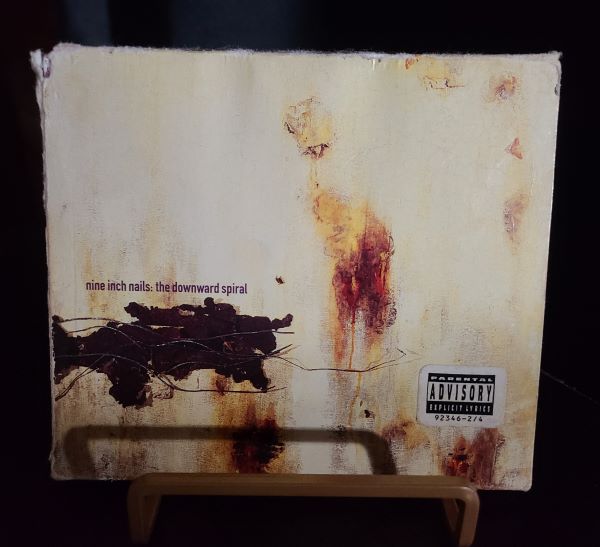
With ever rule or tendency there is an exception, of course. And my collection being a pile of stuff I’ve bought from ’08 onward does have its exception – this one CD that I bought on release day in 1994. It’s the unsellable CD – not because it’s worth anything or even for sentimental value – I love the album, but I have it on vinyl and a reissued CD edition. It’s unsellable because it’s just that – the packaging just doesn’t hold up and no one would buy it.

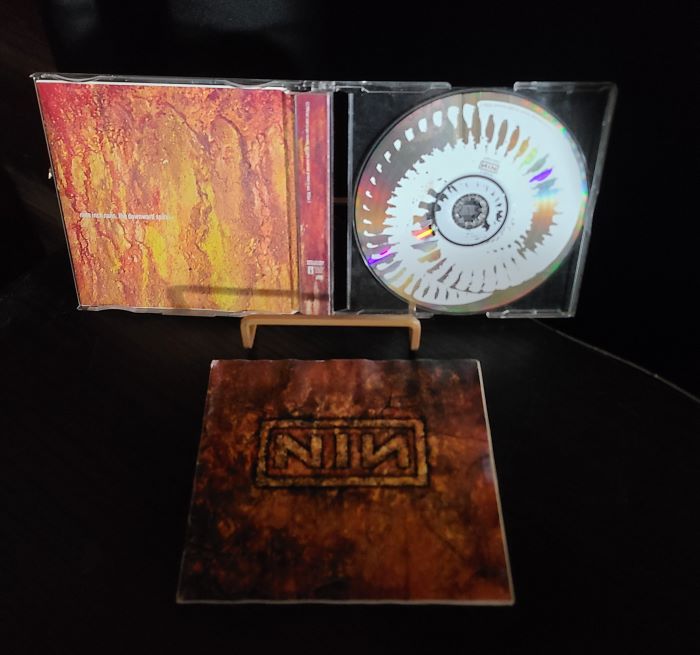
A lot of people reading now who were around back then probably already knew what album I was talking about. The CD packaging for The Downward Spiral was infamously “collector unfriendly.” It has a rickety cardboard sleeve to hold a slimline jewel case and a thick booklet. These did not hold up well at all and the packaging bombed out pretty quick on them, even if someone tried to take care of it. As I recall from a lot of collections back then, many people did not try to care for their stuff.

My copy I guess still holds up – the CD itself has small scratches but plays just fine and the whole jewel case part is in primo shape. But the outer packaging is hosed, in fact it broke apart when I dug it out for these pictures. It all looks a bit waterlogged but I can’t for the life of me figure when it got wet – I think it might just be from the famous Missouri humidity. Nothing else around it or in my collection at all has any signs of being waterlogged.

In the end I guess I do have one CD from my old collection, if only because it was such dim packaging that no one wanted to buy it. I’m kind of glad, it’s nice to have on hand even though it only serves sentimental purposes. I can’t be “that guy” who has an entire life’s worth of a collection on hand, but hey, that’s ok – I have this beat up old copy of a Nine Inch Nails album still.

Last week I covered The Downward Spiral in great detail for its 30th anniversary, that post is here.

For questions, comments or other concerns, use the comment form below or use my contact page to reach me.

The Burn Pile – Remembering The CD-R

For those of us at a certain age, the blank tape is a fond reminder of how we “shared” music in the distant past. You could make a mixtape if you wanted, or you could copy entire albums onto tapes. Often you could get two albums on one tape, one on each side, and be truly ready to jam out.

The cassette tape went away (thankfully, as far as I’m concerned) and the CD came along. That would slowly be phased out by digital files and then streaming services. Those two totally fulfilled and made obsolete the concept of “sharing” music – just tell someone to look up a song or album, send a link to it over a text message. It’s light years beyond the blank tape shuffle of the 1980’s.

But there was another medium for sharing music that ran concurrently with the rise of the MP3. The CD itself offered up a writable disc and by 2000, most PC’s had CD-R drives in them. Copying an album to CD was a process that didn’t take a lot of time and was super reliable, only very rarely going wrong compared the potential headaches of the cassette.

I do remember “burning” a CD in 1997 or thereabout. It took several hours and the CD wound up not working right in spots. A few years later allowed the technology to catch up and become more practical for the typical home user. Just as the idea of keeping digital music on computer hard drives was becoming a reality, it was very easy for someone to burn a CD and play it at home, in a car, or wherever.

I would take to burning CDs in the early 2000’s and wound up generating quite a pile of stuff. A lot of mine came from a friend who worked in radio at the time and was getting promo stuff from record labels. Some labels were already sending promos via digital distribution, but others sent physical CDs and I would copy a lot of those. Otherwise I was borrowing stuff out of friends’ collections and making sure I had my copy of that, allowing me to concentrate my purchases in focused areas.

My horde of CD-Rs, first time I’ve had them out in eons

The CD-R was a currency of music but it also didn’t quite take off the same way tapes did in the ’80’s. This was because the digital music revolution was happening at the same time. The time and material needed to burn a CD, while nothing that would set someone back a lot, was more than the simple act of ripping it straight to the hard drive. For more die-hard music fans like myself who are album-oriented listeners or who enjoy long mixes spanning a lot of songs, the CD was an ideal format. But for the more casual fan who is generally just into songs, simply having them on a hard drive was good enough. And with the advent of smartphones, even needing a PC was eventually phased out.

I would join the digital age somewhere around 2008, scoring my first iPod. This would naturally phase out the concept of burning CDs for me. Over the years I have occasionally made a copy of something for someone else but the days of buying spindles of blank discs were long over. And now with streaming I almost don’t even use my digital collection now, though it does have its uses from time to time and isn’t something I’m ready to part with yet. It’s not like it’s doing anything other than taking up disk space that I’m not using anyway.

What really inspired me to write this was me going through stuff and still having my two containers of burned CDs laying around. I haven’t even gone through them in over 10 years, they haven’t served a purpose for me at all. It’s finally time to send these relics of the past to the recycling center. I do have to remove them all from the paper sleeves I keep them in, but that would take all of 15 minutes if my lazy ass would get to actually doing it.

As I go through these I’ll probably check to make sure I’ve ripped everything I want to my PC. It’s probably not a big deal, some stuff I burned is stuff I now own, and many of the promos I had access to didn’t really excite me in the end. I might throw one or two on to see what I think now, but I’m not gonna spend a ton of time with it. I’m also curious if any of these degraded over time, the conventional wisdom on writable CDs is that they might not hold up over many years. But I’m not going to conduct a survey of the total pile I have.

The CD-R doesn’t really come with the nostalgia factor that the blank tape does. The CD thing was a practical matter that was no fuss, there was no need to time things right like would often happen with tapes. Just set your burn list and let it go, get out the sharpie and there you have something to listen to. People do still fiddle with CD-Rs, in some cases it’s to play music in cars and in others it can be to make and send mixes out. The full arrival of the digital age has ended the practical use of CD-Rs for most, but there are still holdouts out there, just like there are still people using blank cassettes. I won’t be joining them, for me the age of the CD-R has come and gone. But for several years it was a great tool to expose myself to way more music.