Welcome back to the “five songs from a year” series. Simple premise, as always – I choose five of my favorite songs from a particular year (not necessarily my five favorite, just five favorites). I started at 1967 and will run all the way through 2025.
Today is bittersweet as I’m now 22 entries into the series, which is really good. But it’s also sad since this is the final entry from the 1980’s. I grew up in that decade and it was a wonderland of entertainment of all avenues. It’s an era that hasn’t been, and probably can’t be, replicated.
All things must come to an end though, and here we are at the end of the ’80’s. Let’s get into my five picks from the end of the line.
Mötley Crüe – Kickstart My Heart
The Crüe had themselves a banner year in 1989. Their album Dr. Feelgood was a well-produced and written affair that saw them ride the end of the hair metal wave on top. The album contained this song, which ranks among the band’s very best. This is a total ass kicking burst of adrenaline that celebrates the band’s triumph of adversity and Nikki Sixx’s cheating death a few years prior. It doesn’t get much better.
Neil Young – Rockin’ In The Free World
Neil Young did NOT have a good decade in the 1980’s. He recorded some off the wall stuff and literally got sued for not sounding like himself. He spent the latter part of the ’80’s righting the ship and then lightning struck at the ass end of the decade with what has become one of his most well-known songs. Neil wrapped up criticism of the first George Bush administration in both poignant and noisy form. The political ramifications of the song have lived on for nearly 40 years since and the track is one of Young’s most beloved cuts from a discography that has roughly 9,000 albums in it.
Nine Inch Nails – Sin
The times they were a changin’, and the proof was in the pudding even before the decade turned. One signpost of the change was the advent of industrial and electronic music, and Nine Inch Nails would lead the charge into the next decade. This one has a bit of a dance beat to it, which isn’t really my thing in general but I’m cool with what Trent Reznor gets up to here. The song is about power struggle, control, lust and other cool stuff like masochism. It’s a twisted good time.
Aerosmith – What It Takes
When that gal who you had that crazy fling with in the last song is done with you, you can lean on this somber ballad from Steven Tyler and company to pull you through the tough times. This isn’t just a breakup song, it’s a lament of the most painful kind of loss, the end of that deep relationship that was supposed to be “the one.” The band did work with Desmond Child to craft this one but wanted to capture a different essence than the “big-time” ballad they went for on the album prior. I’d say they hit a home run.
Faith No More – Epic
Another sign that things were about to get a lot different was Faith No More’s 1989 hit album The Real Thing. It was their first with new singer Mike Patton and the band would become one of the harbingers of the coming weirdness of the next decade. This one would combine hard rock and a rapping vocal style, so feel free to direct the blame for nü-metal right here.
But there’s a lot more here than the primordial ooze that Korn and Limp Bizkit would crawl out of. This has pounding verses and a soaring chorus that will get wedged into any listener’s head. It’s full of musical movements and switches, including a moving piano outro that really flips things on its head. Faith No More were out in left field even for the coming alt-rock revolution, and the next decade would have their stamp all over it.
That does it for 1989 and the golden decade of the 1980’s. Next week I press on into the sea of changes that turned popular music on its head.
It’s time for 1979, though we’ll find no Billy Corgan here, only songs actually from the year. I turned two in ’79 so I obviously have deep and specific memories of all these songs. Next week the 1980’s will kick off and these lists will be batshit for awhile, no two ways about it. But this one was pretty simple to put together so let’s enjoy this pretty easy week.
Tom Petty and the Heartbreakers – Refugee
1979 saw Petty and his band break through to true mainstream success, and it’s no wonder with songs like this. This a powerful groove with the organ and guitar working together to blast this freedom anthem into your head. I’ve heard the song all my life and it still gets me going any time it’s on.
The Police – Walking On The Moon
The Police obviously incorporated reggae into their sound, but on this one they just totally went reggae. Very atmospheric stuff here with the guitars accenting things at certain points, but the song as a whole moving on its gravity free march in trippy rhythm.
AC/DC – Highway To Hell
AC/DC have a trove of awesome songs and many were from the Bon Scott era, but I feel like this one really puts it all over the top. This is a seamless blend of great riffing and on-theme delivery that stands as one of rock’s truly great songs. It would also sadly be the bookend of Bon Scott’s time with the band, though the group dusted themselves off and kept on in world-conquering fashion after his death. No matter how much rock radio plays AC/DC, this is one song I never get tired of hearing.
Neil Young and Crazy Horse – Powderfinger
Rust Never Sleeps is my favorite Neil Young album and this is my favorite song from that album so here we are, pretty simple pick. Tough tale of a young man who shot at a gunboat to defend his family’s property. The gunboat won the battle, if you are keeping score. It’s an anti-war song for sure but one that offers its message in a poignant story rather than being super obvious about it. Grand work from Neil and company.
Judas Priest – Exciter
Heavy metal was about to blow up big in its golden age during the 1980’s. It was Judas Priest who flew the flag for the genre during its relative down period of the late ’70’s, and here they continued to round into form as their own fortunes would explode in just a year’s time. Here Priest laid the groundwork for the entity known as speed metal, lending not only a musical blueprint but also a band name to one of the subgenre’s pioneering acts.
That wraps it up for 1979 and also for the decade of the ’70’s. Great music to be sure, some of the best, but things really get going in the next decade. The absolute explosion of music and the toughest series of picks I’ve had to make kick off next week.
Moving on with the songs by year thing, it’s time for 1972. This one was pretty easy, I have a few of these left before things get really crowded. We’re also now five years away from when I was actually around.
Deep Purple – Smoke On The Water
One of rock’s most immortal songs with the craziest of stories behind it. Perhaps the most iconic riff in history too. I know this song is over 50 years old so I don’t take it for granted that everyone “knows” it, but I do think just about everyone knows this song.
Alice Cooper – School’s Out
This might be The Coop’s prime anthem, kinda hard to say. But this song is an absolute blast. It’s great every year when school lets out for the summer, it’s great in movies about school, and it’s still great as an adult because school being out means less traffic and headaches than normal.
Neil Young – Heart Of Gold
Neil was 26 when he wrote this sad, sad song about searching for love and growing old while striking out. He’s now a few months from his 79th birthday and has about that many studio albums to his credit. But this song still resonates as one of his signature tracks. His unique vocal timber and acoustic guitar made some damn fine music.
David Bowie – Suffragette City
I talked about this song earlier this year. A nice, crazy and noisy affair with attitude and a great false ending. On heralded album full of classics, this one still jumps out to me. Bowie influenced rock of all stripes with this song and album.
Humble Pie – 30 Days In The Hole
This is a fun song about using every type of drug known to man and getting put away for it. Humble Pie were a supergroup before anyone really knew what that was, though Peter Frampton was gone by the time this song came out. This is one of those songs that wasn’t a hit at the time but it got picked up by FM radio and became an enduring classic in the years since.
That does it for this post. The ’70’s keep pushing on next week.
As for next week – the Album of the Week post will be held back until Tuesday. It lines up in order to celebrate the 40th anniversary of the album on the exact day. Not sure what album came out on September 3, 1984 that I’d be interested in…
Last week I finished off my Iron Maiden singles series with the 18-minute whopper Empire Of The Clouds. While throwing that together I was reminded of another 18-minute slugfest so that one gets the spot as the Song of the Week.
Neil Young originally composed this song in 1988 just after releasing This Note’s For You. The song theoretically was available for the album Freedom a year later, which was Young’s huge commercial comeback, but it was shelved because Young was concerned the audience might not take to the horn section.
Ordinary People got aired out some live over the years but did not see a studio version until 2007. The album Chrome Dreams II comprised a few older cuts as well as new material and the mammoth song finally got a release in 2007. The name of this album even calls back to old, unreleased Young material – the original Chrome Dreams was ready in 1976 but was shelved and its songs appeared in different forms elsewhere. The album sat for 47 years and is just now about to be released on August 11th of 2023. But that’s not today’s concern, there’s more than enough to talk about.
The song runs for 18:12. That’s a pretty vast undertaking and not something that hordes of music fans would be into, but Neil Young always marches to the beat of his own drummer so this isn’t something out of bounds for him. Hell, Chrome Dreams II has another 14 minute long song on it, No Hidden Path. It was even nominated for a Grammy in 2009.
Ordinary People comprises 9 verses over the course of its run. The song operates on the same formula the entire time – a verse that winds up with a bit of a chorus-like reprise at the end, then a bit of instrumental jam. That’s really all the song does for 18 minutes is repeat this process. There are no interludes, no movements in arrangement or anything like that. It’s just a straight jam all the way through.
The question becomes – does it work? It’s extremely long, it runs the same ground all the way through without the kinds of movements that most “long song” purveyors employ, and hell, it doesn’t even have a chorus. But, as it stands, yeah, the song is pretty good. It hooks you in pretty quickly with its rhythm that becomes almost hypnotic as the song goes along. Each spot between the verses holds a bit of horn and guitar jamming and it’s worth it to check out what’s going on through those passages.
And the verses serve to pay tribute to the title of the song – the ordinary people. Each verse is its own little story about someone screwing over the common people or maybe actually helping them out. Young offers up some choice phrases that he revisits later in the song, “patch of ground” people is one that really sticks out and also sums up the experience. It does honor the hardship and perseverance of not being one of the “silver spoon” people.
The song would be quite a feat to pull off live, especially given how much would have to be cut to fit it in. But Neil has managed 8 performances of it, all from 1988 and ’89, according to setlist.fm. The sites accuracy might be off too, especially going back to gigs that old, so it’s possible this got aired out a few more times. There is at least one recorded live performance found in Young’s insanely extensive archives series, that version runs more brief at 12 minutes and the band shifted up the verses some for that version.
The concept is something that honestly shouldn’t work. If someone pitched to me the idea of just playing roughly the same stuff over and over for 18 minutes without any breaks in the action or major shifts in the song to keep things fresh I would dismiss the idea out of hand. But here we are with just that and it’s something I enjoy quite a bit. Neil Young does exactly whatever the hell he wants, of course, and if he wants to play for 18 minutes then let him have at it.
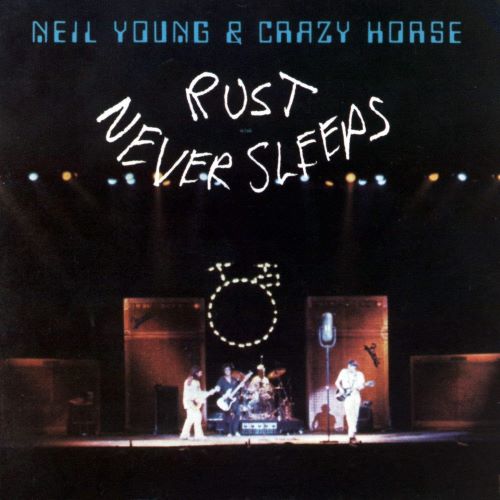
This week’s pick goes back to the end of the 1970’s and a highlight record from one of the decade’s most outstanding artists. A tour comprising of split acoustic and electric sets fueled the idea to do the same on an album and the result would become one of the more iconic albums in a crowded discography already laden with immortal records and songs.
Neil Young and Crazy Horse – Rust Never Sleeps
Released June 22, 1979 via Reprise Records
My Favorite Tracks – Hey Hey, My My (Into The Black); Thrasher; Powderfinger
The story of Rust Never Sleeps is a bit of a long and winding one – many of the songs were collected from earlier points in Young’s career, a typical thing for a guy who has had multiple “lost” albums in the course of his history.
While Young had made waves with a folk and country-infused style, he had also veered off on other courses and was leaning hard into distorted guitars by the late ’70’s. He would marry both concepts with split-set performances on the tour dubbed Rust Never Sleeps in 1978, which would serve as the birthplace and even live studio for portions of the album.
As for the album and tour title’s name, that came courtesy of Devo singer Mark Mothersbaugh. Devo and Young were collaborating on a film project when they took time to enter a studio and work on the electric track Hey Hey, My My. Mothersbaugh threw the line “rust never sleeps” in the lyrics – it was the marketing slogan for Rust-Oleum.
Of the album’s nine songs, seven were initially recorded live and then overdubbed in studio later. An effort was made to remove crowd noise but that was not always possible with studio technology at the time. Two songs – Pocahontas and Sail Away – were not cut live and were studio recordings instead.
My My, Hey Hey (Out Of The Blue)
The album features different renditions of the same song, the opener done acoustically. The song was born of Young’s fear of becoming obsolete in music and also would shout out Sex Pistols frontman Johnny Rotten and liken his rise with the fall of the recently-departed Elvis Presley. This first version of the song also features the lyric “It’s better to burn out than to fade away,” which became one of Young’s most famous and widely-quoted lyrics. While used in a wide variety of places, it was a part of Kurt Cobain’s suicide note in 1994 and Young was greatly affected by that.
Thrasher
A masterfully done acoustic tune that sees Young rambling off on his own, away from society and its machinations. The song is actually about Young’s bitter relationship with his former bandmates in Crosby, Stills, Nash and Young. While Young and Stephen Stills were able to maintain a working relationship through the ’70’s, David Crosby and Graham Nash were on the other side of the fence and a lot of animosity came through various failings to record a new CSNY record. It’s interesting to note the actual genesis of the song of course, but even without that knowledge this is a fantastic tune.
Ride My Llama
A short tune, though far from to-the-point. Here Neil takes a trip with a guy from Mars and also rides a llama from Peru to Texarkana. Not sure what ideas or substances Young might have been engaged with here, but the song works pretty well in its fanciful outlook.
Pocahontas
Another highlight of the acoustic side of the record, Pocahontas sees Neil again approach the issue of European settlers massacring Native Americans. He had previously sung about that on his acclaimed track Cortez The Killer from 1975. Pocahontas is one of three songs from Rust Never Sleeps that were originally intended for the never-released Chrome Dreams album a few years prior.
Pocahontas is also a bit of a weird song, as Young goes from a muddled recount of the massacre, to living in the present day with Marlon Brando and the Astrodome. The song really showcases Young’s vocal abilities and creates an uplifting atmosphere despite the grave subject matter.
Sail Away
The acoustic portion of the album ends with this nice, light and airy tune that really isn’t about much more than getting away. It’s a nice, clam and smooth way to get the hell away from it all for a few minutes.
Powderfinger
It’s on to the electric songs now and another cut meant for the shelved Chrome Dreams record. Young tried doing something else with the song, namely giving it to Ronnie Van Zant of Lynyrd Skynyrd. Skynyrd never got around to recording the song before the 1977 plane crash that claimed the lives of Van Zant and others. Young would eventually retool Powderfinger for his own use here.
Powderfinger sees a young man forced to defend his home from an arriving gunboat. Thinking quickly, he decides to grab his own gun and fire on the ship, which would lead to his own death. The lyrics tell a pretty heart-wrenching tale that isn’t the conventional approach to a war or combat song.
Powderfinger is held in the highest regard – often considered one of Young’s best, and in 2014 Rolling Stone magazine ranked it as his best overall.
Welfare Mothers
The next track is a nice rock number but also a bit of a strange one – if we’re to take the song literally, then Neil is suggesting we head to the laundromat and pick up divorced, down on their luck mothers as they’re better lovers. There’s probably some kind of social commentary here that means one shouldn’t take this track literally but honestly no one really talks about this song much so the listeners are left to make their own guesses as to what’s up.
Sedan Delivery
The third song intended for Chrome Dreams appears in here electric and quite distorted form. It’s almost a punk or metal tune with its rendition here. The song could just be about some guy’s life or maybe about drugs of some kind, it’s not evident what’s going on here.
Hey Hey, My My (Into The Black)
The album closes with the electric version of the opener. They lyrics are altered slightly on this version but the song is essentially the same, just with Young and Crazy Horse bashing their way through this amped up version. It’s another of Young’s most famous tracks and has been covered by about half of all music artists in the decades since release.
Rust Never Sleeps was a massive artistic statement from Neil Young. He wove his own fears of being cast aside into the kind of riffs and noise that punk and other artists were making, and cranked out a set of immortal songs to stave off his obsolescence. And on the acoustic portion he worked within more familiar parameters to craft engaging songs that added to his legacy in the folk/country realm.
The album would reach number 8 on the Billboard Album Chart, the precursor to the Billboard 200. It charted well in many other countries as well. The album has a lone US platinum certification but that might be more of an issue with a record label’s lack of desire to re-certify albums than an accurate picture of sales figures.
A year later Young and Crazy Horse would release Live Rust, featuring both tracks from this album and other Young standards. It too would chart highly and also gain platinum certification. The somewhat unconventional Rust Never Sleeps approach paid huge dividends for Young, who was about to kick off a very strange and meandering period when the 1980’s hit.
At the end of the day, Rust Never Sleeps was a career high point for Neil Young and proof he could carry on even as he’d put some years behind him. He would strike gold again and again in the years since, both carrying on as he saw fit and also keeping his finger on the pulse of the music of the moment. The conversation over the best Neil Young album is a tough one considering both the size and scope of his total output, but Rust Never Sleeps is certainly a part of that conversation.

 The Crooked Wanderer