Black Sabbath – Black Sabbath (the song)

This post was part of a series that I called S-Tier Songs. I later decided to abandon the series in favor of a simpler Song of the Week format. I am keeping these posts as I wrote them but removing the old page that linked to the list of S-Tier Songs, so that is why these posts might look a bit odd. Enjoy.

Today it’s really simple – the first song on the first album from heavy metal’s first band. In the spirit of convenience, the group chose to name their band, song and album all the same thing.

Black Sabbath – Black Sabbath

Let’s just lead with this thought – imagine hearing this for the first time in 1970 when it came out.

Seriously – I know the 1960’s were a golden age of music and had divergent offerings from all around, but think about hearing this in 1970 for the first time.

The bells, the thunderstorm, then that RIFF. No matter what else Black Sabbath had, it has always been the riffs of Tony Iommi, the absolute god of heavy metal guitar, that made this band what it was. And the riffs in this song were the noted birth of heavy metal in general and specifically doom metal.

This was just other-worldly and I can’t imagine what it would have been like to hear it without context upon release. People can always point to Cream as a boarding ramp for Sabbath and heavy metal, but Cream didn’t tread this ground. And any other precursor to heavy metal – Hendrix, Mountain, Steppenwolf, whoever else – wasn’t here.

And I didn’t hear this until 1990. I was 13 and got a home stereo system for Christmas, I snagged this and several other classic albums on cassette to break in my system. Hell, I’d heard Ozzy solo but I hadn’t really dug into Black Sabbath. Even hearing it as a dumb kid 20 years after it first hit was a mind-altering experience. I knew Sabbath were regarded as the founders and masters of the metal I was getting die-hard into, but I didn’t know it was like this.

Everything is just so ominous – the opening riffs, the barely-there presence of Bill Ward’s drums and Geezer Butler’s bass, and Ozzy Osbourne’s haunting vocals. In lockstep with the lyrics that paint this dark and dismal picture, it is just something straight from Hell.

This dirge goes on for over four minutes, then things kick into high gear. Iommi offers a higher tempo riff, Bill and Geezer join in at full volume, and Ozzy wails away through the descent into Hell. The last minute lets Iommi head out on a solo and the band slamming along in a dissonant yet perfectly coherent mess. Heavy metal was born.

It can be said that the song, and by extension the band, was blues music mutated into a volatile concoction. Black Sabbath were a blues band named Earth before changing gears, and blues music has influenced every notable Western music movement around. It would only stand to reason that there’s a pretty direct line from the blues to this godawful, Satanic wailing. And, as Sabbath would showcase on the rest of their debut album, it was a very direct line without much padding inbetween.

But, this isn’t the blues. This is not the music of the Mississippi Delta – this is the cacophony of life in industrial hell, aka Birmingham, England in the postwar 20th Century. Heavy metal was born there and would continue to flow out of there for decades beyond.

The lyrics behind Black Sabbath are dark and occult-based. The tale behind the lyrics is both stark and amusing. It has been told both by Ozzy Osbourne and Geezer Butler in various places, by Geezer in the liner notes to Sabbath’s 1998 live album Reunion and Ozzy’s 2010 biography I Am Ozzy. The gist is that Geezer had an occult phase and decked his apartment out in all black and with spooky decorations. Ozzy, a noted thief at this point in life, lifted a book about the occult and gave it to Geezer. Geezer woke up from a nightmare and saw a figure in black pointing at him. Geezer went to throw the book away but it had vanished. He swore off the occult and relayed the tale to Ozzy, who penned the lyrics to the song. Combine it and the legendary Iommi riffs, and a whole new thing was born.

Sabbath would go on to further and refine the heavy metal template the same year with Paranoid. But the song Black Sabbath especially would also lead to a new subset of metal down the road. Bands like Saint Vitus, Candlemass, Pentagram, Witchfinder General and Trouble would take what Sabbath established and make some memorable (and depressing) metal. Crushing dread via riff and vocal would be its own subgenre.

Why is this an S-Tier song?

Purely on its own, Black Sabbath is a crushing, haunting work that communicates dread and despair in a way not heard before its time. It is also the beginning of an entire movement in music that happens to be my favorite and is a highlight in a long catalog produced by the world’s most important and influential heavy metal band.
A demo version of the song released by Ozzy in 1997

The Ever-Winding Saga of Tool Vinyl

It is time to update the ongoing Tool Fear Inoculum vinyl saga. I have posted about it before, this was when I brought it up as part of a larger look at vinyl prices. While I want to cover that latter topic again, this Tool thing has grown legs of its own now and deserves its own post.

Last I wrote, the band had offered an ultra deluxe 5 LP, signed version of the album to VIP ticket holders at concerts. The box was priced at $800 for them. A “normal” (or, uh, unsigned) version of the box was made available to the public in April for around $160. I secured a copy, even though I’ve had a bit of a year and have better things to spend my money on.

My last line about the Tool LP package in that post has me cracking up right now:

“These will be flipped very hard when they hit in April, no doubt about it.”

It’s LOL time. Quite the opposite of being flipped hard, it turns out there is plentiful supply of the 5 LP box set. As soon as the boxes hit the market it was clear that supply was going to outpace demand. $160 quickly turned into $130, then the Discogs median crashed into the $99 dollar range. It is very easy to pick up a copy of the 5 LP box set for $99 plus $8 or so shipping today, months after release. Brick and mortar stores will sell them at cost just to get rid of them, which is a touch more than online pricing but should tell you something about just how depressed this asset is financially.

It turns out I was wrong about something. But hey, in today’s climate of Record Store Day flipping and price gouging, can anyone blame me for guessing that the Tool box would go for big money? I was far from the only one – many Tool fans rushed to get their pre-orders in, with good old FOMO (fear of missing out) playing its part in the modern vinyl economy.

Before I move on I do want to mention something – I am not, at all, mad about this. I wanted Fear Inoculum on vinyl and I have it. It’s not “worthless” by any means, though it is worth less than what I paid for it. It is an album I really wanted to have on vinyl and now it is on my shelf – its financial value is not a concern beyond any possible replacement cost from a disaster of some sort. I don’t feel “ripped off” because the price is less than I paid for it. I don’t complain when a record has a secondary market value far above its retail price, so I’m not gonna cry over spilled milk if one isolated album actually was pressed beyond demand.

If the Tool vinyl saga ended here, it would be a mildly funny but not all that out there story. It’s almost a nice thing – in the age of vinyl scarcity and supply constraints, a group of fans got a deluxe format for not a bad price. But, alas, the saga does not end here.

This is actually the third time I brought up the Tool vinyl in a post. I also covered it in a post called “Sticker Shock” when the world first learned of the deluxe box. I’ve updated it once to reflect a lower price point than what I originally anticipated, and I’m about to update it again to reflect that almost everything I said in that post is now bullshit. Or actually, it isn’t.

Here’s a choice cut from the Sticker Shock post:

“After all – if the vinyl takes up 5 sides, that only requires 3 LPs.”

It’s true – the deluxe version of Fear Inoculum is on 5 single-sided vinyl records with etchings on the other sides. That would easily fit on 3 LPs, it’s very obvious. It was obvious to me when I typed it in February and it’s obvious to Tool and their record label, who will be releasing a 3 LP version of Fear Inoculum in August. The price point for this release is running around $65.

On the surface it does seem funny that there will be a $65 version of the record when a $99 deluxe version can be had. But hey, in today’s economy, that $35 difference can add up. It saves money, it takes up less space than the gigantisaur 5 LP box, it (probably) isn’t insanely reflective and impossible to photograph like the 5 LP box. This version also has unique artwork from guitarist Adam Jones, so I’ll bet even some people who bought the big box will also buy this. Tool fans are easily parted from their money, we’ve certainly seen that in action. (I will not be buying the new configuration, for clarity’s sake).

Something else I said in Sticker Shock still rings true – Aenima is not readily available on record, the original pressing is scarce and costs several hundred dollars. And yet that’s better than the status of 10,000 Days, which is 16 years old and has never been pressed on (official) vinyl. But here we are with now two official pressings of the most recent album. That is one point several fans have been up in arms about that I can’t fault them for. I too would like to have vinyl copies of both of those records.

Of course, no one outside of the usual channels knows if there are plans for pressings of those other albums – we’ll find out if an when pre-orders open, more likely than not. It would seem strange to essentially flood the market with Fear Inoculum yet ignore highly sought-after versions of past records. But Tool is a strange band, so I won’t place a bet on it either way.

And so now, finally, I can (probably) lay the Tool Fear Inoculum vinyl saga to rest. My old “Sticker Shock” post from February seems freaking obsolete now, and even the blurb in the other post barely covered the tip of the iceberg with how this whole ordeal panned out. But hey, it’s hard to complain about having a ready supply of something on vinyl, given the scarcity and supply constraints still gripping the industry.

Album Of The Week – July 4, 2022

This week it’s time to have a look at one of metal’s now-bygone bands. They were heralded yet quite underrated, always noticed but never quite breaking through to the heights many thought they ought to achieve. The album in question would be recognized by many as one of the best (if not the best) they have done.

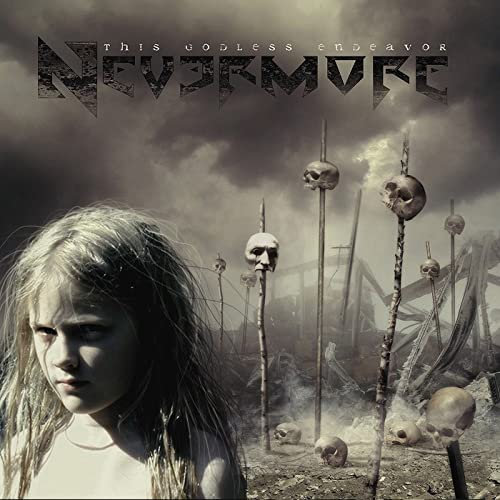
Nevermore – This Godless Endeavor

Released July 26, 2005 via Century Media Records

My Favorite Tracks – Medicated Nation, The Psalm Of Lydia, Sentient 6

The album marked the band’s sixth effort. The core lineup of vocalist Warrel Dane, guitarist Jeff Loomis, bassist Jim Sheppard and drummer Van Williams would remain. They would be joined on guitar by Steve Smyth, formerly of Testament.

The band would continue plying their trade in a straightforward metal sound that often defied categorization. While they “fit in” with the power metal scene, they were not power metal. Elements of thrash would appear but Nevermore certainly were not a thrash act. I don’t think they ever got properly sub-categorized in the whole of their 20 year history, though no such sub-category may exist.

The album runs 11 tracks in just under an hour, and with one being a very short instrumental. I’ll get it out of the way now so I don’t have to mention it on every song – the guitar work is absolutely out of this world. Jeff Loomis is a world-class guitarist and he was complemented well by Steve Smyth. The guitars are always high points of Nevermore albums.

Born

The opener goes hard and heavy, kicked up a notch even for Nevermore. The song is an indictment of the stagnant pool of beliefs that keep society pinned down from progress.

Final Product

Another brutal number in both music and verse. More about the negative aspects of the world and how they are dragging everything down. Pretty spot on and very much unimproved from the 17 years since this song first hit.

My Acid Words

Yet again with the caustic and harsh assessments, the band does not relent via instruments and Warrel Dane goes even harder with the lyrics. It is a cold and ultimately heartless conclusion rendered in the song. I had thought that Dane had said this song had to do with his brother but I imagine that would have been an interview from a print magazine and I can’t find it to confirm. I do believe my recollection is correct, though. It was obviously a tragic story.

Bittersweet Feast

A song that several cite as their least-favorite from the record but one I enjoy. There are two distinct lyrics being delivered in the pre-chorus, which takes a moment to get used to and can easily be missed. The song is a dirge about the fat and happy minions feasting on the remains of a dying society.

Sentient 6

The music turns down a notch to deliver a quasi-ballad. Of course the ballad is not typical fare lyrically – this song is about some sort of artificial intelligence being that struggles with the questions of humanity, tries to become like humans, then ultimately decides to destroy humans. All of the songs have happy endings on this album.

Also catch the Jimi Hendrix tribute, paid lyrically in the first verse.

Medicated Nation

Another of the album’s highlights for me and a track with possibly dual meanings. The literal interpretation of society being over-medicated is very real and very well discussed here. But many speculate that the intent goes beyond that and into the media, belief systems and various ways people figuratively medicate themselves from the realities of life and civilization.

The Holocaust Of Thought

A brief instrumental at not quite 1.5 minutes long. It features solo work from guest James Murphy, a metal guitar luminary who has logged work with Death, Obituary, Cancer and Testament, among many others.

A bit of an aside – in the mid 2000’s I was on a few message boards and on one of them, some guy complained endlessly about this song being on the album. Like, it’s not even two minutes long and you probably have it on CD anyway, just skip it dude. It just cracked me up because he complained about it at every possible opportunity, like maybe he was getting a dollar per complaint from someone, I don’t know. I just wanted to make sure I have that noted for posterity’s sake.

Sell My Heart For Stones

This song does stand out in a few ways. It is another quasi-ballad, so it gives a bit of a breather. It is also has a far, far more positive outlook than what has been playing so far. It’s honestly a breath of fresh air to actually have something philosophically positive for once.

The Psalm Of Lydia

This song picks the pace back up and goes into a bit of fantasy territory, at least a shade. Lydia seems to be a mythical, prophetic figure who winds up “slaying the demons.” Perhaps Lydia is slaying the metaphorical demons being chased throughout the first part of the album, there is lyrical evidence to make that conclusion. And also this song is guitar solo after guitar solo, just a magnificent work. No clue who Lydia actually is or what this song’s true composition is about, but it gets the job done.

A Future Uncertain

Heading towards the album’s close is this ponderous affair that offers a bit more introspection and hope than the savage beginning half. The song doesn’t quite arrive at its own lyrical conclusions but that’s probably surmised by the title.

This Godless Endeavor

We close on an epic, nearly nine-minute movement that questions the meaning of life and searches for answers in the void. The song does not waste its time, rather it keeps moving with more philosophical lyrical fare and, of course, more guitar.

This Godless Endeavor was a significant work for Nevermore, the work was praised by critics and the band toured with several acts during the cycle – they would open for old friend Dave Mustaine and Megadeth and would even get a support slot with Disturbed in 2006. In hindsight it is considered one of their best two albums and is often found at number one on a lot of lists. Even back in late 2009 when I was blogging elsewhere I named it one of my top five albums of the decade of the 2000’s.

Nevermore would not get to realize much greater promise from their masterpiece. Health problems beset, well, the entire band save Jeff Loomis in 2006-07. The group would record one more album in 2010, then split up. Loomis would link up with Michael Amott in Arch Enemy, while Warrel Dane would resurrect the pre-Nevermore outfit Sanctuary. Reunion talk began in the mid 2010’s but was ended when Warrel Dane died of a heart attack in 2017.

I have always felt Nevermore was a band that was kept a bit too far under the radar. A lot of people knew them and were into them, yet they didn’t latch on in a wider fashion. Their sound was heavy but not alienating to many listeners like extreme metal often is. And the sometimes very heavy lyrical matter is dressed in a higher vocabulary that keeps it from being just some noisy ranting about the world. Maybe the really were “just” a metal band without a way to further sub-categorize them, but they certainly were not “just” a metal band.

GTA Vice City – VRock

Yesterday I talked a bit about the unique and game-making soundtrack to Grand Theft Auto: Vice City. Today I want to elaborate a bit on the game’s rock and metal station. If anything screams 1980’s it’s rock and metal, and the game got it right on their own metal station, V-Rock.

V-Rock was the quintessential metal hits of the mid-80’s. Here is a complete list of songs from the original release of the game (note that Bark At The Moon was removed and that Love Fist is a fictional, in-game band who I’ll get to in a bit.)

Twisted Sister – I Wanna Rock

Motley Crue – Too Young To Fall In Love

Quiet Riot – Cum On Feel The Noize

The Cult – She Sells Sanctuary

Ozzy Osbourne – Bark At The Moon

Love Fist – Dangerous Bastard

Iron Maiden – 2 Minutes To Midnight

Loverboy – Working For The Weekend

Alcatrazz – God Blessed Video

Tesla – Cumin’ Atcha Live

Autograph – Turn Up The Radio

Megadeth – Peace Sells

Anthrax – Madhouse

Slayer – Raining Blood

Judas Priest – You’ve Got Another Thing Coming

Love Fist – Fist Fury

David Lee Roth – Yankee Rose

That is quite a list of signature 80’s rock and metal. Of course I can listen to this stuff all day and night long and probably make a years-long playlist out of it, but I think this selection really captures the spirit of the time.

A radio station is more than its songs. V-Rock features everything that makes this a true 1980’s rock station. The station has hilarious transition lines like “V-Rock – for people who wear name tags to work” and “While other stations’ listeners are in school … we’re shoplifting!” A few of the commercials, like the “complete the look – goth edition” spot for the Vice City Mall are also tailored to the station.

And above all else, V-Rock has an entertaining and outright hilarious DJ. Helming the mic for the station is Lazlow, who was an intern to the station’s former DJ, Couzin Ed. Ed was fired and Lazlow given the reigns as a cost-cutting move. In fact, Couzin Ed calls in at one point to lambaste Lazlow for being unqualified to host a metal station.

Couzin Ed has been a real-life radio DJ, and Jeffery “Lazlow” Jones was also a DJ and multimedia personality when both were hired by Rockstar Games to be involved in the Grand Theft Auto series. Lazlow is in fact chiefly responsible for the success of the game’s radio stations in his role as executive producer of the soundtrack.

While very accomplished in real life, Lazlow’s in-game character is much less heralded. Lazlow is a loser, being unable to score with a local waitress and having played in marching band while Couzin Ed was doing bong hits. Lazlow even laments that V-Rock’s mascot, the Vulture, gets more airtime than he does. It makes for some entertaining drives around Vice City to listen to Lazlow get cut down by most of the population, such as when biker gang leader Mitch Baker calls in to give Lazlow shit for playing “sissy music.” And this call-in happens right after the station plays Loverboy, if I’m not mistaken.

In a bonus segment only available on the game’s officially-issued soundtrack, Lazlow is fired as the host of V-Rock. Lazlow would go on to find hosting jobs throughout the GTA series, culminating in being an actual character in Grand Theft Auto V. The real-life Lazlow would continue his involvement with Rockstar Games until 2020 when he left the company.

If having compelling music and on-air “talent” wasn’t enough, the game outdid itself by inventing its own band. Love Fist is a group of drug-addled Scotsmen who fit right in with the hair metal scene. A handful of original songs were recorded for the game and feature on V-Rock. Two other songs air in segments during Love Fist-related game content. A Love Fist EP with all four songs present was made available in 2013 for digital purchase and streaming.

The band were given members and personalities to suit the times. Lead singer Jezz Torrent (say his name in a Scottish accent…) is featured in several cutscenes as a party guest. The band also has a series of missions in-game where Tommy Vercetti must help the band escape a stalker, get their needed drugs, and get to their gig. Love Fist’s former members and mentions of their music can be found in later GTA games as well.

The music of Grand Theft Auto: Vice City was great overall, and having a dedicated metal station with so much work put into it made the game that much better. I’ve spent countless hours in Vice City, driving my stolen cars and jamming to the great songs on offer. And Lazlow’s work as DJ is great. The game both celebrates and totally rips on metal culture and is a hilarious stew of satire and dark humor. In terms of video game soundtracks it just doesn’t get any better than Vice City and V-Rock.