The song this week is a hit cut from Cypress Hill’s 1993 album Black Sunday. This song was big business for the California rap outfit, as it hit number 19 on the Billboard Hot 100 and was a number 1 on the rap chart. It also was certified 3 times platinum as a single, and Black Sunday was the group’s second multi-platinum album in a row, it going 4 times platinum. Cypress Hill had already gained a following, but this song would blow them up.
Insane In The Brain is a song with a very, very familiar beat – if you think it sounds a lot like House Of Pain’s 1992 hit Jump Around, that’s because it does on purpose. This 2019 interview with The Guardian lays out the song’s background – DJ Muggs of Cypress Hill was the producer for the House Of Pain song. He originally tried getting Cypress Hill to use the beat but they didn’t want to record at the time, so he worked it into the HoP song. He liked the foundation a lot so he worked it up again for the next CH album. So no one was ripping anyone off on this one, except DJ Muggs ripping himself off.
Also there is a bit of the song’s lyrical background in the interview, courtesy of Sen Dog. He says the inspiration behind the title was a phrase that the hardest gangsters would use when talking to each other. If one walked up and said “I’m insane, got no brain,” that meant some crazy shit was about to go off. Even in gang culture, it was something reserved for the real heavy stuff.
As it turns out, the actual verses themselves are diss tracks, or Cypress Hill’s responses to being dissed. B-Real’s first verse is a response to a rapper named Chubb Rock, who apparently did a whole song mocking B-Real. And Sen Dog’s verse is aimed at Kid Frost, someone Sen had been close to but who changed and talked some smack about Cypress Hill.
What I’ll say is this – I’d never heard the names Chubb Rock or Kid Frost before looking into this song for this post. I’ve “heard of” Cypress Hill for over 30 years now, so I think the diss winner is pretty evident.
For all of the background that might not be evident on listen, the simple distillation here is that this is a slamming track. It is slight bits creepy and goofy, just enough of both to lend shades to the song without coloring it too much. B-Real’s vocal delivery on the chorus lends a twisted atmosphere to things, and everything comes together with the already familiar beat template to put together a total banger. No one really needed to know what the song was about, just that it was nuts and was a great time.
This song was all the rage back in 1993, when I turned 16 and was happy to enjoy these different sorts of things presented on MTV and through the alt-culture that sprung up around then. Cypress Hill had a ton of crossover appeal and it wasn’t hard for them to get heads bobbing to their songs.
I do have one funny little story, borrowed from an old friend from around that time. He had a PA system and would often DJ high school dances. I myself did not attend these but he did relay this really funny bit about this song. He had this on at one dance and B-Real’s famous line came up “Cops – come and try to snatch my crops.” The teacher who was supervising the dance came over and told him “there will be no crop snatching here!” and demanded the song be stopped. This was the life of small town high school dances in the early ’90’s, in case you were wondering. These days there will be no crop snatching because hey, it’s legal, but this was a long time ago.
That’s about all that needs to be said about this Cypress Hill blockbuster. It was fun, hard and drove everyone wild and it’s still great fun all these years later. It’s probably even more fitting now since just about everyone seems to be ate up, it’s kind of a theme song for these crazy times.
Our song this week comes from Fight, the early 1990’s project of the metal god himself, Rob Halford. Rob had left Judas Priest in 1992 in order to “spread his wings” and do some solo stuff. The story is that Rob had only wanted to do a side project and the rest of Priest was cool with it, but someone in band or label management screwed it all up and Halford’s letter of intent to do another band turned into him resigning. Judas Priest has some messed up management gaffes but that’s all for another time.
Halford’s first post-priest project would be Fight, a band a little more “with the times.” This band was heavy with a groove edge. It was reminiscent of Pantera, who were quickly becoming heavy metal’s most talked about band around this time.
Halford didn’t come from Priest alone – along for the ride was drummer Scott Travis, who did double duty in Priest and Fight, though Priest was not doing much at the time. Rounding out the band were bassist Jay Jay and guitarists Brian Tilse and Russ Parrish, the latter who you might know today as Satchel from Steel Panther.
Little Crazy was the second of three singles from the band’s debut album War Of Words. The album sold rather softly but did generate good critical and fan buzz. Halford’s gamble on updating for the times did pay off, at least in reputation. The videos from this album got pretty good airplay on MTV and there still was a good noise around the group, even if true commercial success was elusive.
This song isn’t a ballad by any means but it’s a slower tune, a bit “in the pocket” for a metal band. It does kick hard though, there’s no doubting its ferocity even in its middle pace. The riff here is totally southern deep fried, like this song came straight off the bayou. Everything here is played fantastically and the recording was fantastic.
Rob Halford keeps it subdued here, at least in terms of his general wail. Of all the renowned heavy metal singers, Halford is the one that can really take his voice to some different places. Here he keeps things on the level but it fits the song perfectly.
The song’s theme is exactly that of the title – it’s all about going crazy, or in fact being crazy. It isn’t the kind of hyped up, hey I’m batshit and going a million miles an hour kind of crazy often portrayed in old entertainment and especially metal songs. This is the creepy, crawly kind of crazy that is more like what going crazy is truly like (so I’ve read).
The music video fits the song very well and is also a product of its time. It features mostly shots of Halford writhing around as if he is slipping into the abyss, and some brief clips of the band playing. It’s all cut apart and pieced together with multiple angles in one frame, it’s very ’90’s and the sort of thing young, dumb meatheads like me ate up on MTV at the time.
Little Crazy wasn’t a hit in the commercial sense of the word. It did place at number 21 on the Mainstream Rock Chart, which is a bit of a feat for a debuting band, even one with a legendary singer in front of it. But this song was a hit with us at the time, the end of Generation X growing up on the alt-metal videos sprouting up around then. Fight would do one more album before folding, but their brief time around produced some pretty cools songs, and Little Crazy might be the biggest gem in the bag.
This week I’ll take a look at an EP that had both some live and studio tracks on it. One of the songs would gain hold on MTV and launch the commercial peak of “Evil Elvis.”
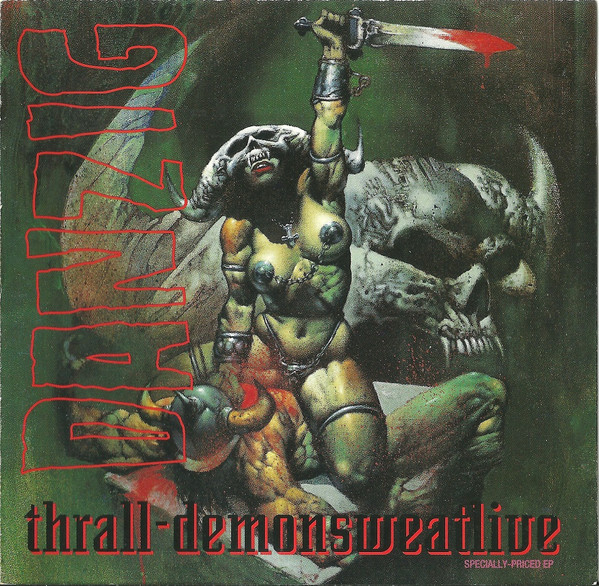
Danzig – Thrall-Demonsweatlive
Released May 25, 1993 via Def American Records
Glenn Danzig was in a pretty good spot entering 1993 – his profile had risen considerably on the back of three strong albums and the music environment was accepting of a lot of alternative metal that probably wouldn’t have gotten the time of day in the ’80’s. Danzig would become one of the flagship acts of this “alt-metal” movement with the hit contained here.
The cover art was done by renowned comics artist Simon Bisley. This was the first of many collaborations between Bisley and Danzig, as Bisley would soon join Danzig’s new comic book company Verotik as an artist.
The band’s lineup remained the same as it had since the group’s inception – Glenn Danzig on vocals, John Christ on guitar, Eerie Von on bass and Chuck Biscuits at the drums. This roster would remain for one more studio album after this then all three others besides Danzig would vacate their positions, marking the end of the “classic” era.
This EP comprises two parts, as well as a “hidden” track. The hidden song was on track 93 of the CD, leaving 86 tracks of silence between the listed songs and this bonus. This was a thing back in the CD days and not the last time Danzig would use the gimmick to place a hidden song. As a note to those hunting for this on Spotify, only the 7 listed tracks appear on that service.
Thrall
The first three songs are all new studio recordings, done in early 1993. All of the songs were knocked out in a day. Up first is the heavy banger It’s Coming Down. This is one of the heavier tracks the old Danzig lineup did. It is a very meat and potatoes metal song, with very few lyrics and just a bunch of heavy riffs and drumming. This one works pretty well and is the highlight of the new songs. There was a music video filmed for this but it contained a lot of bondage scenes in it so MTV said no. A less saucy version is linked up at the end of this post.
Up next is The Violet Fire, a bit more of a gothic vibe to this one but still a pretty heavy tune. The lyrics are about the dark arts of seduction, a Danzig staple. The last of the three studio cuts is Trouble, which is a cover song. In keeping with Danzig’s nickname and vocal styling, the song is an Elvis cover. The song is suitably spruced up for the atmosphere of a Danzig song and works pretty well. It’s fair to say that a lot of people listening to this EP in 1993 might not have been aware that this was an Elvis song.
Demonsweatlive
The four live tracks are from a 1992 Halloween concert at the Irvine Meadows Amphitheater in the Los Angeles area. The entire show was pretty available in bootleg form, though that boot probably came about as a result of this EP’s notoriety.
Up first is Snakes Of Christ from the album II – Lucifuge. Like everything here, this is an excellent live version that captures the raw and gritty sound of this music at its best. One of two cuts from the self-titled debut is up next. Am I Demon gets a whole new level of energy from the live outing and sounds like Danzig at the top of his demonic underworld. This could be considered the prime offering of the live cuts, though another one would go on to claim all of the glory.
The third song is Sistinas from III – How The Gods Kill. This is a bit of a different song, being a quiet ballad that fits Danzig’s style pretty well despite being well outside the usual heavy offerings. Even when I was a dumb 15 year old listening to this and only wanting heavy stuff I could appreciate a slower tune like this one.
Another song from the first album rounds out the live stuff – Mother was a single initially but did not move the needle back in 1988. Several years later, the song’s appearance on this EP would catapult it and Danzig into another layer of the atmosphere.
What appears first on the EP is the actual live cut from the Irvine show. It is certainly a live performance, it is a much more raw and open vocal outing from Danzig than any sort of studio track. It is a worthy live cut, as all four of these songs are, but it’s also not the version that actually got popular, even though footage from the same live performance is in the music video.
After letting the CD play for about seven minutes of silent tracks, track 93 hits with the Mother 93 mix of the song. This is a re-recorded version the band did in studio and is the single release that wound up getting so popular. The video was put with this new studio version and the release got huge traction on MTV.
Mother would hit the singles charts, getting to number 17 on the Hot Mainstream Rock Chart and just missing being a top 40 hit on the Billboard Hot 100, getting to 43. Sales of Thrall-Demonsweatlive and the original Danzig album would shoot up after the video’s explosion, netting the original a platinum cert and this EP at least a gold, its actual certification status is a bit murky and it may also be platinum.
Mother has lived on as a mainstream one-hit wonder and found use in many movies, video games and other places over the years. Danzig would depart his hard gothic metal sound a few years later, specifically citing the “MTV audience” as one he was happy to part ways with, though he did also appreciate his time in the sun.
While this is just an EP and the actual version of the song that got popular was an odd hidden track, Thrall-Demonsweatlive was a triumphant moment for the first iteration of the Danzig lineup. The breakout success of Mother can be attributed to the changed state of rock at the time, back when the song first came out it didn’t move the general music audience but did bring on some of Danzig’s core fans. This EP might not have been the touchstone moment it was without the single doing insane MTV business, but there are still several worthwhile cuts to check out here.
This post was part of a series that I called S-Tier Songs. I later decided to abandon the series in favor of a simpler Song of the Week format. I am keeping these posts as I wrote them but removing the old page that linked to the list of S-Tier Songs, so that is why these posts might look a bit odd. Enjoy.
Today I’m switching genres and offering up the first country song to appear on the list. It was a hit in the early 90’s, a time in country that is now being looked back on fondly. The song and artist both had a degree of crossover appeal, which lent to some exposure to a wider audience.
Dwight Yoakam – A Thousand Miles From Nowhere
Today’s song hails from Dwight’s 1993 opus This Time, which was a multi-platinum hit. It had three singles each hit number 2 on the Billboard Country singles chart. The album itself peaked at number 4 on the country chart and hit number 25 on the mainstream chart, no small feat for a country record.
A Thousand Miles From Nowhere is a bit of a departure from “pure country” standards, though Dwight Yoakam has always been a bit off in left field anyway. He’s perhaps the poster boy for the phrase “too rock for country, too country for rock.”
Our song today is a sad tale, though, not a number to rock out to. The song puts its narrator in the aftermath of a break-up and the desolate feelings associated with that. The lyrics paint a vivid picture of someone drifting along, remembering what was said at the end of their split. This is a completely broken person who has nowhere to be and isn’t even at nowhere.
The song is almost the literal opposite of the hit from The Proclaimers, I’m Gonna Be (500 Miles). The latter sees someone willing to walk a thousand miles for their love, while Dwight is so far gone that he’s a thousand miles from nothing. And in a bit of an ironic twist, The Proclaimers’ song would hit the charts in a second life just after Dwight’s song released.
The music video for A Thousand Miles From Nowhere is noteworthy. It is a simple yet visually breathtaking film that sees Dwight singing while riding in a train car across the Arizona desert. The beautiful simplicity of the shots lend weight to the sad song. For a bit of trivia, country singler Kelly Willis is the woman standing in the stream as Dwight’s train crosses a bridge at about 1:35 in the video.
I am extending myself a bit here as my memory of 30 years ago isn’t going to be spot on, but I am pretty sure the video got airplay on MTV. It was not common at all for MTV to play country but again, Dwight hasn’t always fit the country mold. I know I saw the video quite a bit when it released and I never watched the country music channel so I’m assuming MTV is where I saw it. It sounds logical, as MTV played Chris Issak frequently and this song sounds like one that could slot perfectly alongside his work. I’m happy for any correction to this from anyone who knows for sure, but I can’t imagine where else I would have seen the video as much as I did back then.
The song would appear in two movie soundtracks – the 1993 film Red Rock West used a demo recording of it as the film hit theaters before the song and album were released. And the 1994 comedy Chasers used the tune as well. In 2018 the song came up again, this time as a cover version from artist Jesse Woods used in a Yeti coolers ad.
Why is this an S-Tier song?
A Thousand Miles From Nowhere is a somber tale of loss and rejection. It paints its images vividly, the words pour out the heartbreak and desolation. The video adds to the presentation with its majestic scenes of a lone man traveling across the gorgeous desert. Everything adds up to an expression of how sad can be beautiful.
This week’s pick is a notable album from 1993 that marked a major lineup change for a long-running group as well as a shift in sound from their standard thrash to a more fit for the times alternative metal approach.
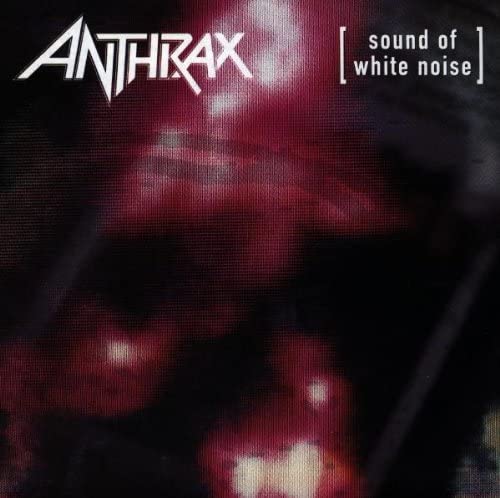
Anthrax – Sound Of White Noise
Released May 25, 1993 via Elektra Records
My Favorite Tracks – Only, This Is Not An Exit, Black Lodge
Anthrax had parted ways with longtime singer Joey Belladonna and replaced him with renowned Armored Saint singer John Bush. Bush’s visceral style fit the new songs well and put the band in prime position to remain afloat as thrash metal was falling out of public attention.
Anthrax did not sacrifice heaviness on this record but they did set the standard thrash formula aside for a more straightforward attack. While “grunge” influence is often spoke of when discussing the album, it seems more like just a very heavy metal album to me. I don’t really hear grunge on this. It fit the times but there was a lot more going on in metal than just people aping grunge back then.
This set runs at just under an hour with 11 tracks, so let’s jump right in to this beefy offering.
Potter’s Field
The blistering opener presents the view of a person mad at his mother for having been born, the troubled guy would have rather been aborted than left to live his crappy life. The song is a harsh, straightforward pummeling through the angry rant towards the mother. John Bush’s raspy and powerful delivery enhances the sharp sting of the lyrical content.
Only
The album’s lead single also serves as its most-known track and one of the highlights of the Bush Anthrax era. The song gets into dealing with someone who is clearly batshit crazy.
Only was a calling card for the new era of Anthrax right out of the gate. It saw consistent MTV play and has gone on to be widely considered the top track from this period of the band. It is also the only “Bushthrax” song that Joey Belladonna has performed after returning to the group.
Room For One More
This is something about a person seeking to use someone with a checkered past for something probably not good. The subject matter of these songs is far beyond the typical thrash offerings and suits the higher intellectual period of the early ’90’s very well.
Packaged Rebellion
A look at how the concept of rebellion was commercialized and put on display as a scene rather than an actual revolutionary movement. A very fitting song that strikes at the heart of music and culture of the time period. Rebellion was sold to the alternative crowd and was bought up just like food on a buffet line.
Hy Pro Glo
This is some kind of “callout” song that doesn’t specifically offer what or who it’s getting into. Many of the songs on the album have lyrical fare that keeps a certain distance and fits the music well yet doesn’t offer an open, literal interpretation that’s easy to digest.
Invisible
Another sort of “you suck” song, this one deals with the friend who is never around in times of need. This one’s meaning is easier to pick up on than some of the others.
1000 Points Of Hate
A title twisted from the famous “1000 points of light” phrase that George Bush the Elder uttered as president. The album’s most aggressive track, this one spells its points out clearly and is a true beating of a song.
Black Lodge
A dark, plodding “ballad” of sorts that was inspired by the Twin Peaks TV show, this was issued as a single and stands apart from the pounding that the rest of the album delivers. It deals with a person living with some kind of demons that aren’t spelled out – it could be mental illness, drug addiction, perhaps even terminal illness. The song is a well-crafted and creepy tune that uses John Bush’s voice to highlight the plight at hand.
Sodium Pentothal
The track listing spells out the actual chemical formula for this compound, I am not attempting to type that out or even copy and paste it into my document and declare war on my formatting. The drug has been used in lethal injection executions but also saw some limited use as a “truth serum,” and that is its application in the song.
Burst
Another pounding of a song that gets into how opinions are just that and really don’t hold much meaning when put up against each other. Sadly a lesson unlearned as the years have gone on.
This Is Not An Exit
The album closes with this extended number that gets back into the creepy vibe explored on Black Lodge. The song deals with the idea of immorality and the mental toll that living forever would actually have on a mortal being.
Sound Of White Noise would be a highlight album for Anthrax. It charted at 7 on Billboard, the band’s highest position. It went gold in the US and Canada and the singles Only and Black Lodge landed in the Top 40. The album received well among critics and it is often featured toward the top of lists of fan rankings.
It was a gamble to reinvent musically and also part with the groups signature singer in Joey Belladonna, but the gamble paid off as Anthrax entered the revamped ’90’s metal scene with a relevant sound and approach. Future albums with Bush would not see the same fanfare, though some highlights are around.
Anthrax would go through some silliness with vocalists for awhile before eventually reuniting with Belladonna and joining the Big 4 of Thrash tours. And while the signature Anthrax era will always be Joey and records like Spreading The Disease and Among The Living, there is no doubt that Sound Of White Noise and John Bush left a huge mark on the band’s career.
This week it’s back to 1993. It was a bit of a strange time, the vacuum left after the events of 1991 wound up being filled by some interesting stuff. One consequence for the years after was that heavier music was getting noticed and would even see mainstream chart success. Today’s album is from a group who’d been known as pioneers of the heaviest possible sounds, and this album provided a template for the shape of metal to come.
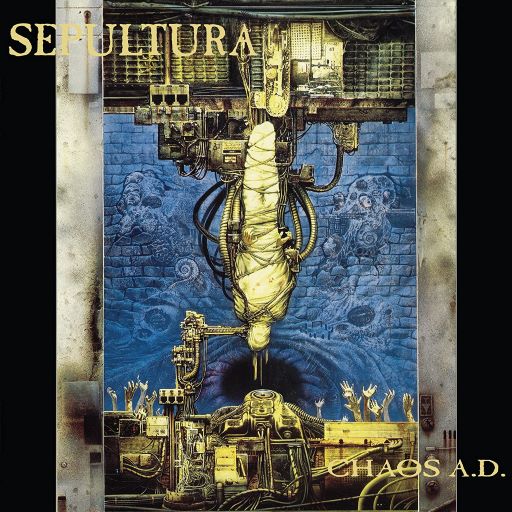
Sepultura – Chaos A.D.
Released September 1993 via Epic/Roadrunner Records
My Favorite Tracks – Refuse/Resist, Amen, Territory
Brazil’s Sepultura had captured the attention of the world with several albums of thrash bordering on death metal. By 1993 the band had worn out on the sound and looked to change up the formula some. The results would be downtuned guitars, more groove-based riffing in place of a thrash assault, and drums incorporating tribal and samba influences. It was as if Sepultura timed their move from thrash at the same time the rest of the world did.
There are 12 songs with a run time of a fairly lean 47 minutes. Should be pretty easy to get through.
Refuse/Resist
Opening with one of the album’s three singles (all the first three tracks are), this heavy hitter is an anti-police/authority song that has come away as one of the record’s signature anthems. Even with the band’s move away from thrash, this song is a chaotic, frantic mess. It does its job well of being a protest anthem, and in a time when protests and riots would see a big uptick.
Territory
The second single and most likely the best-known song from the album. Territory is a slow, plodding affair that looks at relations between leader/dictator and the people. Topical footage from the Israel-Palestine conflict is used in the video. Sepultura’s new groove-based music was being matched with incendiary political content, something that would get noticed in the same time frame that bands like Rage Against The Machine got big.
Slave New World
The final single from the album, this song was co-written with Biohazard bassist/actor Evan Seinfeld. The song tackles the issues of censorship and what it means to be “free” in modern society. As with the other two singles, this song is a common staple of the group’s live sets.
Amen
Though apparently not said outright, the song is a look at the Branch Davidian cult of Waco, Texas. The cult and its leader David Koresh were burned alive by US federal agents in April 1993 after an extended standoff. The song handles both the point of view of the cult leader and a more distant perspective that outlays the apocalyptic consequences.
Kaiowas
We arrive at an instrumental and all-acoustic performance, featuring only guitars and tribal percussion. The album’s liner notes pay tribute to a Kaiowas tribe in Brazil that committed mass suicide in response to government taking tribal lands. I have not done the proper scholarly research to corroborate that information.
Propaganda
A song about …. uh, propaganda and confrontation, I guess. It’s a very nice song but I have no idea what Max Cavalera is on about here. Sometimes you just have to quit paying attention and headbang along.
Biotech Is Godzilla
Here is a track with guest lyrics written by Dead Kennedys frontman and alternative icon Jello Biafra. The song gets into the issue of biotechnology and its more insidious uses. The song offers a conspiracy theory that the US government sent lab techs to Brazil to experiment with germs and chemicals on unsuspecting citizens. While the song is brief at two minutes it packs quite a punch and a lot of information and conjecture in its slim timeframe.
Nomad
An ode to the tribal and traveling peoples of the world, and an appropriately harsh, doom-ridden tune to weave that tale with.
We Who Are Not As Others
Another slow, doomy number that literally just repeats the title as its lone lyric over and over again. And it doesn’t suck. Pretty good job on making that better than a throwaway track. I mean, sure, it’s kind of damn dumb but it still works.
Manifest
An interesting twist on a metal song, this track provides a spoken-word account of a bloody news item from Brazil – the Carandiru prison massacre of 1992, in which military police handled a prison riot via the slaughter of 111 prisoners (who were pre-trial and not yet convicted). Max Cavalera does offer a few brief, one-word choruses along with the spoken account. It is an interesting and different approach to a metal song that is also obviously really fucking depressing.
The Hunt
We wind toward the close with a cover song – this originally being an offering from 1986 and the English group New Model Army, an act that can be called “rock” but honestly defies most specific categorization. No real matter here, as Sepultura twist this song’s form into their own. It is a tale of street justice and vigilantism in the face of the criminal underworld, a song very fitting of Chaos A.D.’s themes.
Clenched Fist
Bringing it home with one of those tried and true, defiant ’till the end and I’m angry and gonna get busy with it metal songs. It’s an anthem for weightlifting, running or whatever other crazy exercise shit people do (I do cycling myself).
Chaos A.D. saw Sepultura reinvent themselves and their new form landed squarely in the 1993 metal marketplace. The album went gold in the US and three other countries and saw top 20 or better action in several nations’ charts. Sepultura would tour the US with Pantera in 1994, just as the latter obliterated the Billboard charts with their own Far Beyond Driven. Groove metal was here, a “new” metal approach that beckoned great change on the horizon.
This would not be Sepultura’s greatest success – they truly conquered with their next effort, the multi-platinum Roots. That album would lean harder towards the “new” metal approach and was a benchmark for new trends in heavy metal. The band themselves would not enjoy the full fruits of their labor, as frontman Max Cavalera would depart the group in acrimonious circumstances at the end of 1996. While both Sepultura and Cavalera press on in various incarnations, there has been no heralded reunion of the band’s classic lineup that overtook mainstream attention with their very harsh sounds.
But for all that would come after, Chaos A.D. remains as a staple of the band’s catalog. It helped that one of extreme thrash’s most promising bands helped usher in the new age of metal (though some old-school keepers of the gate did not take to the new sound..) and also that the band incorporated specific, real-world examples of big issues in society as opposed to abstract cackling about bad stuff. It is as much a thinking person’s album as it is a vehicle of aggression, and its combined form is a force to be reckoned with.
This week’s album comes from 1993 and when extreme metal looked like it might be poised to be big business. This album marked a stylistic departure for one of Sweden’s pioneering death metal acts and also served as an ill-fated marketing ploy on the part of an opportunistic record label.
The unedited, original version of the album
Emtombed – Wolverine Blues
Released October 4, 1993 via Earache/Columbia Records
My Favorite Tracks – Contempt, Full Of Hell, Demon
Entombed were one of the original Stockholm wave of Swedish death metal luminaries, along with Grave and Dismember, who used headache-inducing guitar tones to accent their brutal approaches to extreme music. The band’s first two albums Left Hand Path and Clandestine are hailed as essential building blocks of the death metal genre. The magic of downtuning and the Boss HM-2 pedal were on full display in Sweden’s death metal scene.
In 1993 Entombed threw a curveball with their third effort. Wolverine Blues, while still savage and rancid-sounding as ever, was not standard death metal issue. Instead the band were playing fast and loose with their sound and incorporated a fair bit of rock and groove into their formula. They would be chief among several in starting the subgenre of “death n’ roll.”
There is a lot to talk about here, both the implications of stylistic change and a major media tie-in offer quite a bit to discuss. But for now I’ll get through the 10 tracks that run a lean 35 minutes, then I’ll jump into those other issues.
Eyemaster
The opener sets the tone with sick riffing and a lot of hoarse singing going on about “I’ll do me and you do you” kind of stuff. A bit of philosophy sprinkled in with our death metal, I’m cool with that.
Rotten Soil
A very gnarly, nasty tune that exemplifies how scuzzy and scummy death n’ roll can be. The lyrics are a bit of an incomprehensible mess but apparently walking on rotten soil will cause your blood to boil, and even better, blood will be pissing down your spine. Pretty good shit there.
Wolverine Blues
The title track lives up to its animal namesake’s ferocity. The wolverine is some kind of mutant badger/bear thing that is just utterly destructive. It is towards the top on a list of animals you don’t want to run into and Entombed capture the ferocity of the animal very well in song form.
This is also the link to the coming media tie-in I’ll be discussing later.
Demon
A very tight, well-done tune that invites demonic possession. Not something for church but a highlight from the album, which as a whole is also something not for church.
Contempt
This blistering song takes aim at society, or “civiliezation” as the lyrics spell it. While heavy metal and misanthropy have long been dance partners to the point of it getting boring, Entombed bring the fire on Contempt. The low-tuned, sloppy music fits like a glove but is almost secondary to some of the lyrics L.G. Petrov is belching out here. The line “No matter how low you are, there’s always someone to look down upon” is one I find in my head a lot these days as society seems desperate to tear itself apart. This is the star of the show.
Full Of Hell
Not to be outdone, this song also shines with its descent into willful madness and chaos. The lyrics flow right along with the disgusting riff and it’s a full-speed bullet train straight into insanity. It’s a death-groove stomp through just going nuts and it works splendidly.
Blood Song
We’re out of the peak of the album now and into a bit of a valley. As the title might suggest, we are cosplaying as vampires here. The marriage of death n’ roll and vampirism doesn’t quite pan out. The song is sufficiently heavy but the theme doesn’t quite land. It sounds like Petrov is just fucking off as he delivers the lines, which include gems like “I fuck your blood.” It’s probably a good thing that Entombed’s media tie-in wasn’t with Interview With A Vampire.
Hollowman
Off now to the song chosen as the album’s single. Hollowman was released as an EP, which for an album the length of Wolverine Blues is like half the album. The song is a bit abstract in its lyrical fare but does post the equally profound and dumb question “Who examines the doctors?” I think doctors do but I’m not entirely sure. At any rate it’s another worthy track and a good pick-me-up after whatever the hell happened before it.
Heavens Die
The song is monstrously heavy and a nice addition to the record. I have no clue what’s going on in the lyrics, this is some masters-degree level philosophy shit here. It’s beyond me.
Out Of Hand
We close the record on a song that leaves no lingering philosophical questions – everything is fucked and fuck it all. Even on an album full of nasty, intense songs, this one kicks the dial up a notch further and bookends the album in properly brutal fashion.
Wolverine Blues was a curveball album from Entombed. Just as death metal was making international noise and gaining in popularity in 1993, one of its formative bands changed gears and threw out a death n’ roll platter instead of staying on the death metal train. The album did alienate a fair portion of fans, to this day many swear off the record.
The album does have its fans, myself included. There’s just something about the nasty, unhinged approach to it that makes everything work. Death n’ roll would not spring up as much of a subgenre though a few other bands took a stab at it. It would mainly become the music that Entombed was known for. They would continue on a similar course for years afterward with the band eventually splintering and leaving only vocalist L.G. Petrov, who for legal reasons had to change the group’s name to Entombed A.D. Petrov would succumb to cancer in 2021.
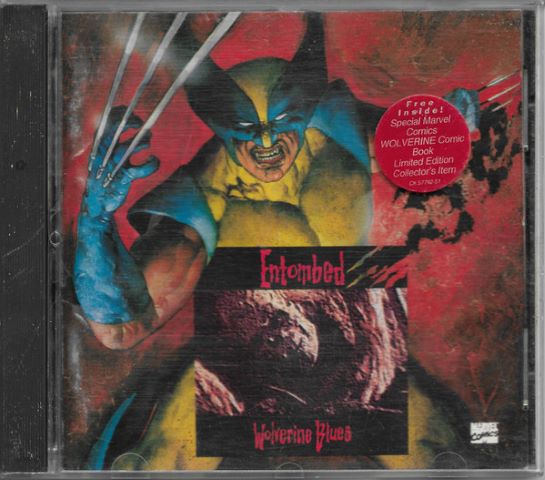
For all the talk of the album, there is also a discussion to be had involving the record label and their decision to force a corporate tie-in on the band and record. Against the wished of Entombed, the label Earache Records got a hold of Marvel Comics and produced a variant cover to the album featuring the mutant comic character bearing the same name as the album. A mini-comic was included in the CD’s booklet.
The Marvel version
It was an attempt at marketing to a wider audience and it wasn’t a really good one. There was no real connection between the Wolverine of the comics and the song or album. Comics were a bloated mess by this point in the 90’s and were destined for a huge crash, and any link between comic books and death metal is minimal at best. The album was also edited in order to avoid issues with the tie-in that would obviously appeal to younger audiences – instances of the f-word in multiple songs were cut out, and the track Out Of Hand was cut completely.
It’s also worth noting the presence of Columbia Records on the label spine – this album was part of an ill-fated pact between Earache and Columbia to capitalize on interest in death metal in the early 90’s. Nothing really came of the merger and it ended without doing much good for any of the bands. If anything, dumb tie-in ideas like this were all that the partnership brought. Carcass did get paid for an album twice because of the dissolution of the arrangement, but that is another story for another time.
The Wolverine and Entombed mash-up did not bear much fruit – the band remained underground and hordes of comic nerds did not seek out the album or become death metal converts due to the tie-in. There are probably a few instances of that happening but those are few and far between I would imagine.
But at the end of the day the Marvel crossover is just a footnote in the story of Wolverine Blues. The true story is that a band changed course and provided an out-of-left-field sound that turned off some but captivated others. Metal’s underground was all over the place at this point in the early 90’s and Entombed was still able to bring something unique to the table. Even with detractors, the album is still celebrated as a triumph and is always a treat to put on the stereo.
This post was part of a series that I called S-Tier Songs. I later decided to abandon the series in favor of a simpler Song of the Week format. I am keeping these posts as I wrote them but removing the old page that linked to the list of S-Tier Songs, so that is why these posts might look a bit odd. Enjoy.
Today I’m going to time hop back to 1993 and revisit a song that became a standard of alt-culture at the time. The tune was largely responsible for breaking the band and they would go on to great success for the next 17 years. Even today the song holds as a well-loved staple and a special treat around the Halloween season.
Type O Negative – Black No.1 (Little Miss Scare-All)
The unedited song
The song was released on Bloody Kisses, Type O’s breakthrough third album that catapulted the group to platinum-selling status and mainstream stars, albeit reluctantly. The group were previously a sludgy, underground entity that suddenly found themselves on MTV and airwaves with their twisted take on doom and gothic metal.
The original album take of the song clocks in at a meaty 11:15. A much-truncated version runs a hair under 5 minutes, this includes the video cut found at the bottom of this post. I don’t have ready stats about radio edits for songs but losing over 6 minutes carves out quite a bit of this tune. It’s probably not a radio edit record considering songs like Freebird and that one by Iron Butterfly, but it’s a pretty noteworthy edit. I’ll be discussing the full song for purposes of this examination, though it’s fair to say many people came to find the band through the video cut and the song’s shorter form.
The song itself exemplifies the duality of its creators – both deadly serious and full of shit. The song can be taken as, and often is, celebrated as a beacon of dark culture, but the truth is that frontman Peter Steele wrote the song to slag off a goth ex-girlfriend of his. The words and imagery were meant sarcastically, as outlined in this Revolver magazine retrospective on Bloody Kisses. And to further the irony, Peter was literally waiting in line to dump a truck full of shit as part of his job when he came up with the song.
The song’s silly-yet-serious presentation would define the tune and the group. The whole thing had the feel of a giant joke but came off with deadly execution and passed for totally serious dialog. All of the hokey goth references, everything from Lily Munster to wolfskin boots sound goofy on the surface but did truly define a valid subculture. And Black No. 1 would go on to draw more people into that subculture, one that previously wasn’t as friendly with heavy metal as many might think. This was a convergence of two different circles rather than an eye cast toward one.
The song, for all its girth, is divided into 3 movements. The first part opens in creepy fashion, introducing the song’s villainess and painting a specific vision of her gothiness. The lyrics reference everything from Halloween to makeup, clove cigarettes and the namesake black hair dye. It’s the kitchen sink of goth talking points. The song builds into a heavy chorus featuring Peter Steele’s distinct low-register chant of the title and a smooth-yet-dirty guitar tone that stood out from the pack in 1993.
The song moves into its second portion, where Steele spends several minutes singing “loving you was like loving the dead” over and over again. On the surface it sounds boring but the music provides enough variety through the passage to keep things fresh. The ultimate “gotcha” wasn’t that Peter was able to insult his ex this way, it was that he was able to make interesting and a huge hit. Of course the full-length version of the song builds to slight lyrical change that radio and MTV did not carry. The song’s final movement calms things down a bit and lets the guitar riff for a moment before the chorus/title leads everyone out into the night to either find or be their own haughty goth chick.
Black No. 1 would lead the way for Type O Negative’s charge onto the shelves of music collectors. The band blew up on MTV and began selling copies of Bloody Kisses at a breakneck pace. Peter Steele was very reluctant to take the band on tour, fearful of giving up his job and life. His feet-dragging cost the group their drummer, Sal Abruscato, who left to join Life Of Agony. Eventually Type O would hit the road and cash in on their success, becoming a mainstay on the touring circuit and selling plenty more albums until Peter Steele’s untimely death in 2010.
Why is this an S-Tier song?
Black No. 1 is a monolith of a tune that put a band on the map and kicked off a celebration of darker subcultures that endures to this day. The song itself is equal parts plodding doom and campy jeers at goths yet somehow invests the listener on its 11 minute runtime. It gave shape to Type O Negative’s direction moving forward, which would largely explore the same “droopy doom” tunes and shed any pretense of past thrash metal influence.
Even greater than the contribution to the band’s fortunes is its long-lasting impact on culture. Not a Halloween passes anymore without this song being posted all over social media. It cast a light on goth subculture, perhaps not something anyone was asking for but it happened anyway and the song went a long way to putting that scene out there for the world to see. It was a lasting influence, seen in makeup and fashion all these years later. I’m sure some people would take exception to pointing to this as the moment goth culture entered the main timeline, but I don’t know of a more telling spot where that happened.
Type O Negative struck the sonic equivalent of oil with Black No. 1. The song marked their arrival on the early 90’s alt-metal scene that they would help shape and would mostly outlast. While most of that music of the time was a brief movement that didn’t make it past 1996, Type O would go on in stride until 2010 in much the same vein as their signature hit.



 The Crooked Wanderer