Last week was a huge moment in music – Oasis announced a series of North American concerts to be held in August and September of 2025. Their previously announced UK and Ireland shows sold out in a matter of minutes with a ton of issues surrounding demand and pricing. But Oasis were also far bigger in their native England than they were in the US, so how would the handful of North American shows fare?
Before tickets officially went on sale on Friday, October 4th, the band announced second shows for all North American dates, except one – the Chicago show at Soldier Field would remain a lone date. Lucky me, as I would be trying to secure tickets for that very show.
I did get a pre-sale code that would let me buy tickets on Thursday, a day before the general sale. I figured I’d take a shot at seeing them, I never had despite having lived in Europe through the late ’90’s and having every opportunity to see them whenever I wanted.
There are a few other things I’ve never done – I’ve never been to a stadium concert and I’ve never bought a ticket for a high-demand event. I think the 20,000 capacity amphitheater style gig is the biggest type I’ve been to, and none of those shows were sell-outs. I’ve been to several sold-out or near sold-out shows, but all of those were smaller, club-level shows at 1,000 or less capacity. I’ve never had a problem getting tickets to something even if it was a hot ticket.
But this Oasis reunion is a HOT ticket. Again, it melted down Ticketmaster in England due to demand. Many people over there were left out, which also served to increase North American demand as many from England would be trying their luck with shows across the pond.
I’ve bought tickets at box offices and record stores back in the days of paper tickets, I’ve obviously boguht online a lot in the past many years, and I’ve showed up to many shows and simply paid at the door without an advanced ticket. One thing I’ve never done is use an online queue system like what Ticketmaster had set up for these shows.
I got home on Thursday from work about fifteen minutes before the pre-sale began. I logged into my Ticketmaster account and, in what proved to be a grave mistake, I waited until the sale launched to join in. Had I jumped in right when I got home, there might have been a different outcome to this story.
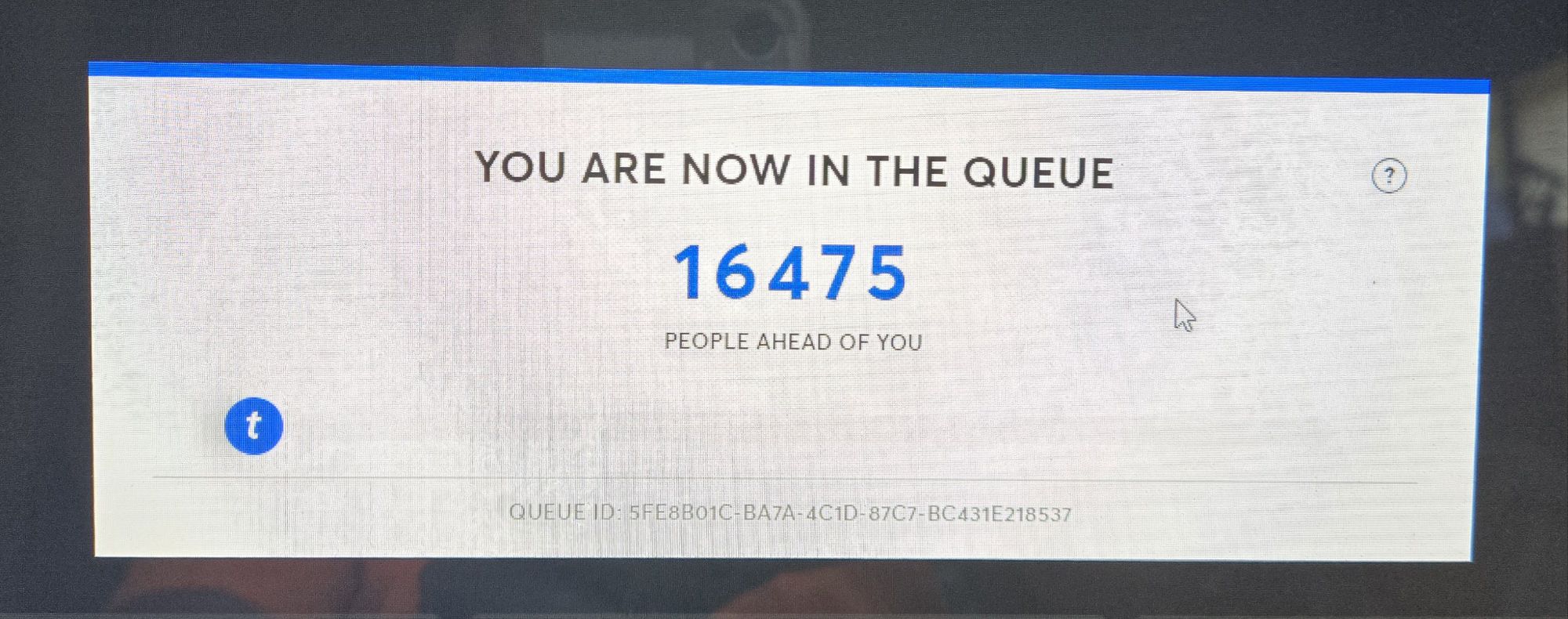
When I got into the queue, there were 16,800 people ahead of me. I was a bit miffed that I was so far back, but then I hopped on reddit to see what people were saying and I found out I messed up by not joining as soon as I could.
this was after I’d been in the queue for a few minutes
I don’t know the exact number of tickets available – Soldier Field concerts seem to run around 54,000 or so. The number of people in the queue, who could each buy 4 tickets, far exceeded the capacity. Take into account that not all tickets were sold during the pre-sale and pickings were truly slim.
Anyway, I waited 40 minutes to get in and when I did, it was a bloodbath. There were a few scattered seats, but I couldn’t get one quick enough. The GA floor only had VIP available, and it quickly came down to only having VIP seats as well, at a $600 minimum. I simply closed my browser tab and went about my day.
I did not bother trying for the general sale the next day. I believe Chicago sold out in 19 minutes, and all of the other gigs (with two shows on all the others) sold in similar fashion. I saw that quite a few people got in on the Mexico City gigs after missing on both the UK and other North America shows. I guess up next is Australia, who are getting a whole two shows.
No, I won’t be seeing Oasis next year, barring some kind of oddball luck on the resale market. I’m not inclined to pay much attention to that, honestly. I’m not really upset about it, I knew it would be kind of a lottery to get tickets and I just didn’t hit. Besides, I’ve heard from plenty of people that stadium shows kind of suck anyway, it’s more about just being there than it is taking in the show. I’ll make do with the inevitable live album and documentary when all of that comes around.
I was talking with a buddy awhile back about canceled shows. It’s the hidden scourge of attending concerts – you show up to the venue ready to have a good time and someone’s back is out or they have the flu or a new divorce to navigate, and they aren’t playing that night. Usually these things come around in time enough to absorb, but there are times people have found out in front of the venue or even in their seats.
I’ve never personally had the worse scenario happen – I haven’t even traveled some distance only to find last-minute that the show is off. A few friends of mine have been in that predicament before, I recall many years ago texting a good friend to let him know that the band he was driving up to Kansas City to see was buried under snow in Denver. And my friend was just outside of KC, a three hour drive from here, when he found out.
But I have had a few cancellations in various circumstances. I figured I’d run through them today just for something different to do.
Megadeth
The first one is also the most recent one. Megadeth planned a huge tour with Lamb Of God, In Flames and Trivium and included little ol’ Springfield on the original routing. Well, this was early 2020 when the shows were announced, and we all know that COVID hit not long after. The tour was pushed to 2021 and Springfield was dropped entirely.
I wasn’t surprised, the show was being held in our 10,000 seat college arena and I was very skeptical that Megadeth was going to even come close to filling that. And they didn’t – tickets weren’t moving much at all, so they quietly threw our show into the bin when re-routing the tour.
And one person really made out like a bandit over it – me. I excitedly hopped on to buy tickets as soon as I could dig up a pre-sale code and I used the seat map to buy two awesome seats right on the aisle. Only problem was the seat map was oriented weird and I bought seats in the upper most row of the section instead of closest to the stage. I bought the two tickets I intended to buy so I was on the hook for four tickets at $125 a pop. When the show canceled and I got all my money back I felt a lot less stupid, I wasn’t gonna have to try and sell expensive tickets to a show people weren’t lining up to attend.
Oh, and that wasn’t all – I had bought the two closer seats under some kind of package deal involving Lamb Of God. A few months later when they released a new album, that record showed up to my doorstep, signed by the band. I can only assume that was part of the deal I bought as I didn’t order a signed record on my own. Or maybe it was a quiet kind of make-good thing after the tour got postponed and later canned. Either way, thanks.
Deicide
This goes back to 2004 and doesn’t involve a whole show cancellation but rather just one band. The tour package was Superjoint Ritual, the post-Pantera outfit of Phil Anselmo. Deicide were opening the show along with someone else. I wasn’t ever into Superjoint but I was happy for the chance to see Deicide, I do love my old school death metal.
Well, Deicide did what they often did in those years and didn’t show. I got to the front of the venue and there was a sign saying that they canceled. I hadn’t bought a ticket so I turned around and left. Deicide would jettison their troublesome members not long after and go on a run of more stability. This one didn’t really bother me too much, Deicide canceling shows was not out of the blue back then and they were the only reason I was going so it was a free evening for me.
Merle Haggard
This next one goes back to early 2016 and, if you know Merle’s life story at all, you already know the tragic reason for this one.
Merle had booked a tour with Willie Nelson, with Jamey Johnson opening. You talk about a chance to see two legends under one roof, this was it on a silver platter. And Jamey was no slouch either, he was running high around this time.
Well, sadly Merle wouldn’t make it. He came down with pneumonia and wasn’t able to shake it. He canceled his participation on the tour fairly early, and then died on April 6. This was only two days before the show was set to hit my town.
Willie and Jamey went on with their sets, both paying homage to Merle. It was a fantastic show but it’s sad that Merle passed away and couldn’t be a part of it as well. But it’s one cancellation I’d have a hard time complaining about. Totally understandable.
Slayer
These last two are inter-related. At some point in 2004, Slayer announced a tour for later in the year that was to include our humble little village. I had never seen Slayer live so I was very much looking forward to it.
Well, fast forward 20 years, and I’ve never seen Slayer live.
This one was pretty simple – just as the tour started, Tom Araya was having some kind of issues, I think with his throat but I’m not sure. The band postponed the first few shows, of which ours was one. A bit later they announced the rescheduled dates, and our show was not among the new dates. No official word was given but the rumor mill indicated that soft ticket sales were the reason.
I was disappointed by this one but not much I can really do about it. The saddest part of all is that it might have played a role in a gig we never got.
Cradle Of Filth
This final one is not an officially canceled gig. Nothing was ever booked and no tickets were sold. And all of the info I’m about to give is all second-hand information that I can’t confirm, and also it was 20 years ago so my own memory might not be the best on it all.
But the premise was this – Cradle Of Filth were looking to book US shows and somehow got in touch with a booker here. The band’s fee was huge, which is understandable as they were the most successful extreme metal band going back then. But I guess our booker was willing to play ball and everyone exchanged dates. The kink in the hose that killed the show was this – the only available date was the same night as the Slayer gig.
So we didn’t get a Cradle Of Filth show because Slayer were running town the same night. That much is understandable, as the crossover in audiences is pretty big. But, as we’ve just seen above, that Slayer gig wound up canceled. So that’s a possible double bummer, if this story is true.
I really don’t know if CoF were actually close to playing here. It’s possible that there was a low-level inquiry that didn’t pan out and then someone in the scene added a bunch of layers to the story that weren’t really there. Or it’s possible that it is all true – it’s one of life’s dumb series of coincidences that is just strange and stupid enough to happen. I kind of don’t buy it because CoF’s tour routing for the fall of ’04 doesn’t line up with Slayer’s that much but something still could have been brewing.
That about does it for the canceled shows, at least the ones I can recall. I consider myself fortunate – I never had to drive a great distance to find a show canceled at the last minute. But I’m sure many of you who read here have your own canceled gig stories, feel free to share them below. And may any future gigs go on without a hitch.
For questions, comments or concerns, either use the comment form below or head to my contact page.
Last Friday was the big show, one that I would have never expected to book in my town. But it happened against any expectations and it was quite a night.
The venue was the Gillioz Theatre. This is a historic spot that was originally opened in 1926, then closed in 1980 and re-opened after restoration in 2006. The spot holds roughly 1,000 people. It has been an occasional hotspot for shows and I’ve seen a handful there. It is a seated venue with not a ton of room to stand around in, a point that will come up in a bit.
The show was Saxon and Uriah Heep, two long-running British rock and metal acts who are still going strong after decades. Uriah Heep started in 1970 and have been running since, and Saxon got off the ground in 1975 and released their first album in 1979.
While Saxon was the first act to play, this was a co-headliner tour where each band got equal stage time, roughly an hour and twenty minutes. No openers or anything like that, just long sets for the featured acts and straight to the point. I’m getting to enjoy this kind of show without openers who I forget about before they’re sometimes even off stage. Opening a show like this would be a killer opportunity for an emerging band, though I do also appreciate the extra spare time from not having one.
Saxon were up first and got right into it, they played the intro and then the title track from their newest album Hell, Fire and Damnation, which I conveniently reviewed the other day. In all, five songs from the new disc got into the setlist so Saxon are clearly high on this new material.
Another thing Saxon do a lot of are title tracks – including the new album, a total of seven title tracks got stage time. This ran the string from early Saxon releases like Denim And Leather and Wheels Of Steel, to the more recent Sacrifice and also stuff like Power And The Glory being somewhere inbetween it all.
Saxon celebrating after their set
The band were totally on point all night, these guys are seasoned pros and there wasn’t going to be any let down. It could be said that their intensity was greater than that of the seated crowd, who to be honest were a bit tame. This did seem to capture Biff Byford’s attention as he brought it up more than once and a fair portion of the crowd got up and put in some energy in response. I have nothing bad to say about the venue, but an open standing sort of place would have been a much more appealing venue for this show. Sadly we don’t have much of anything like that in town, at least for a show this size.
Even with the contrast between a heavy metal band on stage and a crowd all stuffed in theater seats, the show went off without a hitch. I was very happy to see Saxon as it was my first time. I don’t know why I hadn’t caught them before, they aren’t exactly shy about touring, but whatever the case I finally got another band off my bucket list.
In a bit of trivia – I have no clue if Saxon had ever played Springfield in the past, this town did get some shows in the ’80’s long before I lived here. But I do know that their most recent member, guitarist Brian Tatler, had played town just seven years prior with his main outfit Diamond Head. There’s a story or more in that show that I will tell in a post sometime down the road.
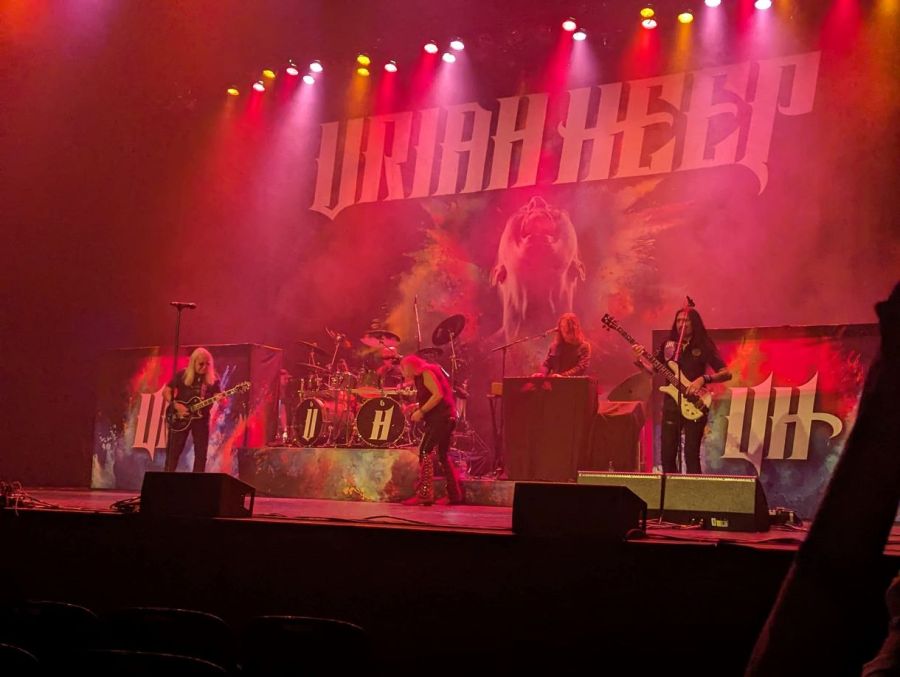
After Saxon left the stage there was a pretty quick stage turnover to get ready for Uriah Heep. Saxon were actually only occupying the front part of the stage in fairly cramped conditions, as UH already had their gear set up behind Saxon so the changeover was pretty seamless. I’ve noticed that set turnover is a very quick process these days – back in the ’90’s when I started attending shows, the change from one band to next could take an eternity.
Uriah Heep is a band I have been familiar with but haven’t spent a ton of time listening to. They’ve had a few songs in rotation on classic rock radio but I hadn’t played an album of theirs or anything. I did put together a playlist of sets they’d done at shows prior to my stop in order to familiarize myself more with their stuff, another nice convenience of the modern age.
Uriah Heep does have one remaining original member, guitarist Mick Box. In fact, Mick is the only surviving original member so it’s not like anyone else would have the opportunity to join him. Mick was joined by singer Bernie Shaw, who has been with the group since 1986. Bassist Dave Rimmer has been around since 2013, and Drummer Russell Gilbrook has been on board since 2007. Regular keyboardist Phil Lanzon was unable to join Heep for the tour, so the band landed one hell of a special guest in his place – Adam Wakeman, the son of legendary Yes keyboardist Rick Wakeman, helmed the organ keys for this show.
The Heep are also touring behind a recent album, 2023’s Chaos and Colour. Three songs from that album made the set, as well as one from their 2018 effort Living The Dream. The rest of the set was culled from the band’s classic early 1970’s work. I will say that the newer songs were all really good and have me eager to visit these more recent albums. It’s a tough task to catch up with the group as they have 25 total studio albums.
Uriah Heep in action
The band were in fine form as they delivered their goods. Most of the stuff was performed faithful to the original, while UH took a few liberties here and there. After shouting out Saxon, Shaw made a remark that today’s music is pigeonholed into genres, while when Uriah Heep were starting out music was mostly either good or not. Then UH showed off their own metal chops with a heavy rendition of Free n’ Easy. Russell Gilbrook especially got down hard and heavy on the song, an illustration that sometimes drums are honestly the line between rock and metal.
There were a few treats in store for those, like me, who enjoy extended live jams and departures from the original recordings. UH again struck up a heavier tone on Look At Yourself and also drew the jam out for a pretty long time. They also aired out their long ballad July Morning, a gentle reminder that ten-minute long songs existed long, long before Taylor Swift. We then got the encore, which was capped off with the band’s obvious hit Easy Livin’.
That was all for the show, it was off into the night for us afterward. It was a true honor to finally see Saxon live, a true stalwart of the NWOBHM. And it was a real privilege to see Uriah Heep and I will be working their albums into my rotation as I move along, they are far too good to not listen to. I was surprised that this show got booked here and I’m damn glad it did, my gigs these days are very few and far between and this was a true highlight of my concert going.
Photography by Susan Cummins
For questions, comments or concerns, use the comment form below or head to my contact page.
A disturbing trend has been moving through music in the past several years. It was already happening before 2020, but the COVID pandemic really thrust it into high gear – small music venues have been closing, and at an alarming rate.
That rate is very telling, and it’s not isolated to the United States – this September 2023 article from mixmag estimates that 10% of UK grassroots music venues would close by the end of 2023. Though I don’t have word on if that came to be, I’d say the estimate was fair since a good bit of the year had already passed. And even without this stat, if you pay attention to music news at all, you’ve surely noticed several doom and gloom articles about the state of smaller music venues.
Closing venues may not seem like a huge deal to some – these are very small businesses that cater to somewhat limited audiences, and there are the stereotypical cracks about small music places – the bathroom of death being just one.
But the loss of music venues is a massive deal to music – it eliminates the place that musicians have to play. Sure, the Internet is here and makes it easier than ever to “get your stuff out there.” But – getting anyone to actually pay attention to it is another matter. Do anything on social media – post a song, an article, hell – a blog, and you’ll find it takes thousands upon thousands of impressions to generate tens of actual plays or views. Nothing about using the Internet to gain exposure is as easy as just posting it – not music, not blogging, not OnlyFans, not anything.
The music venue is the one place where people will be interested in underground or independent music. It is where people go to specifically seek that out. There is no more receptive audience for music anywhere than at a music venue.
And this plays out at all levels – I listen to a lot of underground and extreme metal. These are bands that are internationally known but let’s face facts – the audience for extreme metal isn’t usually massive. These bands will often play 300 or 500 capacity venues, the same kind of venues that host other forms of independent and local music. Losing these spots is the loss of an opportunity to see bonafide national touring acts, there are only a handful of extreme bands who draw the numbers to fill larger venues.
And the biggest impact of venue closure is to the local scene. Sure, things have changed from the old days – bands don’t have to “pay their dues” for years on the live club circuit before “making it.” But bands still have to have their first handful of gigs somewhere, even if they do catch fire early and make a name for themselves. These local venues are the lifeblood of emerging bands of all stripes – those who might go on to be signed acts, those who stake out a claim as a noted regional act, and even those who are local “weekend warrior” type bands.
The local venue gives all these bands and the fans a place to meet, mingle and network. They aren’t just important places, they are the place to meet up and get to business. It’s where you say “hey” to the like-minded people in your network and get to hear what’s going on in the scene. And for many in scenes that aren’t mainstream, this is the only social network around besides online. It’s what people look forward to and gear up for, going to these small shows, to see the bands and to touch base with friends and acquaintances.
I am totally a product of this culture. I have spent the better part of the 2000’s being at local shows. Many times that meant seeing bands that maybe I knew one of. Other times it meant I was there for a band or two comprised of good friends, and a few other bands of the same style and mind that I was into. And other times I wandered in to a local club, not even knowing that a national touring act was playing that night, and was blown away by a spectacular performance by a band that I don’t even listen to.
And I did thrive on the social scene just as much as the music itself. I’m not the most social person on the planet, and I also don’t have “approachable” written on my face as a 6’3”, mean looking dude. But at a local show I could spend plenty of time greeting show-goers and people in bands, all people I came to know and would call friends on some level or another. Those nights were as meaningful as any in my life, actually being welcomed and appreciated just for being in a space and time to check out a form of music.
As I’ve gotten older I don’t go out as much, though there has been life in our local scene these past few years. But all those years I did spend going out do mean a lot to me, and to think that this way of life is threatened by business issues and real estate prices is hard to swallow. I had a very hard time in my life in 2006, I truly had to reset everything I ever knew, and being able to go to local shows with friends was the lifeblood that honestly kept me going through that time. To see the scene possibly falling apart is tough to deal with, even if I’m nearly 20 years removed from that time.
This post was originally inspired by the closure of a very meaningful local space. I intended to eulogize it here, but after typing I’ve decided to give that eulogy in a separate post. I think this post today will be better served to address the larger issue, then I can offer a more meaningful post for the venue I’m talking about later.
I know that the world is going very cold and corporate. Things that don’t generate millions or billions don’t really mean anything. We don’t ascribe value to art, it is treated as a joke in the quest to become a shareholder. But art is the essence of life, and for many of us around my age we have ties to these venues that are now shuttering due to real estate hedge funds and equity holder interests. With these small music venues closing at an alarming rate, I do worry about the future. I don’t know what to do about it, this is not a post addressing a problem with a solution at the ready. I can only address the problem and hope forces align in a better direction.
I’ll leave off with this old Saxon song, a classic from their vital period. I can only hope that the bands will have a place to play on in the future. It means everything to them, and it also means everything to those of us who were watching and listening.
The past few weeks have seen an uptick in the dark art of scamming, and some of it relates to music. The worlds of live ticketing and record buying have both been hit with a flood of scams, mostly related to the modern age of electronic payments and digital goods.
In today’s world many concert tickets are digital codes. Simply show the QR code on your phone to the door person, they scan the code, you’re in. Physical tickets do still exist but the COVID era has seen a huge rise in the amount of paperless ticketing going on.
And with that comes the scam – a person on a Facebook group (where a lot of this is going on) says they have tickets for a show, at a decent price compared to the predatory resale market. Someone agrees to buy the tickets. The buyer pays the seller through PayPal or Venmo (same company, btw). The seller gets the money then vanishes into the ether, leaving the buyer hanging for tickets that never truly existed.
I’ve heard about this happening with concerts but I’ve personally witnessed it in the sports world – St. Louis has a new Major League Soccer team and it’s been a hot ticket so far with a massive resale market. Scammers have popped up in Facebook groups offering non-existent tickets quite a bit the past few weeks. It’s the only stuff I’ve really seen, but I’ve heard these same scammers are floating around with fake concert tickets too.
The easiest way to not be scammed like this is obviously not to buy from an untrusted source, which is tough if you want decently price resale tickets. Using the Goods and Services option through PayPal does provide a measure of protection, it is an absolute red flag if a seller asks for payment via the Friends and Family option, no one should ever make a PayPal purchase through that unless the person selling is a family member or friend. But buying from some random poster on a Facebook page is not really the way to go, even if legit sales do happen.
This will continue to be a thing as concert tickets go digital. I don’t know what real solutions are for this, the digital ticket market kind of lends itself to needing an official resale outlet- which is just what the few companies who engage in that trade want, of course. It used to be pretty easy to buy a paper ticket from someone who needed to sell, now it’s a whole other ballgame.
The other realm seeing scam activity is the secondary vinyl market, and specifically on the Discogs site. Discogs has become the premier place to catalog records as well as sell them. It’s a mostly convenient site for doing anything vinyl-related, though the scam bug has infiltrated it as of late.
Most of the information I’m using here comes from the Discogs subreddit. There’s been a lot of discussion about scammers in the past while, though there’s also been some misplaced hysteria over it too.
The Discogs scam goes like this – someone lists a record for sale, usually a hot item that goes for a few hundred bucks. For awhile the going price on these scam listings was around $80. A susceptible buyer jumps on the deal, then the seller disappears and the money with them. Even with word getting around about this type of scam, it appears plenty of buyers have fallen for it.
Discogs offers a few degrees of protection that the concert ticket thing does not. There is a seller and buyer feedback system, though the scammers are usually long gone by the time feedback means anything. There is also a reporting system for suspicious listings, and it seems to have some effectiveness. The typical method of payment is also PayPal Goods and Services, which provides PayPal’s own protection that often favors a spurned buyer. A seller seeking payment through means that circumvent PayPal G&S is an auto red flag and also against the Discogs terms of service.
There are a lot of if, and’s and but’s about this whole thing. Discogs themselves issued a message about scamming on Friday, April 28th to all users. They are going to take action on the matter, including a waiting period for new sellers. It’s a good move but it also affects me, since I am getting ready to sell on the platform. But I can’t really bitch since they are taking active steps to stem the scamming tide.
The actual email Discogs sent outlining their response to scamming
One bit BUT to this is the issue of user feedback. The feedback is essentially a score on Discogs, and in all honesty it doesn’t work out that great. I’ve only been a buyer on the platform to this point and all of my transactions have cleared without issue, about 50. I have a 24 score in feedback, all positive, and all on the buyer side. That’s less than half of what I’ve truly bought on there. Many sellers have reported getting less than 50% feedback on successful transactions as well.
The mitigating factor is that you don’t need a massive buyer score. Mine is 100% and is totally fine, even if it doesn’t represent half of my actual purchases. For a seller? Discogs feedback is massively important. A new seller might ship off three records to three different buyers and get dinged on one for some odd reason. The 66% seller feedback rating is a killer for them. To add in new metrics that affect new sellers is another hurdle to clear that sometimes isn’t practical.
The big issue which is sort of in the background here is the scammers and their accounts. No one should buy a cheap record from a new account, that ought to yell out scam to anyone. But – scammers have also been hacking accounts of established sellers and pulling this same crap. I don’t know how often it’s happened but there has been a bit of talk about it on the reddit forum.
Some have wondered just how much scamming was really going on through Discogs. Some feel the issue is overblown, while others point to a fair amount of clear scam listings as well as testimony from people who got ripped off. And an official response from the site itself would indicate it’s a big enough issue, at least in perception, to make official policy around it.
There are a mess of other issues entwined in this – what about the person who actually wants to sell a record cheap? Some personal collectors do fire sale their stuff because they need money pretty badly. Selling below the Discogs median will still net far more money than what most local shops will pay. These scams have been far below the price line so hopefully it won’t catch up anyone truly needing to make a buck or the lucky person who scores a nice haul out of it.
And yes, buyers do scam too. One common one is to pretend the item never showed up and get a refund. Another is to order a clean, nice condition record, request a refund and then return a damaged record to the seller. This is a thread I intend to pick up in a separate post.
In the case of Discogs scams, the easiest way to protect yourself is to not buy listings that are far below the median price. No one is selling a rare Cure record for $200 less than its median price. PayPal does offer its usual degree of buyer protection, but it’s still far easier to not get caught up in the scam to begin with.
This issue will likely crop up again, as it’s clear that the digital money age has lent itself to a whole host of predatory people. I don’t know how the live concert/digital ticket market will shake out, that one is kind of a frontier. I do expect the Discogs saga to relent some but that’s just a gut feeling, I could be totally wrong about that. Either way, be careful out there with your money, it’s a shark tank.
The issue of backing tracks live has become a hot-button one among musicians and music news recently. It’s an argument that has been playing out over the past few years especially and a new take on the matter pops up almost every day. While there are a billion pieces about it floating around, the most recent one involves a comprehensive and level-headed take from Jeff Scott Soto, who provided his thoughts via a Cameo request. His words are transcribed in this Blabbermouth.net article.
Backing tracks are absolutely nothing new in music. It is fairly common for an act to bring part of their set on tape or hard drive and play it through the PA. It’s most commonly used for the types of instruments that rock and pop bands don’t haul around with them – strings, complex synthesizer parts and the various electronic sounds found in various styles of music. If a band comes out to an intro they did on a record that wasn’t a typical guitar/bass/drum tune, it is most likely a backing track.
The issue of backing tracks doesn’t really gain any traction when talking about that sort of use – it’s practical and no one really cares. It’s when the backing track is assisting the delivery of one of the primary instruments – guitar, bass or vocals – that musicians and fans have issues. And vocals is the big one that has caused a great deal of the back and forth in recent music headlines.
(NOTE – drums would not really have backing tracks, instead they can use “triggers” to mimic other sounds or even repeat sounds and give the appearance the drummer is playing faster than they really are. A different sort of topic.)
There are numerous names out there either outright found to be using backing tracks or very much suspected. Kiss are probably the biggest name as far as relevance to this site – Gene Simmons has ranted about backing track use in the past, yet it’s pretty evident that Paul Stanley has a track going as they wind down this iteration of their final tour. People in the Kiss camp have talked in a lot of circles about the track use, but it is there.
In other cases, musicians have freely admitted the use of backing tracks. Both Shinedown and Motley Crue members have openly stated they use backing tracks and provide various justifications for them – mainly to fill out the sound or to replicate a studio piece that can’t practically be handled live. WASP mainman Blackie Lawless has said he uses tracks to copy the layered vocals he does in studio. Other performers, like Charlie Benante of Anthrax and Marty Friedman, have spoken in favor of backing track use without explicitly mentioning that they use such tracks.
But there is a lot of buzz against the use of backing tracks. Many feel it robs the audience of an authentic performance, which is a valid argument when a track is used to cover a vocalist’s deficiencies. Piping in choir vocals for parts of one track when it’s impractical to tote a live choir around on tour is one thing, but covering for wear and tear is another. There’s an easy way for me to get a studio-worthy performance from an artist – look them up on Spotify, or put on the record or CD. I don’t see the need to spend a premium on tickets to watch that live.
I won’t personally claim to be all that off-put by these revelations about backing tracks. I’m not a purist or idealist by any means and I think that arguments over authenticity can go too far and into very unrealistic territory. But I also do see the point when it comes to buying what are pretty expensive tickets anymore just so some legacy act can piddle through their set when they aren’t actually capable of doing it. I don’t know how I’m going to retire, I don’t think I need to worry about padding Jon Bon Jovi’s 401k.
And yeah, it does have to suck for those singers that get up there and can’t hang anymore. A few rare gems like Klaus Meine and Rob Halford can keep at it, but by and large a person’s vocals fall off when they get older. And sometimes the fall-off is pretty brutal.
The issue of backing tracks doesn’t seem to be going away anytime soon – rather, it gets brought up nearly every day as it clearly drives engagement and clicks. People will make their own choices on it, but it would seem the show is going on whether or not a fair part of that show is on a computer in the back. At the end of it all, the machine of the music industry will keep churning along, and the outrage vented over backing tracks will somehow become money in someone else’s pocket.
The past few years have been hard on everyone and every aspect of life, and that certainly includes music. It was impossible for bands to tour in 2020 and even in 2021 tours were on a much more limited basis, both in availability and capacity. 2022 saw touring come back in full force, though venue closures and other factors have altered the landscape.
And yes, ticket prices are more expensive now than they were before the pandemic. I don’t have a data-driven point to make here, but I’m pretty sure anyone who attended shows before 2020 and after 2020 can attest to the steep increase in ticket prices.
But today’s post doesn’t concern the fans’ side of the equation. It isn’t just more expensive to go see a show – it’s more expensive to put one on. And that has been throwing a wrench in the works of a lot of acts as they try to recover from the lost year of 2020.
A quick check of music news from any genre will find a now common headline – “Tour canceled due to logistical issues.” I recall that both Anthrax and Stryper called off European tours last year, citing the costs associated with gigging. And those are just two names common to my site – this has gone on across music as a whole, affecting absolutely everyone. While tours are still happening, it’s concerning to see veteran names like Anthrax and Stryper on a list of bands calling it off due to cost.
Putting on a tour involves a lot of expenses, and those prices were huge in 2021, just like everywhere else. Fuel costs were a massive concern and possibly high enough to derail a tour all on their own. A band’s crew has to be paid, and there are less available crew after the pandemic, a lot of folks had to switch careers to get by. That leaves the remaining ones at a premium.
And just like for us at home, everything else was more expensive – food, basic consumables, what have you. All those expenses snowballed to a point that made bands throw in the towel on heading out to tour.
In the pandemic climate of counting every dollar, venues have added a brutal twist – some venues are now demanding a cut of bands’ merch sales. Not only does a band have to absorb the higher costs of touring, they also have to part with a cut of the one thing that actually brings them some decent money. And with the idea now out there, this insidious idea probably won’t go away.
It all becomes a grind perhaps too much to bear for a musical act. As we’ve all known for quite some time now, the way for an act to make money is through touring. Album sales haven’t been much in years and record label deals keep bands from the money anyway. Streaming famously pays squat to anyone but those who get billions of plays. Being on the road is where the money is, or at least was.
In some respects, the issues of high-cost touring may wind down some. Prices are on a general decline and the economic forecast is at least decent in that regard. Shifting employment trends may lead more people into the road crew, helping that shortage. And more money in consumer pockets is more opportunity for acts to tour in front of them.
2020 and the pandemic obviously hit the live music scene very hard, in fact halting it for awhile. And the return to touring has been full of obstacles, some insurmountable at times. Sure, ticket prices are higher and there entities to blame for that, we all know who they are. But the musicians can’t catch a break either, and being unable to earn money on the road threatens the very ecosystem of music. I don’t know if a doomsday scenario is imminent in this case, but the struggles of the touring musician at all levels of success are a cause for concern.
Today I’m gonna go somewhere back in time to what is now astonishingly nine years ago. I first saw Iron Maiden in 2000, now in 2022 I’ve seen them four times. The concert I detail today was my second time seeing them.
Maiden were touring a retro set this time around – it was based on the 1988 Maiden England tour. The set lists between 1988 and 2013 would differ a bit, I’ll get into that below. I was personally very excited for this one – while Maiden alternate between “legacy” sets and current material a fair bit, this tour was paying homage to my favorite era of the band.
The show was in what used to be called the Sprint Center in Kansas City. For those unaware of the “unique” geography of Middle America, Kansas City is partially in the state of Kansas but a lot of it is in Missouri, and arguably the most significant stuff. (The same is true for St. Louis – a lot of it is in Missouri but a part is in Illinois). And to continue with the unimportant trivia, the Sprint Center is now known as the T-Mobile Center because Sprint and T-Mobile merged a few years ago.
The show was on a Saturday and it’s also important to note that Maiden had not played in Missouri for 13 years at this point – exactly the last time I saw them. The Sprint Center is located near a fairly large entertainment district in KC and the place was electric hours before the show. We had a few adult beverages in the area with a legion of people in Maiden gear before heading into the arena.
One other minor note about the venue – I’ve seen Maiden twice now in this same arena and both times the place was top-notch at getting people into the venue in a timely fashion. This point will come in handy in the future when I get into the time I saw Maiden in a different city with a much less capable entry mechanism. But no such issues in KC.
Most any show has an opening act, and Iron Maiden brought a doozy for this tour – Megadeth were the support for this tour. It made for a stellar tour package but did raise an interesting question – what exactly were Megadeth going to play in an opening slot? They have more than enough material to air out a two hour headline set, so what did they go for in slot an hour or less?
They stuck to the hits, of course. All but one of their nine songs came from their classic run of albums from 1986 through 1992. The lone exception was Kingmaker, from their just-released Super Collider. The album is regarded as a flop in the Megadeth lexicon, though Kingmaker is cited as a highlight track. The song worked fine in their set and I wasn’t bothered by it. The classics played were fantastic and Megadeth was in fine form. Somewhat sadly, to date this still marks the only time I’ve seen them live.
With the crowd ready to go, Iron Maiden took the stage. It was sheer joy after the day-long party outside the arena and Megadeth’s opening set. As mentioned before, the set was a retro offering. The set list closely mimicked the 1988 Maiden England tour list, with a few exceptions. We did not get Killers, Heaven Can Wait or Die With Your Boots On in 2013. Instead two songs from Fear Of The Dark were thrown in – Afraid To Shoot Strangers, and the ever-present title track. I would have personally rather had the old songs in but I wasn’t put off too bad by the decision.
Overall the set was fantastic and it was a trip through the highlights of Maiden’s career. The Maiden England set is a de facto greatest hits, omitting the reunion stuff but hitting on the band’s classic era when they were in top form. The set naturally included many of Maiden’s hit songs, including The Trooper and Number Of The Beast, alongside Wasted Years, 2 Minutes To Midnight, Run To The Hills and Aces High in the encore.
The real highlight of a Maiden England retrospective is the focus on stuff from Seventh Son Of A Seventh Son, which was the current album when the original Maiden England tour was rolling along. The 2013 edition featured five songs from that album, including the opening salvo of Moonchild and Can I Play With Madness? Hearing the title track toward the end of the set was a massive highlight and the band went all out for that presentation. This is a set with no real valleys, but hearing Seventh Son live was the definite peak.
The Seventh Son… love was not over with the title track. Maiden brought The Evil That Men Do out in the encore and that was a massive highlight. I was just a hair too young to see the band live on the original tour when this first came out, but here was my chance all these years later to hear it in concert and it was spectacular. Hearing all of this stuff from way back when was a massive treat, I never expected this kind of a set with the way Maiden have leaned hard into the new material in the reunion era.
There were a few “hidden gems” in the set, in a manner of speaking. They were songs played on the original tour but the band saw fit to bring them back and play them in 2013. Most fans wouldn’t have bet on hearing these songs in the reunion era. The Phantom Of The Opera was played for the first time in a long time, and The Clairvoyant was part of the Seventh Son love fest.
But the true jewel of the evening was The Prisoner. This cut from The Number Of The Beast has been one of the more underrated gems of the Maiden lexicon and I was over the moon to get to hear it live. This was again another chance to live in an era I wasn’t originally able to participate in.
The September 2013 concert is a very special one in my memory. It was my second time seeing my favorite band live. A whole bunch of my friends from town made the trek too, I’ve honestly never been in such a huge place with so many familiar faces. The pre-party before the show was something to behold, with Maiden fans of all ages converging and celebrating this massive event. And while it’s hard to ignore the first time I saw them when I wonder what my favorite show of all time was, this one is certainly a contender. Can’t go wrong when your favorite band does a retrospective tour of their golden era. I always have been someone searching for his wasted year, but I did get to live one of my golden ones.
No easily found footage from the show I went to, but here’s some stuff from both bands that year.
Notes as of 5/30/2023 – These posts are being updated to reflect newly played songs on the band’s Future Past tour.
Today and tomorrow I’m going to run through an interesting list. A few weeks back, Loudwire published a list of all the songs Iron Maiden have not played live. It’s an interesting look at what songs didn’t quite make the cut for a band who is a prolific touring act and I wanted to run through the list and offer some thoughts.
By my very quick and unofficial count (which may not be entirely accurate), Iron Maiden have a total of 175 studio tracks – 174 on albums and one non-album single that is included here. The various B-sides of singles are not included on this and don’t include a ton of legitimate original songs anyway. The total of unplayed songs live on the list is 51 (46 as of May 2023), so just a hair under a third of their output.
Maiden have aired every track from 2 of their 17 albums – the 1980 debut, which makes sense as they didn’t have a ton of songs then, and the 2006 record A Matter Of Life And Death, which was played in its entirety on tour. All other albums have at least one track that didn’t get time under the stage lights.
I’ll go through the list as it’s presented, album by album. I’ll leave off after the two Blaze albums today and pick up with the reunion era stuff tomorrow. It’ll likely make this post longer than the second one but it seems like a good place to split the proceedings.
The self-titled debut is not in consideration for this effort, so it’s off to 1981 to start the list.
Killers
One song unplayed – Prodigal Son
The only track from the second album not to see the light of day is Prodigal Son. It’s a logical exclusion from live sets, the song is very, very different from anything else the band have done. I do like the song but yeah, they’re never playing that one, no one would know what the hell was going on.
No real surprises here, neither song is considered terribly strong and I doubt too many people pine for a live airing of either. I don’t mind Invaders but it’s nothing to write home about, while Gangland is honestly kind of weak and a song the band even wishes they hadn’t put on the record. I don’t expect either tune to get the time of day on stage.
Piece Of Mind
Two songs unplayed – Quest For Fire and Sun And Steel
Nothing really shocking here, either. I do like Sun And Steel quite a bit but at this point I don’t ever expect it to be played live. Quest For Fire isn’t really anyone’s favorite track, I don’t personally mind it much but I’m sure it will remain on this list for all time.
Powerslave
Three songs unplayed – The Duellists, Flash Of The Blade and Back In The Village
Maiden truly made hay on the Powerslave album cycle and massive tour, but three of the album’s cuts haven’t been played out. The two sword-fighting songs and the the quasi-sequel to The Prisoner have been omitted from set lists. I wouldn’t mind hearing any of them live, especially Back In The Village, but I’m not really banking on it.
Powerslave was Album of the Week not all that long ago, here’s the post.
Somewhere In Time
Two songs unplayed – Deja Vu and Alexander The Great
Only two songs haven’t made the live cut from this well-regarded album. Deja Vu is a fine song but one I kinda doubt will ever see live play.
But we have a whole other story with Alexander The Great. The album’s closer is an awesome, epic track and this is probably the song that most fans would say they want to hear live. I can only speak from the anecdotal stuff I see in the wild but I think this is the holy grail of unplayed live cuts. I can’t speak as to whether or not it’ll ever make the cut but it’s the first one on the list that I hope does.
Update 5/30/23 – Alexander The Great has now been played live, it is a part of the Future Past setlist, as fully expected
Seventh Son Of A Seventh Son
Two songs unplayed – The Prophecy and Only The Good Die Young
I guess no real surprises here, The Prophecy is widely considered the weakest track from this beloved album. I do enjoy Only The Good Die Young but at this point there is little hope of it getting stage time.
No Prayer For The Dying
Three songs unplayed – Fates Warning, Run Silent Run Deep, Mother Russia
Now we’re into the 90’s era, often considered the band’s weakest. This album, which just had its 32nd anniversary on October 1, doesn’t contain the same epic quality of classic Maiden but is still pretty welcoming in its consistency.
And honestly, the three unplayed tracks are some of the better tunes on the record. I always enjoyed Fates Warning, and it’s possible the Run Silent Run Deep would be my number one selection of the album. Mother Russia is a bit different and I can see why they wouldn’t play it live, but it’s a tune I still enjoy. There is no prayer for any of these songs being on a future set list.
Fear Of The Dark
Seven (!) songs unplayed:
Fear Is The Key
Childhood’s End
The Fugitive
Chains Of Misery
The Apparition
Judas Be My Guide
Weekend Warrior
Now that is quite the list. Less than half of this album has gone unplayed in a live setting. A lot of that probably has to do with the turmoil in the band, which would see Bruce Dickinson leave the band just over a year after the album’s release. And only two songs from the album, the title track and Afraid To Shoot Strangers, have been played since the album’s tour cycle.
Looking at the list, I wouldn’t play most of these live either. Honestly there are some of the worst songs the band have recorded on the list. Weekend Warrior is almost celebrated for how bad it is, and The Apparition is never invited to any of my parties. I don’t necessarily mind The Fugitive but it’s not strong enough for a live set. The other songs are goofy thought perhaps inoffensive, I don’t know.
Well, there is one song on this list that is not at all like the others. Judas Be My Guide is an amazing tune, arguably the album’s best and considered by many to be the band’s most underrated song. (My personal pick for that will come up tomorrow, though Judas is an easy number 2). It is a damn shame that the song hasn’t been presented live and, while I don’t expect it, it is a short tune and could be easily accommodated.
The X Factor
Four songs unplayed – Judgment Of Heaven, Look For The Truth, 2 AM, The Unbeliever
We’re now to the Blaze Bayley era of Maiden, while loved by some it was widely considered a disaster for the group, who saw their fortunes sink in the late 1990’s. I have mixed feelings about it which I’ll save for later blog content.
I can’t say I really care if any of these songs were played out or not. Judgment Of Heaven is one I liked, the others kind of sounded a bit samey to me, one of my gripes about this album overall. Bruce has had no problem doing Blaze-era tunes but none of these will likely pass muster.
Virus – single
We now have the curious case of the only non-album, non B-side track Iron Maiden ever did. The song was a new offering for the band’s first greatest hits compilation and then got released as its own single.
And it was never played live, despite being one of the strongest cuts from the Blaze era. The song is different and does throw some people, but I absolutely love it. It, along with a few of the B-sides from The X Factor are honestly the best songs the group did in this time frame.
That said, I doubt Virus ever gets played live by Maiden. It is very much a Blaze Bayley song and I can’t picture Bruce tackling this one. This is one that absolutely should have been played when Blaze was still with the group.
Virtual XI
One song unplayed – Como Estais Amigos
I’ll finish up part one with the second and final Blaze album. Easy enough – only one song wasn’t played and it’s never getting played. Hell, I don’t even mind the song, but yeah, it won’t see stage time.
That wraps up part one of the songs Iron Maiden haven’t played live. I’ll be back tomorrow with part two and the tunes unplayed from the reunion era.
Back on Tuesday, July 26th, I took in what was – uh, I guess it’s actually my first metal show since the pandemic. Probably since some time in 2019. Some kind of metalhead I am, right?
Anyway, so I drug my poser ass out to a show. There was no way to ignore this one – Louisiana sludge legends Crowbar were in town and they brought one of doom metal’s hottest current names with them, Spirit Adrift from Texas.
I was all about the show when it was announced, but then the realization set in – it’s a weekday show and I’m in my mid-40’s. It wouldn’t have phased me in my 20’s or even 30’s, but dammit I’m old and cranky and need my sleep. Yes, yes, I know that people older than I do the road warrior shit for shows to much further extremes than me going to a place that’s honestly 2 miles away from my house, but that didn’t stop that weariness and dread from setting in a few hours before the show.
But alas, I manned up and went to the show. Two local acts played – being unable to tell time, I missed the first one. The one I did catch was named Martyaloka, they are a newer act local to Springfield and this was my first exposure to them. They do a very noisy and nasty take on death metal with sludge-like riffs that were very much at home at a Crowbar show. I haven’t been in touch with the local metal scene since the pandemic hit and tore everything apart, I’ll have to keep an ear out for these guys in the future.
It was straight into Spirit Adrift after a quick line change. It does amaze me how quickly even small clubs execute their gear changes now – back in decades past it could take eons for gear to get swapped on stage, now it’s like a Formula One pit crew.
Anyway, Spirit Adrift are a band I’ve been jamming out to the past year or so and I was really excited to see their name on this tour. While plying their trade in doom, this isn’t the slow and downtrodden “everything sucks” kind of doom. Instead it’s a riff-filled journey that hits the right groove and translates very, very well to a live stage.
Spirit Adrift played a great set from songs pulled from their four studio albums and handful of EP’s. There was no “big hit” or anything like that, the group is very consistent and the set was killer from start to finish. The band got their set in despite time running a hair long, but we’re talking a matter of minutes, no Axl Rose drama here to delay anything for hours.
Below is a full set video from a SA performance earlier in the year. I haven’t found any suitable video from this specific tour.
After Spirit Adrift it was on to the main event. Crowbar are celebrating over three decades in existence and continue to pound eardrums with their heavy-as-hell sludge and doom. While never “famous,” Crowbar is known the world over as masters of the metal scene and they retain a solid fanbase after all these years plugging away from coast to coast.
To anyone’s knowledge, Crowbar had never played in Springfield before the show a few weeks back. Kirk Windstein had been through town as a member of Down, but this was the first time Crowbar had been booked here.
Crowbar ran through a career-spanning set, including stuff from their latest album, 2022’s Zero And Below. They are at that point where they have to make some choices, having 12 studio albums to construct a set from.
The band ran through tunes old and new in the death-dealing heat of southwest Missouri in late July. It was stupid hot, both inside and out. I had to duck out once or twice to catch some air but thankfully I remained upright for the set’s duration. Even Louisiana native Kirk Windstein commented on the heat, and it’s something he’s probably used to.
It was a great show from Crowbar and one that the crowd ate up. I’ve noted a lack of energy and movement from Missouri concert crowds over the decades, but the lot at the Crowbar show that night was into it and having a good time. It’s pretty easy stuff to get into when you can literally feel the riffs pounding through you.
Seeing Crowbar and Spirit Adrift was a great way to get back into the show scene, something sorely lacking from life since COVID changed all the rules two years back. (And no, despite being in a small room with a lot of people, I or no one I know fell ill to it or anything else). I might not have caught a ton of sleep that night, but hey, sacrifice is what life is all about. We don’t get a ton of shows our way these days, or at least stuff I’d like to see, so having this one was pretty awesome.
Here is a performance from Crowbar on the next night of the same tour.




 The Crooked Wanderer