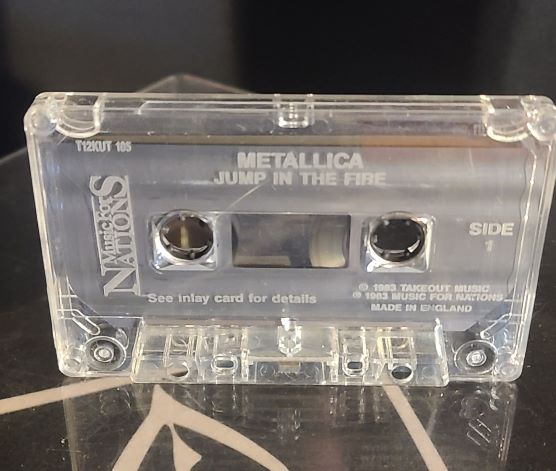
Today I’m going over the two Metallica singles I have in my collection, both on cassette. These are the early singles Creeping Death and Jump In The Fire. Both were released in Europe when Metallica was distributed by Music For Nations over there, I don’t think these singles ever got North America releases.
These are somewhat collectible, owing to them being Metallica releases. They aren’t all that rare and can be had without coughing up huge cash, at least for the cassettes. They do get price gouged a fair bit, but these aren’t worth a huge premium or anything.
Creeping Death
I’m going out of chronological order just because this one was sitting on top of the stack. First up is Creeping Death, from Ride The Lightning. It is absolutely one of my favorite Metallica songs. It’s one I’ll probably talk about in the future in more detail so I won’t get too much into it here, but it is a total beast of a song and is a staple in live sets, I believe it is their most played song. It really doesn’t get much better from Metallica.
The two B-sides are cover songs and are very iconic in Metallica lore. Up first is Am I Evil?, a song that has become an anthem for the originators, England’s own Diamond Head. While Diamond Head’s original did make some waves in the UK, they did not break international markets until Metallica’s cover.
The original is a fantastic tune and Metallica’s version is amazing. This might be the best cover song they ever did, and they’ve done quite a few. It was a boon to Diamond Head, who never broke huge but have had a respectable career.
The obscure picks for cover songs theme marches on with Blitzkrieg. This is a case of the song Blitzkrieg by the band Blitzkrieg. Sadly it was not also from the album Blitzkrieg, as it was a B-side to their debut single and they have never had a self-titled album.
This is also a well-executed cover and one that’s still a highlight of Metallica’s covers selection. Blitzkrieg the band have been on-again and off-again over the decades but were active as of 2019.
Jump In The Fire
The next single on the list is Jump In The Fire. This song is from the debut album Kill ‘Em All and the single was released in early 1984, roughly six months before Ride The Lightning hit shelves. This one has three tracks and repeats the program on both sides. I’ll still use A-side and B-side to denote things but I guess they aren’t technically correct terms here.
The A-side is a fantastic cut from the ferocious debut album. James Hetfield could wail back in the day and it’s on full display here. This is also one of Dave Mustaine’s contributions to the group (no shaking his immense influence).
The two B-sides promise live tracks in the form of Phantom Lord and Seek And Destroy, both also from the debut album. The thing is that both songs are fake live tracks – Metallica recorded alternate versions of the songs and added crowd noise to the recordings. Odd choice but I’m guessing capturing the band live during their first tours didn’t result in the best audio, so this was the chosen alternative. It’s fine from a curiosity standpoint but these B-sides clearly don’t push any real value.
That’s it for my Metallica cassette singles. Tomorrow I’ll wrap up Metallica week with my album ranking.
Yesterday I talked about two line-up changes from Metallica’s early days. Today I’ll get into the two remaining changes, both at the bass position. (Three if you ask Bob Rock, I guess…)
The first change came in 1986 and was born of tragedy – a bus accident claimed the life of Metallica’s legendary bassist.
Cliff Burton dies, succeeded by Jason Newsted
On September 27, 1986, Metallica’s tour bus crashed in Sweden. The cause is disputed – a point I’ll leave alone here. The result was the death of Cliff Burton at 24 years old.
Cliff’s death was an obvious shockwave through the Metallica camp, as well as the metal scene in general. Cliff was a massive force and contributor to the Metallica sound, his presence was going to be missed no matter what.
The band did decide to press on and after a huge audition process, chose Jason Newsted for the role. Newsted hailed from Arizona thrashers Flotsam And Jetsam, who had just been getting the ball rolling on their output. F&J would go on to have a nice career, but Newsted would find something far beyond nice in Metallica.
The lineup formed in 1987 would stay intact until 2001. In this period, Metallica would become one of the best-selling bands in the world. Their first effort with Newsted, …And Justice For All, would become their biggest seller to date. Then in 1991, their self-titled effort smashed records and stands as one of the best sellers of the 1990s.
Success would not necessarily be easy for Newsted. He wound up with just a few songwriting credits during his time in the band, which saw four full-length albums released. Jason was a total sparkplug when playing live, he was often cited as a highlight of the show for his energy and headbanging. The physical toll of that, coupled with another huge issue, led to him departing the band in 2001.
Jason Newsted quits, replaced by Robert Trujillo
When Jason Newsted announced his departure from Metallica, it wasn’t a quiet event. The band happened to have a film crew around them, shooting for a very drama-filled movie that became Some Kind Of Monster.
Newsted cited physical issues from touring, as well as discouragement from the band when he wished to do a side project. The discouragement came solely from James Hetfield, Newsted originally found the rest of the band and management keen on the idea.
Newsted would perform in a variety of bands over the years after Metallica – with that “side project” Echobrain, a tour with Ozzy Osbourne, as a member of Voivod and in a self-named band. Newsted disbanded that outfit sometime in 2014, citing the extreme expenses he was funding to take the band on tour. He has sporadically appeared in various capacities since, though not with a full time act.
For Metallica, they were between a rock and a hard place as they were working on their next album. With a lot of delays and drama found in plentiful supply on the Some Kind Of Monster film, the band’s producer Bob Rock filled in on bass for the album. It did at least come off as if Bob thought he was joining the band in a full capacity, though I don’t wish to speak for someone I’ve never met.
In any case, the audition process for a new bass player commenced, also documented on Some Kind Of Monster. The band chose Robert Trujillo, a career musician with an impressive resume spanning from Suicidal Tendencies to Black Label Society and Ozzy Osbourne (Newsted directly replaced Trujillo as Ozzy’s bassist, in fact).
Trujillo hit it off well with the established members of Metallica and was accepted fully into the band, something that never found his predecessor Jason. And it’s fair to say that Robert’s embrace into the group was the result of lessons learned from Newsted’s departure, James and Lars have said as much over the years. The band have released two albums with Trujillo and have toured extensively as the bearers of a now 40 year legacy as metal’s most successful band.
That about does it for the line-up changes in Metallica. There are other things that could be discussed, like fill-in guitarists when James has injured himself, the luminaries who auditioned for the bass role in 1986 and 2001, and the band’s idea to bring in John Bush as a vocalist and let James concentrate on guitar. But all of that is side stuff that can wait for another day. For today I’ll rest on the band’s present (and likely final) construction, ending with a final mention of Dave Mustaine simply because it’s not a Metallica discussion without Dave Mustaine.
Today and tomorrow I’m going to look at the major line-up changes in Metallica. The band have had a few over the years and they are some of the most-talked about personnel changes in music.
For the first part I’ll go into the two early era changes that would shape the band’s first run. One saw the addition of the “heart and soul” of the group, while the other change is one of the most discussed band member exits in music history.
Ron McGovney quits, replaced by Cliff Burton
When Metallica originally formed, James Hetfield brought with him Ron McGovney, a bandmate in prior outfits. The band used McGovney’s parents’ house to rehearse in during the early days, and Ron played bass on several demos.
There were apparent tensions between McGovney and the rest of the band, and Ron quit in late 1982. McGovney was not especially active in music after departing Metallica, but has joined the band at anniversary celebrations in the years since.
The titanic shift in Metallica came when McGovney was replaced – James and Lars watched the band Trauma performing at the famed Whiskey A Go Go. They discovered that the crazy sounds came from the band’s bassist, Cliff Burton. Burton was approached about joining Metallica and agreed, as long as the band relocated from Los Angeles to the Bay Area. The move was made and history would follow.
Burton would be a massive addition to the band. He played his bass much like a guitar, employing effects pedals and playing riffs seemingly more suited to six strings. His unique sound became a hallmark of the band’s early recordings and landed him solo spots on albums. Burton was also a huge contributor to the songwriting process, responsible for many of the band’s landmark songs in the first era.
While Cliff Burton’s time would be cut short through tragedy in 1986, he bears great responsibility for Metallica becoming a worldwide phenomenon. His entry into Metallica in 1982 is the catalyst for the band becoming what they were. There isn’t a Metallica as we know them without Cliff Burton.
Tomorrow I’ll talk about Cliff’s death and the shockwaves from that. But for now, it’s time to write about that which has already had trillions of words spilled about it. A few line-up changes in history have been titanic and are discussed widely even to this day, but this one might take the cake as far as how often it’s brought up, both by fans and by the aggrieved party.
Dave Mustaine is fired, replaced by Kirk Hammett
The story is well-known – Dave was in the early version of Metallica. The band were drunken hellraisers as a rule, but Dave took it to a line beyond that. Though specific stories are thrown around and disputed, Dave was eventually booted from the group just as they prepared to record their debut album. Mustaine was given a cross-country bus ticket back to Los Angeles from New York and he would form Megadeth. With a giant chip on his shoulder, Mustaine blazed his own trail in the thrash realm and remains the head of the Megadeth table today (a Megadeth line-up change post would be novel length and may or may not materialize someday).
To replace Mustaine, Metallica called across the country and asked Exodus guitarist Kirk Hammett to join. Hammett flew out directly to New York and was given the Metallica job in quick order. Hammett remains Metallica’s lead guitar player to this day.
It’s kind of funny how much there can be to talk about regarding this line-up change, and almost none of it revolves around Kirk Hammett. Kirk seems to be a pretty reserved, quiet guy who doesn’t stir the pot much. Kirk left Exodus, the band he had formed, for Metallica.
Exodus already had a reputation in the Bay Area scene, much of it for their violent live shows. Kirk’s departure left Gary Holt to be the main creative force in Exodus, a path that has served the band well in the decades since. Hammett has appeared live and in studio on occasion with Exodus in the years since.
But, as most already likely know, this line-up change isn’t really about Kirk Hammett. No, it’s about Dave Mustaine. Dave has given countless interviews over the years expressing his displeasure at being bounced from Metallica. While Mustaine is credited for songwriting contributions on the first two Metallica albums, he has in the past claimed to have written far more than he was credited on.
Mustaine also attacked Hammett in the past, accusing Kirk of simply ripping Mustaine off. Mustaine was a vocal thorn in the side of Metallica for many years, though the members of Metallica didn’t often take the bait and discuss Mustaine in any great detail.
It was clear that Mustaine was bitter about Metallica – most likely envious of their huge success, even as he found his own way with Megadeth. I hate to speculate about a person’s thoughts and motivations, but it’s pretty clear there was something to that with Mustaine and Metallica.
Over the years stances would soften, and Mustaine wound up jamming a bit with his old bandmates and his replacement during the Big Four shows. The feud entered an era of relative peace, even though Mustaine can still be counted on to say something occasionally.
A lot is made of Mustaine’s contributions to early Metallica, and this sometimes gets heated fan discussion going over what the band would have sounded like had he stayed, or if he really did provide more early material than he’s credited for, what have you. Various scenarios are argued over and over again, to no real effect but to take up bandwidth on the Internet. No one really “knows” what happened since none of us were there, and it’s so long ago now that it really isn’t important. But people have to have stuff to talk trash on, I guess.
It was just one line-up change for a band in their early years, just before recording their first record. But the saga of Dave Mustaine being tossed from Metallica lives on 40 years later, and will probably remain in the metal consciousness for so long as people have access to the Internet (and Mustaine is around to offer his occasional thoughts).
That wraps up the first part of Metallica’s line-up changes. I’ll be back tomorrow with the death of Cliff Burton and also the departure of the guy who replaced him.
It’s time to do another week revolving around one artist. This will involve a post every day, it’ll include a (long) look at the band’s line-up changes, a few singles I have and cap off with an album ranking on Friday.
I’m leading off with the band’s fourth album, one recorded and released after great tragedy. Despite a few curious choices in sound, the album would be a huge success and propel the group forward to a state of total world domination a few years later.
Metallica – …And Justice For All
Released September 7, 1988 via Elektra Records
My Favorite Tracks – Harvester Of Sorrow, One, Blackened
Metallica had made great strides in heavy metal and music in general, achieving commercial success without the benefit of radio or MTV play. Things would change with this album, and Metallica would start to become not just a successful metal band, but one of the world’s most popular acts.
The group were enjoying a fantastic touring cycle for Master Of Puppets when an icy bus crash in Sweden claimed the life of bassist Cliff Burton. Burton’s death was a massive loss and one that still reverberates today. The band decided to press on after the accident, hiring Jason Newsted away from Flotsam And Jetsam.
…And Justice For All features 9 songs at a massive run time of 65 minutes. The album cover is a fantastic image and possibly the band’s best ever. Singles released from the album include Harvester Of Sorrow, Eye Of The Beholder and One, the latter marking the band’s first MTV video.
It’s impossible to discuss the album without bringing up the curious production choices. The album sounds dry and tinny, with the high end very emphasized. The drum sound is odd, but the missing bass is the typical talking point. The band have blamed “hearing loss” for the bass omission, though a lot of people speculate that it wasn’t an inadvertent decision. The album succeeded even with the odd mix, though it is still a huge topic of discussion all these decades later.
With that out of the way, let’s get into the songs. There is a lot to go over, even with an average number of tracks.
Blackened
The album opens with a super heavy track that firmly suggests Metallica are out to snap necks again. This is a pummeling song that details the nuclear end of the world, a topic prevalent in thrash and also Metallica’s own back catalog. While much of the album drifts away from “pure thrash,” Blackened is one of the more outright thrashy songs.
Blackened is also Jason Newsted’s sole writing credit on the album – he had the main riff “laying around” and played it for James Hetfield, who immediately set about crafting the song.
…And Justice For All
This very extended play at nearly 10 minutes is a direct attack on the hypocrisy and ineffectiveness of the justice system. It is a song that is sadly still very relevant, if not more so, today than in 1988. While the base of the song is pure thrash, there are several interludes and guitar passages that keep things from getting monotonous.
Eye Of The Beholder
The tempo slows a bit for this crunchy track that concerns itself with the idea that expression is not free and is instead bought and controlled by those in power. It’s an interesting topic that could sadly go down too many dark roads these days. The song is one of the more straightforward ones from the album, keeping its pace and general rhythm throughout.
One
The most recognized track from the record and certainly one of Metallica’s most known songs, this single marked the first music video release from the group. The video features movie footage from Johnny Got His Gun, a dark story similar to what is told in One. Both feature a World War I casualty who was blown apart by artillery but is still alive, though unable to do anything but think.
One begins slowly, with a very haunting guitar passage while the lyrics outline the victim’s plight. The song picks up steam as it goes along, eventually entering total thrash-out territory around 4 minutes in. The song’s extended remainder is a solo fest.
One was a triumphant single and video for Metallica and it marked the beginning of what would be a long ride on MTV for the group. Metallica wound up purchasing the movie rights to Johnny Got His Gun so they wouldn’t have to pay royalties to the prior rights holders. The song is a staple of live sets and is also often brought up when people are asking the age-old question “You know that one song?”
The Shortest Straw
Metallica return to the political theater here, offering a song that derides political witch hunts such as the Red Scare of the 1950’s. The song is another of the “thrashier” tunes from the album. Some fans speculate that the title has to do with how Cliff Burton wound up in his fatal section of tour bus the night of the crash, but honestly that seems like a reach to me and I doubt it’s the case.
Harvester Of Sorrow
An extremely dark and twisted song about a victim of childhood abuse that grows up to be traumatized by the abuse and, after going insane, murders his family. Harvester is a slower yet still heavy song that lends the right kind of dark atmosphere to its terrible story. While Metallica did plenty outside the thrash realm on this album, Harvester is a true highlight of how they could turn down the speed yet still offer a compelling song.
Frayed Ends Of Sanity
Very easy song to peg here, it’s a thrash tune about going insane. It slots very well on this album that’s all about the dark side of things. The song has a bit of trivia with it, as Metallica didn’t play the song live until it was voted in to the set via fan request in 2014. They would often tease the intro before going into a different tune.
To Live Is To Die
This is a mostly instrumental passage that serves as tribute to Cliff Burton. You can’t hear the bass, but if you could, you would hear Jason Newsted playing parts that Burton had previously written. There is a brief spoken passage around the 7:30 mark – the first two lines were from poet Paul Gerhardt and the last two were Cliff Burton’s. The lines and the bass parts mark Burton’s final contributions to Metallica’s music.
Dyers Eve
The closing track brings back the thrash in a big way. The lyrics reference someone criticizing their parents for sheltering their child and damaging their development through childhood. The lyrics were born of James Hetfield’s childhood, who had to deal with his father’s abandonment and his mother’s death, as well as growing up in a twisted belief system that would be responsible for his mother’s end.
…And Justice For All was a massive success for Metallica. The album went platinum just a bit after release and charted well in many parts of the world. The album would go on to sell over 8 million copies in the US, some of that of course coming after the band ascended to practical godhood with the Black Album.
Metallica ran into a practical issue while touring behind …Justice – the songs were too damn long. One was a constant fixture and the shorter Harvester Of Sorrow got plenty of stage time, but many other tracks were left alone due to time constraints. Eventually every song made it on to a set list, but highlighting the album live is a very tall task.
Metallica’s course was well on track for future success after this record. The form that took was something beyond which anyone could have realistically predicted, but of course all of that is a story for another time. …And Justice For All was a fitting bookend to the group’s thrash career and a fantastic effort born of the grief over the death of Cliff Burton.
It’s on to part three of this exploration of who killed hair metal. I’ve already rendered verdicts on grunge, the prime and obvious suspect. I’ve also convicted Guns N Roses of killing their own scene by being better than it. Check out the links below to see all that in action.
Grunge, and specifically Nirvana, get the lion’s share of blame for killing hair metal. It’s warranted, as I already went over in part one of this series. But grunge didn’t just kill hair metal. The truth is that heavy metal in all its forms was very much hurt by grunge’s influence.
Record labels weren’t only signing hair bands left and right – they were out to get on the next cash cow, and the next-heaviest thing that seemed logical to take off was thrash. The offshoot of punk had come in hard in the early ’80’s and was the polar opposite of its bastard cousin hair metal. Major record labels stocked up on thrash acts in order to be ahead of the curve and be there when thrash broke big.
The only problem was that thrash didn’t enter the music mainstream. Well, except for one band, and that band turned their back on the thrash that they helped invent and instead conquered every music chart known to man. I submit for consideration as a suspect in the murder of hair metal one of music’s most significant acts who made their own mark on 1991 – Metallica.
Suspect Three – Metallica
Metallica could have killed hair metal very early on. Lars Ulrich has told a story of his band wanting to fight Motley Crue in the streets in the early ’80’s, when both bands were getting their starts. Lars set out to find Tommy Lee and teach him a lesson on who is the bigger badass in music. Unfortunately for Lars, his 5’6” frame didn’t quite measure up to Tommy’s 6’2” stature, and Lars wisely chose to disengage.
Metallica might not have beaten up hair metal way back when, but they got to put their own nail in the coffin a decade later, even if Motley Crue themselves would outlive the death of the genre they founded.
The story is simple – Metallica arrived on the scene with an intense thrash record, they then refined their approach through songwriting and combined heavy with tasteful. They entered the 1990’s looking to do something different and hooked up with Bob Rock. The resulting record, the self-titled affair known as the Black Album, took over the world and is one of music’s best-selling records ever. The record has sold 31 million copies since release and served to catapult Metallica into the upper echelons of rock stardom, an unlikely feat for a group of nasty, long-haired geeks who cut songs like The Four Horsemen starting out.
As a whole, heavy metal did not do that well in the 1990’s. A few exceptions are noted – a brief movement from the early half of the decade loosely categorized as “alt-metal,” including Danzig and Type O Negative, saw some time in the Sun. Pantera rose to mainstream prominence as a pretty harsh act. Extreme metal bubbled toward the surface as thrash fell by the wayside, with black metal being the vanguard sound by decade’s end.
But heavy metal in the 1990’s largely belonged to one band. Metallica took over the world, one platinum certification and sold-out arena show at a time. While their sound was not the same as what they cut their teeth on, there is no denying the massive impact they had on all of music when they stole the show in 1991. Their influence lasted longer and was more far-reaching than grunge, and Metallica have sales records that outpace almost every album released in the decade, even industry titans like Shania Twain couldn’t keep pace.
But what does Metallica and their 1991 advent to superstardom mean in terms of hair metal? Hair metal was already on life support before Nirvana dealt the fatal blow that September. That summer, hair bands were already reshaping their music videos to be more plain-dressed, an effort to keep up with groups like Alice In Chains who were taking over airwaves. Gone were the gaudy shiny leather outfits and make-up of the decade prior, the bands left were scratching for a bit of relevance and a hope of lasting through the record contract they just signed.
Then Enter Sandman hit MTV on July 29, a few weeks removed from the Black Album’s release. It was a whole new ballgame the second that riff fired up. Rock could be menacing, dangerous and yet still accessible and catchy. There is no doubt that Enter Sandman is one of the catchiest songs in history. It might have been overplayed, sure, but that fatigue came later and detracts from its immediate impact on the music scene.
What did a person about to enter their freshman year of high school want to be caught dead listening to – some 12th generation hair band that was dead in the water before the first single released, or Metallica? If someone wasn’t on the grunge hype train, they’d better be sporting Metallica gear. No one could argue with that, even if Metallica had pared their sound down from the pioneering thrash days.
Metallica was a safe haven for the rocker who was caught with his bleached jeans down as hair metal made a quiet exit stage left. Was Nirvana too incomprehensible and dissonant? Check out Sad But True! Still need that feeling a good ballad generates? Nothing Else Matters and The Unforgiven scratch that itch. Metallica were just as big as hair metal – bigger, even – eventually eclipsing the mark that even Guns N Roses left on the music.
It might be something of an abstract link, but Metallica deserves some share of the responsibility for killing hair metal. It’s only fitting that the band throws darts at a picture of Winger in the Nothing Else Matters video. Metallica themselves irrevocably altered the face of rock and metal music while bands like Winger were left churning in the wake. It was the combination of a heralded reputation and the fusing of metal with accessible sounds that made Metallica one of music’s biggest bands, and that commercial likability helped give people a lifeline as they fled the sinking ship of hair metal. The alternative music wasn’t for everyone and heavy metal’s biggest act came to save the day.
Tomorrow – we deliver the final verdict on who really killed hair metal, in case anyone actually didn’t already know.
This week it’s time to dust off an all-time metal classic. One of heavy metal’s most important bands and one of their most significant albums. I haven’t had the occasion yet to discuss Metallica besides in passing mention, now it’s time for my first exploration into a band who will certainly be discussed here more in the future.
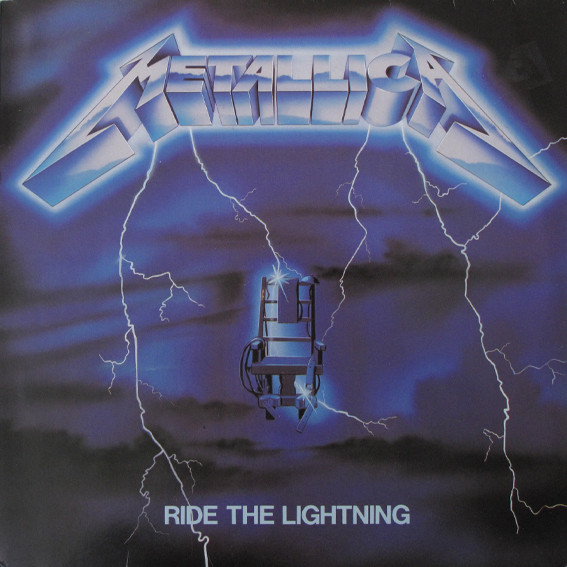
Metallica – Ride The Lightning
Released July 27, 1984 via Megaforce Records
My Favorite Tracks – For Whom The Bell Tolls, Creeping Death, Fade To Black
The album had an immediate impact on the market, selling out of its original pressing in a few months and forcing the band’s move to a major label as they outgrew underground infrastructure. As Metallica entered a supernova period of growth, they gave rise to a heaver version of metal than what was being favored by radio and MTV.
But even as Metallica brought forth the ferocity that would be a hallmark of heavy metal to come, they also displayed a refined songwriting approach that would serve them in the future as they went from being one of metal’s biggest bands to the biggest band in the world. Their musical evolution would being on Ride The Lightning.
Books could, and likely have, been written about this record. I’ll not bother with too much exposition, instead I’ll go in to the 8 songs on Ride The Lightning track-by-track and get under the hood of one of metal’s greatest albums.
Fight Fire With Fire
The album opens with a short, melodic intro that belies the sheer force to come. Fight Fire With Fire is the song that connects this record to Metallica’s savage debut Kill ‘Em All. It is pummeling and unrelenting throughout its 4:44 runtime. This misanthropic plea for nuclear annihilation sets an image and tone that would be ever-present in the oft-pessimistic world of metal.
Ride The Lightning
The title track marks one of two writing contributions from former guitarist Dave Mustaine, he of subsequent Megadeth fame. The song chugs along to the lament of a convicted killer being executed by electrocution. (Shocking, I know). The track flies along in a precise, militant manner while James Hetfield executes some of his best early vocal work in the higher register, his screaming sounding like the pleading of a condemned man.
For Whom The Bell Tolls
It’s time now for one of Metallica’s most iconic and beloved songs. For Whom The Bell Tolls is a long-celebrated staple of the band’s live set and is always in the conversation when discussing the band’s best songs. The song was inspired by Ernest Hemingway’s novel of the same name and depicts a particularly brutal sequence where a group of 5 soldiers die in an airstrike after capturing a hill.
Everything about this song is pure magic – Cliff Burton’s effect-drenched bass intro, the lyrics, the frenetic music. It all just works on a level few bands ever achieve.
I did read Hemingway’s book after hearing Metallica’s song. Hey, at least I like the song.
Fade To Black
Perhaps the most unique track on the album, Metallica have a go at a power ballad. For a band that had so heavily thrown the gauntlet into thrash metal, a subgenre they were helping invent, Fade To Black marks the first sign that more than savage heavy metal was to come from the group.
This song, like the preceding track, fires on all cylinders. The guitar work is gorgeous and perfectly suited to the morose subject matter. James Hetfield delivers haunting vocals that portray someone giving up on life. While such is common lyrical fare in metal music, very few acts execute it on this level.
Trapped Under Ice
Now for the first of two songs that are, at best, considered less than their fellows on Ride The Lightning. Trapped Under Ice is a perfectly fine thrasher that doesn’t break new ground or anything, but also isn’t a total stinker. It fits fine on the record, it’s sufficiently thrashy and I don’t feel it should be as maligned as it sometimes is. It might stick out a bit on an album with at least 3 of the band’s best-ever works, but in the end only a few songs can be the greatest. Not everything has to be best ever or worst ever, there’s plenty of room in the middle, and Trapped Under Ice fits just fine there.
Escape
The second, and the truest version of, what the hell were they thinking? Escape was apparently an attempt at a radio single that was apparently forced on them by the record label. James Hetfield supposedly hates the song, an opinion shared by a lot of Metallica fans. This song is the runt of the litter on the album, whereas the records before and after this tend to lack for a lesser track.
I honestly have no real problem with Escape. It’s still heavy enough, it has some attitude, and I never feel the need to skip it when I play the album. I’m used to it and I’m not that offended by it. No, it’s not great and it does ding the record, but it’s not that big of a deal in the end. It didn’t become a single and the 3 songs that needed to be singles did, so no harm no foul.
Creeping Death
It’s back to business in full for Metallica on the last vocal track of the record. Creeping Death is an epic headbanger about the biblical story of plagues in Egypt. This is thrash at its finest as the band shreds through verse and chorus in true Old Testament style (not to be confused with Testament the band).
The song’s mid section offers a breakdown that translates to one of music’s iconic live moments, with thousands of people screaming “Die!” along with the band. Sunday school at church was never as badass as Metallica.
The Call Of Ktulu
The record closes with a great instrumental piece that fits with the album musically and provides an interesting listen, something that some instrumentals find hard to do. The song would mark the end of leftover Dave Mustaine riffs for Metallica, something I’m sure they were happy to move on from just as Mustaine was about to start his own legacy.
Ride The Lightning is one of heavy metal’s all-time classic albums. It bridged a few gaps between their raw beginning and the polished sound to come, but also offered its own weight in thrash metal gold. Metallica would go on to become a massive band in the 80’s without the benefit of radio play, an effort owing to the force of their music.
It’s long been argued that some old-school die hards have a problem with recognizing anything beyond Metallica’s first four albums. Plenty of those arguments can be had another time but, for the sake of the albums themselves, just listen to them and then ask yourself why people wouldn’t be hung up on them. They are high points of heavy metal and lie on the summit of the genre.



 The Crooked Wanderer