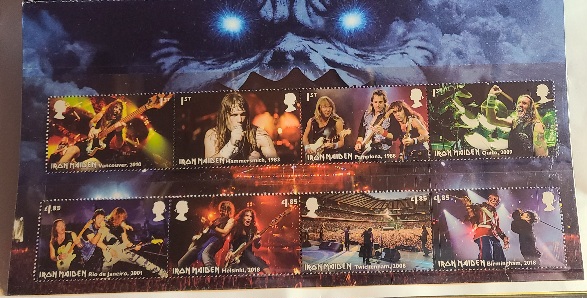
A quick post today and more of just a show-off thing. I have apparently entered the world of philately, which isn’t a strange sex act but rather the practice of stamp collecting. Since I’m pretty well broke from buying music, my stamp collecting begins and ends with this series of Iron Maiden stamps the Royal Mail issued earlier this year.
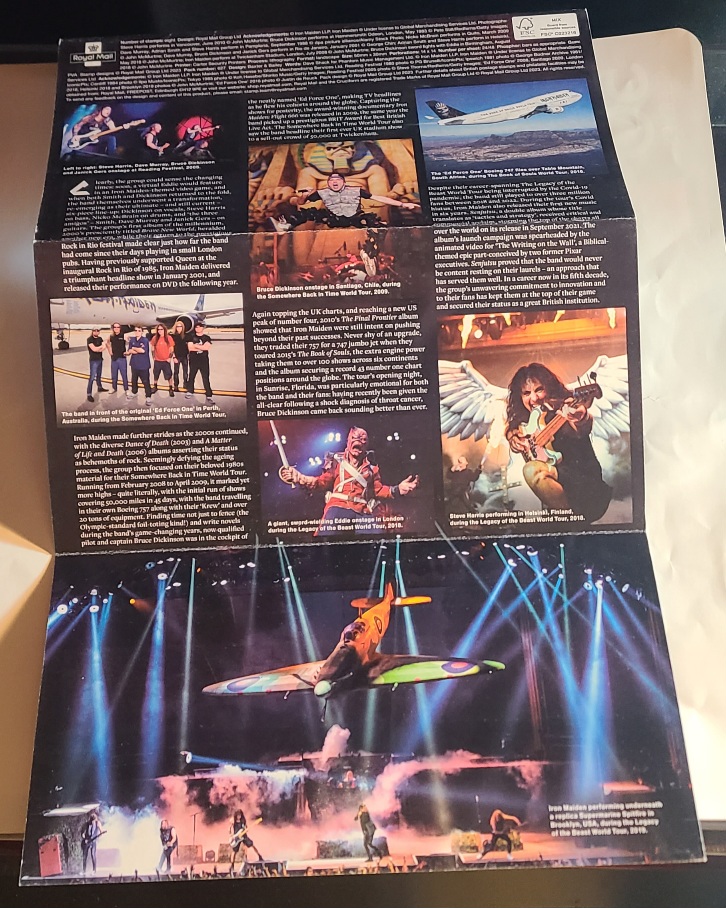
There were a wide variety of stamps and collectible packages available, I settled on the presentation pack as a one-shot deal to cover all the bases. It includes the stamps pictured below as well as a pretty detailed biography on both sides of the presentation card. Eddie gets his own bio on the back of his stamp series, as the most important member of the band surely should.
In ironic fashion it did take a little while for these stamps to arrive, because mailing stuff between the British mail and the US Post Office can’t be as quick and easy and one would figure. I know people in Canada got theirs a bit before anyone here in the US did. Though in fairness I’ve had these for a bit now, I’m just now finally getting around to taking the pictures and making this post.
I am very impressed with the setup and how well done it is. I have no previous exposure to the Royal Mail’s collectible stamp issues, as honestly Iron Maiden is the only band I’d really drop money on for stamps. My intent was to frame this and I probably still will, but it seems a bit of a shame to do that when the double-sided layout is so neatly done. But in the end framing is still likely the best option for display.
And that about does it for the Iron Maiden stamps. Not much more to say, really – they’re very nice and a pretty high-class presentation. Behold the postage of the beast.
This week’s pick is going to turn 17 later this year, which is just screwed if you ask me. Pardon me for a moment while I tend to my joint pain.
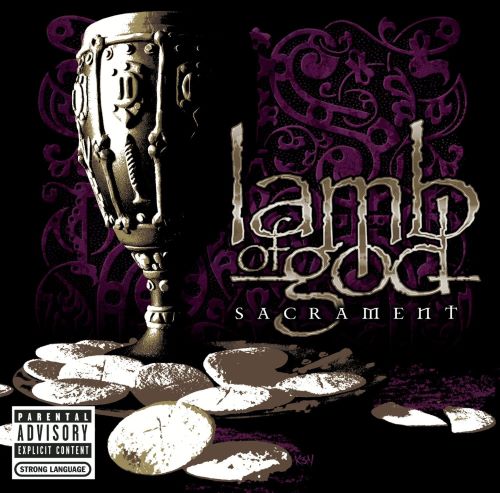
Lamb Of God – Sacrament
Released August 22, 2006 via Epic Records
My Favorite Tracks – Walk With Me In Hell, Redneck, Descending
Lamb Of God were riding a high after the splendid reception to their 2004 landmark Ashes Of The Wake. (that Album of the Week post can be found here). Heavy metal as a whole was well on the rise in the mid 2000’s and Lamb Of God were becoming a huge part of the resurgence.
The only real way to go was up, and the band would do just that with their fifth album. Lamb Of God were breaking out of the metal underground and becoming a familiar name across the music landscape as a whole. The album today is 11 songs in 46 minutes so let’s get at it.
Walk With Me In Hell
The opener leaps out with a massive riff and the sense that something beyond just a song is going on here. Guitarist Mark Morton wrote the track knowing he was on to something more and was able to work the chorus into a dedication to his girlfriend, who would later become his wife.
One of the album’s three singles, Walk With Me In Hell exploded out of the gate and became an instant classic. It remains today as one of the band’s signature songs.
Again We Rise
The song is bordering on death metal territory with its insane guitar work and pace. Lyrically it deals with the issue of “modern” US Confederates, or people who praise the losing side of the American Civil War eons after the war ended. This is not a flattering portrayal of that crowd. And the issue would only increase in scope after 2006.
Redneck
The lead single slams in both musically and lyrically. It’s a thunderous groove metal masterclass and a pointed confrontation song. This quickly became a crowd favorite and today sits behind only Laid To Rest as the band’s most recognized song.
While Lamb Of God is often dark and dreary, Redneck is a pretty fun song. The music video is an absolute laugh riot, with the band being booked to play a kid’s birthday party and the hi-jinx that ensue.
Pathetic
Another twisted riff from Mark Morton and some great drumming from Chris Adler shape this next track, which thematically is Randy Blythe screaming at someone who sucks. It’s kind of a connecting theme of this album. Lamb Of God played this song live on Conan O’Brien’s show in early 2007, and it became far more common to see metal acts on the late-night shows after that.
Foot To The Throat
A political track this time, as the band takes aim at politicians and other “powers that be” keeping the rank and file citizens down. The music is as unrelenting as everything else on the album.
Descending
Another brutal track nearly in death metal territory, the song has lyrics purporting to reflect the duality and contradiction of religion, yet unverified sources indicate that the song is really about alcoholism. Either way it’s an album highlight.
Blacken The Cursed Sun
This was the album’s third and final single. The song is a very dark and dreary affair about being at the end of your rope and going out with one final push. There’s a bit of a call and response anti-sermon kind of thing at the end that’s pretty cool.
Forgotten (Lost Angels)
A short but slamming track that is chock full of Morton riffs and takes aim at Los Angeles and the fake and plastic culture. It was reportedly inspired by shady music industry execs. Taking aim at Los Angeles has been a favorite pastime of heavier bands but LoG pull it off in pretty convincing fashion here. This is also a song that invites comparisons to the prior kings of groove metal, that being Pantera.
Requiem
Don’t be fooled by the title – this song is not a requiem from the punishment the album delivers. It’s another song with some religious symbolism and being down and out and trying to go for it one more time after being completely broken. It has a spoken word portion that’s hard to make out in the middle before a bit of soloing. It’s another track where Chris Adler is pounding the piss out of the drums too.
More Time To Kill
This one’s a pretty evil track aimed at someone who is dying but was on the wrong side of the ledger with the narrator. It’s another confrontation, go get bent kind of song. No clue what the story might be behind this one but it’s very hard feelings and not for the faint of heart. Also a bit of black metal style vocals from Randy Blythe here, pretty neat little part.
Beating On Death’s Door
The closing track keeps with the “fuck you” theme, this time it’s about a woman of ill repute who apparently pissed some people off. The song is more aimed at the unlucky sap this woman ended up with. A fittingly brutal end to a brutal album.
Sacrament was a huge success for Lamb Of God. It joined Ashes Of The Wake with a US gold certification for more than 500,000 copies sold. It peaked at number 8 on the Billboard 200 and even higher on several other US subgenre charts. Redneck was nominated for a Grammy in 2007, an award that went to Slayer. Several metal publications had this at or near the top of their year-end lists for 2006, back when print media was still a thing.
While it was the prior album that truly broke Lamb Of God into a wider audience, it felt like Sacrament was their true superstar turn. The band had previously been a part of the wider “New Wave of American Heavy Metal” movement, but by this time had broken free and far wider than the more underground sensibilities of that designation.
And the inevitable comparisons continued for LoG – both fans and detractors noted the “new Pantera” vibe to Lamb Of God, something not really present in their more extreme early days. And on this album those comparisons seemed at least somewhat valid, even if LoG were still their own distinct entity. It’s probably fair to call them the spiritual successors to Pantera’s crown, but LoG are far from a pale imitator of a past revered act.
With Sacrament, Lamb Of God solidified their place on the top of the metal mountain, or maybe scrap heap is more appropriate. They are still going all these years later, through some kind of crazy drama and all the changes in the times. A lot of riffs and a bit of cussing can take you pretty far sometimes.
We’ve hit a big one in the single series, time to go under the hood of one of Iron Maiden’s most beloved songs.
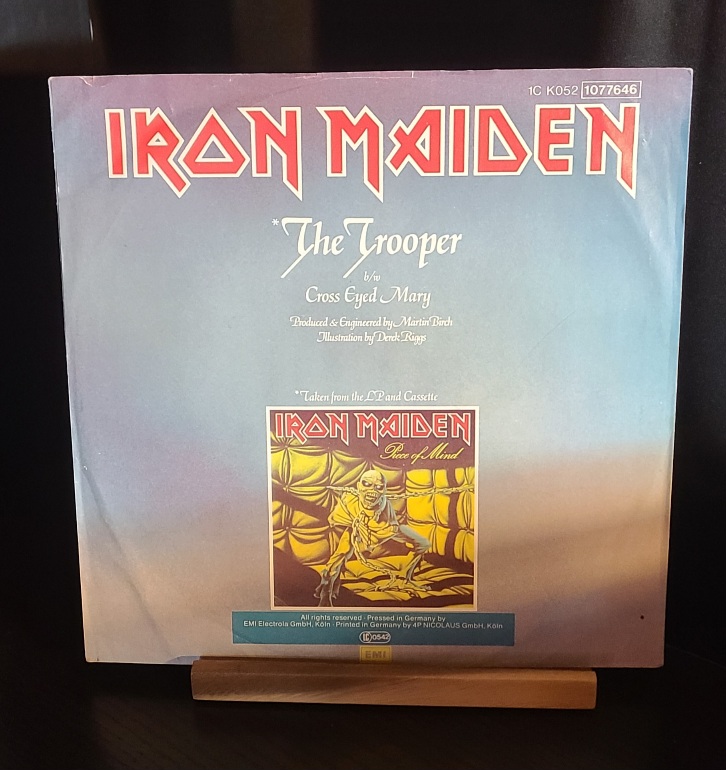
This is another from the series that is fairly standard issue – several variations but all with the same cover and track list. Mine is again a 12 inch version, note that this did get issues primarily as a 7 inch release. This song has been repackaged and re-released with other content so there are multiple releases floating around. Today’s focus will be on the original issue.
The cover art is here is beyond good – this is one of the most recognizable images of Eddie around. Redcoat Eddie holding a tattered Union Jack and his blood-spattered sword with the results of a battle and the Grim Reaper behind him is one of the instant classic pieces in Iron Maiden art. This ranks alongside Powerslave Eddie as one of the mascot’s most revered poses.
The Trooper
The cover art might be iconic, but certainly so is the featured song. It’s a bit of an exercise to pick Iron Maiden’s most recognizable and beloved song, hell those might be two different things. But The Trooper ticks both boxes and is a certain top-tier contender in those battles.
The song’s riff hits right away and is a knockout from the word go. It’s fast-paced and high energy all the way through the song, never letting up. When combined with the bass and drums, the “horse gallop” effect comes in. It’s fairly common through a lot of Iron Maiden songs but is highlighted here big time. I mean, I love it and I personally can’t stand riding horses.
This is a case of a Maiden song where Bruce really isn’t the shining star. Sure, he delivers the vocals splendidly, but there is no real “human air raid siren” moments here. He just belts out the lines and the ever-so-simple chorus that isn’t even real words. It’s the band who do the work on this one, highlighted by two fantastic solos from Adrian Smith and Dave Murray that fit the song like a glove and keep the horses charging in the right direction.
And where are these horses going? Honestly, not in the right direction. The song is based on The Charge of the Light Brigade, a huge blunder by British cavalry in the Crimean War in 1854. The British made a guess about where to best deploy their cavalry units to attack Russian positions and their guess was bad – most of the brigade died in the attack. It was immortalized in a poem by Lord Alfred Tennyson and that poem is where Iron Maiden got much of the inspiration for the song.
The Trooper has endured as one of Iron Maiden’s most popular songs. Bruce often dons a redcoat jacket to compliment the song on stage. The single just missed the UK top 10 and was also a rare notable US single, hitting number 28.
Cross Eyed Mary
The B-side is a cover of the beloved Jethro Tull classic. It is a well-done rendition, though sans flute and piano. Here Bruce really does go all out, hitting parts of a range that he wouldn’t normally tackle in Maiden tunes. It’s generally considered one of the best cover songs Maiden did and this also did get some airplay in the US. There is a radio promo single of it though I don’t own it and it’s just this song so it won’t be a part of this series.
That does it for this week’s entry in the singles series, a pretty monumental one. The hits keep rolling as the singles from Powerslave are on deck and we continue the true golden era of Iron Maiden’s career.
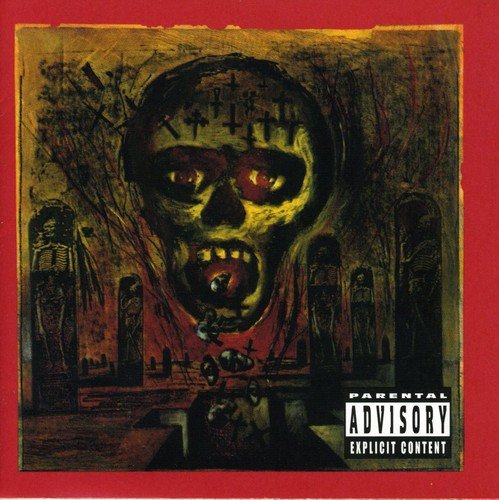
This week it’s time to head back to 1990 and have a look at an album that propelled Slayer into a new decade.
Slayer – Seasons In The Abyss
Released October 9, 1990 via Def American
My Favorite Tracks – Seasons In The Abyss, Dead Skin Mask, Skeletons Of Society
Slayer had quite a run of it through the late ’80’s, what with essentially redefining thrash metal with Reign In Blood and then pulling up on the throttle and chilling out a bit on South Of Heaven. The change in speed and/or sound did not resonate with everyone but was probably a wise choice, as attempting to do RIB again would have likely proven disastrous.
The band hit the studio with Def American mastermind Rick Rubin to crank out their next album and hit on a bit of gold with a combination of their more mid-tempo fare along with some bursts of energy. Slayer would also mostly pull back their lyrical fare from the demonic and supernatural to more of a look at real-world issues.
Seasons In The Abyss comes in with the standard American Recordings track list of the time at 10 songs (that’s all Rubin and company would pay a group for) and a run time of 42 minutes, which is a virtual eternity in Slayer world.
War Ensemble
The opener sets a quick pace as the band pound through a dark look at war, one of metal’s favorite topics. This is a stark look at the true scope of a battle and it’s supplemented with a very aggressive and re-energized Slayer. We don’t necessarily know what or where this battle is, though the Rhine is mentioned so Germany is a good guess, but it is definitely brutal.
Blood Red
The pace comes down just a hair as the band shred through a condemnation of governments using violence to silence their citizens. This one is quick and dirty and the next song kicks straight off.
Spirit In Black
This time we do revisit the more supernatural with a descent into Hell. Tom Araya is running the show as some poor sap is sent on his way to the eternal torture chamber. The song gives a few call backs to prior Slayer works, such as “blood forever rains” and “Hell awaits.” It’s also clear that the band did not piddle around with finding new guitar tones or anything – they have their sound locked in and banged this out efficiently.
Expendable Youth
A song that discusses gang violence, though of course in Slayer fashion. Gangs were the number one scapegoat of media and politicians around this time and of course the root causes of gang existence were never truly addressed. Slayer are not offering any solutions, though, this is more of an observation of the battle for turf and the cold reality of bodies on the ground.
Dead Skin Mask
This track is a look at infamous murderer and grave robber Ed Gein, the real-life influence for many Hollywood serial killers. Slayer amps up the creepiness factor with a twisted riff as Tom Araya yells through the process of a killer’s mind deteriorating. It would mirror how Gein would claim that he did not remember moments during his murders or grave robbing. This one has been one of Slayer’s marquee tracks through the years.
Hallowed Point
Pretty simple here – the band kicks the speed up a fair bit and discusses the issue of hollow point bullets, which were a hot-button issue in the early 1990’s. The bullets expand on impact and can literally tear apart a person’s insides, as opposed to the more straight shot of a “typical” bullet. The song does not really participate in the debate over the bullet, rather it simply follows the journey from firing to shredding someone apart.
Skeletons Of Society
The tempo on this one goes way down, almost to a doom metal pace. The song marches through the eyes of a survivor of an apparent nuclear holocaust. It’s probably not shocking that Slayer’s version of the post-apocalypse is a grim one. The solos from Kerry King and Jeff Hanneman here, always dissonant, are an extra special touch on this track that’s a bit of a departure from the album’s norms.
Temptation
Back to a thrash pace again and also the topic of satanism and the old classic stuff like possession and being corrupted. While couched in a lot of fanciful and supernatural stuff, the song does make a fairly real-world point about how it’s always evil that is the tempter and the attractive option, at least viewed through the lens of belief in that sort of thing.
Born Of Fire
Slayer breaks it open speed wise here as they get at least within the ballpark of Reign In Blood speed. The song is kind of a stock rundown of more evil imagery as the lyrics were written last minute by Kerry King. While Slayer’s slower pace has worked well through this album, it is nice to hear some straight-ahead bashing for a bit.
Seasons In The Abyss
The album closes with a track that really slows things down and gets into some gnarly sounding tones. A creepy intro runs for a few minutes before the song really kicks in and picks things up a fair bit. The lyrics are a bit more abstract here, they are dealing with the concept of The Abyss as presented by noted occultist Aleister Crowley. I personally have no clue what it’s really about so I’ll leave it alone. A brilliant video was also filmed for the song and was shot in Egypt, adding a huge degree of visual awe to the song.
Seasons In The Abyss would mark another notch in Slayer’s now-lengthened thrash belt. The album would get to number 40 on the Billboard album charts and also break on several other nations’ charts. An eventual US gold certification would come, and the album has sold at least 800,000 copies.
For Slayer it was a boost in reputation after South Of Heaven and its transitional nature left some fans alienated. Now people were used to the newer Slayer sound, and there were still a few all-out thrash moments to be had. It also positioned Slayer quite nicely entering the 1990’s, as their style would fit in with rising “alt-metal” movement while conventional thrash fell by the wayside. These songs, both in studio and live form, would frequent MTV programming, especially Headbanger’s Ball.
Though Slayer would make it through the very tough 1990’s relatively well, it wouldn’t come without some cost – drummer Dave Lombardo, often regarded as the band’s best asset, would quit the group in 1992. But he left after a successful album and tour cycle for a record that reinvigorated long-time fans and brought in many new ones, myself included.
This post was part of a series that I called S-Tier Songs. I later decided to abandon the series in favor of a simpler Song of the Week format. I am keeping these posts as I wrote them but removing the old page that linked to the list of S-Tier Songs, so that is why these posts might look a bit odd. Enjoy.
I always have the next handful of songs for this planned out. I was about to work on one of them when I went back and read through the list of what I did so far. I could have been knocked over with a feather to find that this song was not already on my list. So today it’s time to right that wrong.
Metallica – For Whom The Bell Tolls
The third track from 1984’s seminal thrash record Ride The Lightning was a massive force that captured the attention of the metal world out of the gate. The song was released as a promotional single and has endured as one of Metallica’s best-loved songs through the course of their 40-plus year career.
Ride The Lightning has been the subject of the Album of the Week before, that post is here.
The intro to the song is classic, but it actually begins with something else. Two bells ring, followed by the drop of the riff. If you hear more than two bells, then you are most likely about to enjoy the classic song Hell’s Bells by AC/DC. Or maybe some other song that has bells but isn’t as good as either this or AC/DC. It’s a fun game to play if listening to the radio or whatever and the bell starts ringing to figure out which song is playing.
Once the bell is over with it’s all guns blazing with the guitars and – wait, what is that infernal noise? It’s actually bassist Cliff Burton with his rig plugged into a few effects, doing a part he used to do in old Bay Area bands alongside Jim Martin and Mike Bordin, who would go on to form Faith No More. Cliff’s twisted bass piece fits the guitar part very well and the song trudges on to begin the verses.
The song’s lyrical fare is inspired by Ernest Hemingway’s 1940 novel of the same name as the song. I’ll just get this out of the way – I read the book in high school because of the song and I wasn’t all that into it. But it’s pretty badass when distilled into a song – it’s set in the Spanish Civil War of the 1930’s. In the book, a group of fighters are planning to blow up a bridge to stall an enemy advance when shit hits the fan and people are butchered. In the song, a group of fighters takes a strategic hill but get blown apart by an air raid or artillery strike soon after. Different specifics but same general concept.
For all the song’s epic feel and delivery, it is also a very, very simple song. This takes a few minutes for even a novice guitar player to pick up on, and yet it is the full weight of heavy metal crushing down on someone. It was proof that metal was more than just “play fast and scream” and that songwriting and arrangement were a part of the process. And also proof that Metallica especially would be sharp in that field.
For Whom The Bell Tolls entered Metallica’s setlists and did not leave – according to Setlist.fm, it is the band’s fourth most-played song live. It would appear the song has never left the stage in the band’s many gigs over the years. It would be a clear inclusion on any “greatest hits” of Metallica list and certainly ranks toward the top of many fans’ favorite songs lists. And the single went gold in the US, an impressive feat as the band were not a radio or MTV darling in their early years.
Why is this an S-Tier song?
For Whom The Bell Tolls is one of Metallica’s immortal anthems, a crushing tale of the horrors of war set to a simple yet devastating heavy metal track. Even in all the subsequent world-conquering fame Metallica would enjoy, this song remains one of their most beloved. It was a showcase for Cliff Burton and it proved the band had the writing chops to excel beyond the scope of simply playing fast and loud.
We’re back into the Iron Maiden singles series. As a note, the list presented below is now the final list for my series run through. Should I get more singles I’ll update sometime down the road but I’ll go with this for now, which is really easy since many of the ones I don’t have are getting pretty expensive.
We are now on to the band’s fourth album Piece Of Mind. With it comes a new drummer – Nicko McBrain, who had been drumming for years and had most recently worked with French outfit Trust. His replacement in Trust would be none other than Clive Burr, the man Nicko was replacing in Maiden. Nicko has held down the drumming for Maiden all the years since. And this line-up change gives us a period of stability up until the end of the 1980’s.
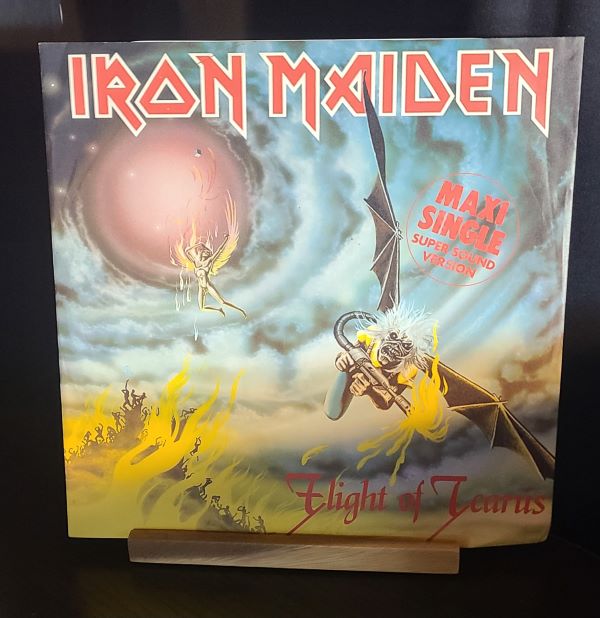
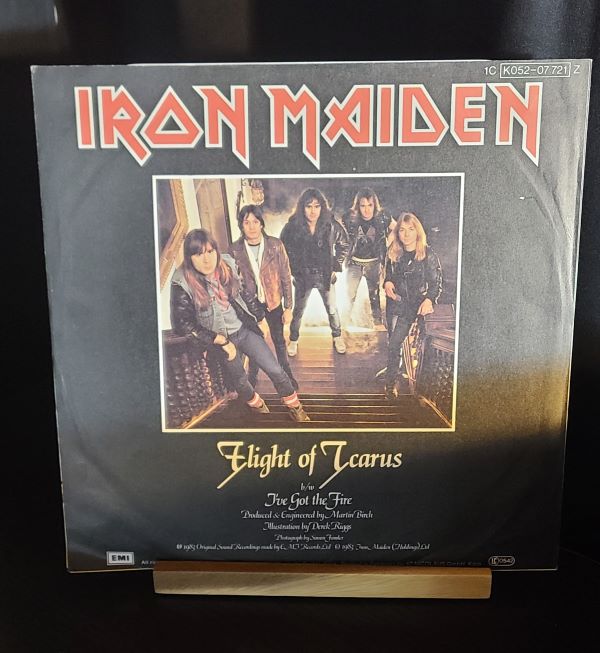
Today’s single is in similar fashion to the past few – really just one version with the same cover and content. I have a 12-inch European pressing. This single did get issued in the US as a 7-inch record but I go after the 12-inch stuff when I can. The cover art shows bat-winged Eddie with a flamethrower, because that’s how the Greek tale that this song is inspired by was told originally.
Flight Of Icarus
The single’s lead track is one that doesn’t go full blast but keeps a steady rhythm through its run. The song tends to soar rather than snap necks and would be indicative of future Iron Maiden music. The showcase of the tune is Bruce Dickinson singing his ass off, especially on a part toward the end that is almost inhuman.
Flight Of Icarus is about the Greek myth of the same name, though Maiden adjusted the story a bit to fit their song better. Icarus flew too close to the Sun and bit the dust, and that was the birth of the adage about flying too close to the Sun.
The song one of Maiden’s more popular tracks, though the band took a long time off of playing it live for a few decades. It left setlists after 1986 and didn’t return until 2018. Steve Harris has always been a bit grumpy about the song so that might explain its extended absence, though I can’t say that for sure.
I’ve Got The Fire
No, you don’t have deja vu (and won’t, that Maiden song was never a single). We are handling an Iron Maiden cover of a Montrose song for the second time and it’s the same song. Maiden did the song live with Paul Di’Anno and this time did a studio version with Bruce singing.
This version is more clear than the rougher live track done very early in the band’s recording career and Bruce is a true highlight handling the vocals of a Montrose song. This is short and sweet and is one of the better cover renditions Maiden have done, though we have a whole heap to go through as this series rolls on. And we’ll visit another Montrose song later down the line.
Back into the Maiden singles and this time it’s the title track to the third album. We get the epic song and a live cut as a B-side.
The cover is again Eddie and the Devil, this time Eddie is holding the Beast’s severed head in hand. While there are other art pieces depicting the pair in later Maiden work, this is the end of the line for the “Eddie versus The Beast” series proper.
While the single had several pressings for different countries and was on both 7- and 12-inch formats, the content remains the same across all versions. Mine is a 12-inch European pressing.
The Number Of The Beast
We again have one of Iron Maiden’s most popular songs to go through. And right off the bat we have a bit of lore and a huge misunderstanding among the metal community – the spoken word intro is NOT delivered by famed actor Vincent Price. The band did want Price to recite the Bible verses, but Price was charging too much money so the Maiden camp passed and got actor Barry Clayton to do it instead.
After the spoken bit, the song proper opens with Bruce Dickinson going in full air raid siren mode. Then the verses roll through into the familiar chorus with the “bad number” 666 and all of that. The song is iconic both in Maiden’s lexicon and in heavy metal in general. I don’t know of a live setlist that doesn’t have this song in it.
The album and single would raise the ire of those engaged in the “Satanic Panic” of the 1980’s, with record burnings and sermons aplenty launched against Maiden. These protests did not have the desired effect, it only put Iron Maiden’s name out there more and helped the single get to number 18 on the UK charts. And the album would be a number one UK hit and gain platinum certification in many countries.
Remember Tomorrow
The B-side is a cut from the debut album, this time performed live with Bruce singing. The song was played in Padua, Italy in October of 1981 and was just three days after Bruce’s first gig with Maiden.
Remember Tomorrow is an interesting tune, a bit of a moody track that picks up later and gets into the signature Maiden riff and rhythm stuff. Hearing Bruce absolutely wail on it, actually dueling the guitar in pitch toward the end, is pretty impressive. This song did get a little bit of stage time in Dickinson’s first run with the group, mostly in the early 90’s before Bruce left, and also featured again in a some 2005 setlists. It’s a really cool live cut here that showcases Bruce very early in his first Maiden tenure.
This single would be the last Iron Maiden release for drummer Clive Burr. Different things have been said about his departure, though I wasn’t there so I don’t know what exactly happened. Burr would go on to drum for a number of other bands before suffering a multiple sclerosis diagnosis in the late 1990’s. Iron Maiden would play a role in fundraising for Burr’s medical needs and Burr’s cause was given a spotlight until his unfortunate death in 2013. Burr’s drumming style had a pretty massive influence on the heavy metal world. Burr’s replacement in Maiden, which we’ll obviously get to next week, would lead to a stable line-up that holds together for the next several singles.
Note – Remember Tomorrow starts at 4:49 in the following video, I use it as it’s from the band’s official channel and won’t get yanked.
This post was part of a series that I called S-Tier Songs. I later decided to abandon the series in favor of a simpler Song of the Week format. I am keeping these posts as I wrote them but removing the old page that linked to the list of S-Tier Songs, so that is why these posts might look a bit odd. Enjoy.
Today’s pick was not a single from its album but was picked out by fans as a highlight track right away. It has gone on to become one of the band’s most famous songs and its fame has grown, even in the midst of a major singer change in the band.
Nightwish – Ghost Love Score
Today’s song comes from the 2004 album Once. In a neat coincidence, I have previously covered Once as an Album of the Week. And after looking back at that post, it’s no surprise that I spent most of my words talking about this very song.
Ghost Love Score is a long, epic movement clocking in at over 10 minutes. It is not a simply-structured pop song with verse/chorus/repeat, rather it is a symphonic piece arranged in movements. It is in parts both progressive and classical, and bears the accompaniment of the London Philharmonic Orchestra. (That would be part of the album’s €250,000 budget) The song was composed by keyboardist and band leader Tuomos Holopainen, as per usual with Nightwish’s music.
The song is about someone looking back fondly on a past relationship. The pair are no longer together, yet the narrator still keeps a place in their heart for their former lover. This isn’t a story-song with a plot or anything like that, but the song does explore the range of emotions when looking back on lost love.
While the band and accompanying orchestra are in fine form on this run, the most-discussed aspect of this song is the performance of the singer. Original vocalist Tarja Turunen cut the studio version of the song and the live version presented above. Her performance on this song is majestic and otherworldly, though that could describe the vast majority of her singing over the years. Ghost Love Score is an operatic performance, which Turunen excels at. It is not an opera, but certainly the vocals are of that style.
Nightwish’s star was on the rise during the Once album cycle and Tarja Turunen became noted as one of the best singers in the world. Then, in a very unexpected twist, she was dismissed from Nightwish in 2005. In fact, she was fired just after the concert that the live footage above is taken from. While the drama surrounding the move is both long and not entirely clear, Nightwish was now without what many considered its star performer, and the one who made Ghost Love Score such an especially compelling song.
Turunen was replaced with Anette Olzon, a Swedish singer who had previously fronted rock act Alyson Avenue. The two albums Nightwish recorded with Olzon suited her more rock-oriented singing style and were well-received by most fans, while derided by others for not being Tarja’s work. It did stand out when Olzon performed some of the older material, as Olzon and Turunen had very different singing styles. While a lot of the discourse over these differences became toxic among fans, I don’t feel it’s wrong to point to the contrasts objectively while being respectful of Anette.
Olzon did perform Ghost Love Score live. Her renditions were well-executed and she approached the song in her style as opposed to trying to imitate Tarja, something only a select few singers on the planet can do. I wouldn’t pass judgment on Anette’s singing or make nasty remarks about her simply for not being able to mimic one of the best singers on the planet, but I’ll also admit that a song like Ghost Love Score didn’t hit exactly the same way without Tarja.
In 2012 while on a US tour, Nightwish entered another stage of drama and the result was the exit of Anette Olzon. The band already had an emergency replacement lined out – former After Forever singer Floor Jansen, another standout singer who also had been speculated as the pick to replace Tarja in 2007. Jansen stepped in to help finish the tour and then was promoted to the role of full-time singer soon after.
And this is where the story of Ghost Love Song takes another turn and the song truly propels itself into the heights of Internet fame. Nightwish performed at the 2013 edition of the famed Wacken Open Air festival in Germany. The show and some documentary footage were filmed for a release later in the year, packaged as Showtime, Storytime. Nightwish performed Ghost Love Score as part of their set and it was this performance that lit up YouTube and social media. The song became the primary fuel of the emerging “reaction” channel movement and everyone with access to a camera filmed their hot takes of Floor’s performance.
Floor Jansen was honestly the perfect singer for Nightwish – someone able to handle multiple styles yet also sing in the range and scope that Tarja previously offered. Her Wacken performance of Ghost Love Score was a complete home run and the song’s viral reaction would introduce Nightwish to new fans all over the world.
It isn’t a terribly common thing for a new singer to come in and knock an old song out of the park, but in the case of Nightwish and Floor Jansen that’s just what happened. Floor was able to fill Tarja’s shoes and even add her own element to the song, in a case of one of the best singers in the world tackling the work of one of the best singers in the world. Ghost Love Score still lives on today in scores of YouTube reaction videos, even if that format has grown beyond stale at this point. Hard to knock it when it brings a masterpiece such as this to the masses.
Why is this an S-tier song?
Ghost Love Score is a wonderfully composed epic that combines the realms of classical music, heavy metal and even film score in a way that suits many fans of all those areas. And its centerpiece is the performance of the singer, a song that has now featured a few of the world’s best vocal talents that have raised the bar of talent and performance in metal.
Today we hit a milestone mark in the Maiden singles series – we are now to the third album The Number Of The Beast and therefore Bruce Dickinson has joined the band as the replacement to Paul Di’Anno. This marks the start of the “golden era” for Maiden and the bulk of their epic releases fall in this time frame.
Run To The Hills features another stunning Derek Riggs cover piece depicting Eddie and The Beast in a fight. The cover was the same across different versions of the single, in fact this single has no differences among versions – everything is just different pressings for various countries. Art and content are the same through all. Mine is a 12-inch paper sleeve version. Also we’re on a run through several singles that are simply A-side and one B-side, it’ll be a little while before something with multiple B-sides pops up again.
Run To The Hills
On the feature side is one of Iron Maiden’s most iconic songs. Run To The Hills is a very popular tune, having been a part of many setlists over the years. I’d wager it’s one of their top 5, if not top 3, most well-known songs.
The song is about the plight of the Native Americans at the hands of the invading European-American forces. Such a song could come off as boneheaded or worse, but Maiden handled the subject matter with suitable degrees of both seriousness and accuracy. The first verse’s lyrics are from the perspective of a Cree native who is lamenting the invasion and slaughter, while the second verse is told from an American cavalryman’s perspective. Note that this verse shift happens before the chorus is delivered. The final verse pulls back into a distant perspective and harshly recounts the brutal nature of the actions against the Cree.
While the subject matter is grave, the song’s iconic chorus is simple and, at least musically, uplifting. For many the cry of “run to the hills, run for your lives” would be one of the first things heard from the lips of the new singer Bruce Dickinson. Iron Maiden was re-armed with a potent young singer, and here was the first taste of what would become heavy metal history. The “Human Air Raid Siren” was just getting started.
Again, this is one of Maiden’s most-played songs live and most recognizable on the airwaves. Some feel maybe it’s been played a bit too much but I personally don’t get enough of hearing it.
Total Eclipse
The B-side is an interesting case, as it was a song intended for the album but cut in favor of Gangland. The band have long expressed regret over the decision. Reissues of The Number Of The Beast have included this song, and last year’s vinyl only reissue actually did replace Gangland with Total Eclipse. While I’m personally fine with the other reissues that have all the songs, I can understand last year’s decision as they had to keep the album to one record to accommodate a (very awesome) double-LP live album press as well.
I’d say I agree that Total Eclipse is a better song than Gangland, but of course that makes this single that much better. The song is a doomsday track, one of many that Maiden would crank out over the decades. It has the sound and feel of the first few albums, but of course with Bruce wailing away on it. I’d say it’s one of the better original non-album cuts the band did.
That does it for this week’s single. Next week it’s on the iconic title track from the iconic album, and another point where we’ll say farewell to a member of the band. And there a few things sifting through the mail system on their way to me to expand the list a bit further, including at least one representation of the Blaze era.
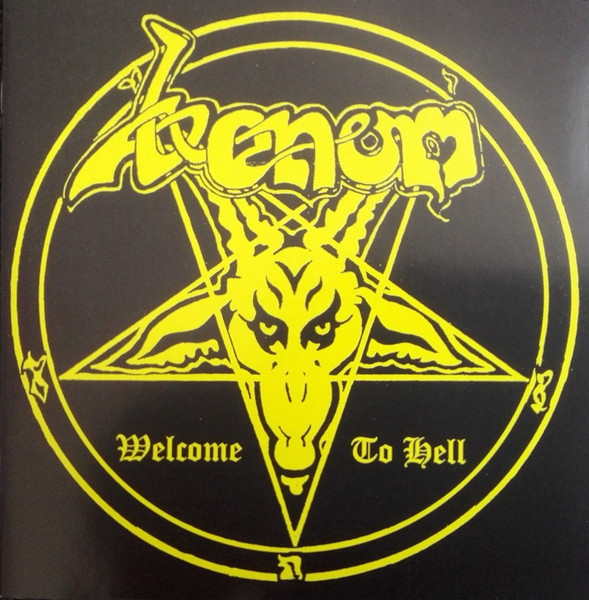
Two weeks in a row for debut albums – this week it’s a first offering from a band that would cast a wide influence on what would come to be known as extreme metal. While much of early 1980’s England was in the midst of the New Wave of British Heavy Metal scene, one band would take noise, speed and Satan to a different level.
Venom – Welcome To Hell
Released December 1981 via Neat and Combat Records
My Favorite Tracks – In League With Satan, Live Like An Angel, Welcome To Hell
Venom was formed when the three core members eventually came together out of the ashes of other bands. Conrad Lant would handle bass and vocals, Jeff Dunn tackled guitar and Tony Bray sat on the drum throne. The three would choose stage names – Cronos, Mantas and Abaddon, and be more known by those names in the pre-Internet era. Much of this first album was composed of tunes that Cronos and Mantas each had worked up in some stage and brought to their new band’s sessions.
There were two other members of Venom early on, but both Alan Winston and Clive Archer would leave the group before the recording of the album.
Venom would record their early demos at Impulse Studios in the Newcastle area, where Cronos had a job and traded work for Venom’s studio time. They would land a record deal with Neat, a British label who also happened to own Impulse Studio. Venom recorded the album proper in a few days, and Neat released the record after a few more days and not much in the way of mixing and mastering. This raw, unpolished sound was not entirely intentional on the band’s part but would wind up being a key point of influence on the later black metal movement.
Venom would use overt Satanic imagery and lyrical fare as an attention getter, but would also fully commit to the gag in a way that pushed beyond the “quasi-satanism” of Black Sabbath and earlier acts. The band’s interest in Satanism and the occult would play into the Satanic Panic of the 1980’s and even later land the group a coveted spot on the PMRC’s Filthy Fifteen list. (I’ve covered the list in the past here).
Today’s album holds 11 tracks with a running time near 40 minutes. There won’t be much in the way of technical proficiency to discuss, but a lot of ripping through songs about evil and lust and the influence many would bear later on the metal scene.
Sons Of Satan
It’s fair to call this a collision of musical parts being played together at once as opposed to a cohesive song. The lyrics implore the righteous youth to abandon their path and join the satanic Venom legions. And perhaps against the odds, Venom would succeed in their dark recruiting mission.
Welcome To Hell
The title track is a much more put-together affair than the opener, though still swamped in the lo-fi buzz that would come to be a defining point of the band. The lyrics are a crude pounding through the glorification of Hell and the end of the world, with a spoken word portion of Psalm 23 from the Bible thrown in because why not.
Schizoid
While the title implies a mental disorder of some kind, the song is about a serial killer. It’s a pretty good song though it’s hard to ignore the awful drum sound here, certainly a case of something that would have sounded better with more work in the studio.
Mayhem With Mercy
A brief instrumental that isn’t of note itself. The Norwegian black metal band Mayhem would name themselves from this track and then go on to live in infamy in the 1990’s.
Poison
A nice song about a girl who entices the song’s narrator, though the girl is of course evil and all that. The lo-fi production works pretty well here. It is worth mentioning that hair metal act Poison did NOT name themselves after this track.
Live Like An Angel
A very nice song here that would be an early influence on thrash metal. This song would be bundled with In League With Satan for release as a double A-side single. This did illustrate that Venom’s primitive sound was down more to studio limitations than musical effort.
Witching Hour
All hell breaks loose on this, one of the most celebrated tracks from the album. So lo-fi it can almost hurt to listen to, but also a fantastic slab of sick heavy metal. It’s pretty easy to find a cover version of this song on any number of underground metal bands’ albums.
One Thousand Days In Sodom
Bit of a concept piece here, I guess, as Venom explores the sin and decay of the city of Sodom, as told in the Bible. It should be no shock that Venom’s recounting of the story does not align with Christian teachings. A very nice riff here and some pretty well-done songcraft. It is widely reported that the German thrash band Sodom named themselves from this song, though I can’t locate actual confirmation of that tidbit.
Angel Dust
In keeping with the lyrical themes that piss off the “moral majority,” we now have a song about drug use. Angel dust is the common street name for PCP, which is honestly a pretty messed up drug. While the song is clearly glorifying drug use, I don’t recall that the members of Venom were particularly taken with drugs, this is just another character piece.
In League With Satan
We are now at what is largely considered the highlight of the record. In keeping with actually doing everything that other bands were incorrectly accused of, the beginning features a backwards-recorded Satanic message. And the main lyrics of the song have the similar Satanic messages said normally. This is a very nice and evil sounding song that hypnotically marches through its dark message and generates the kind of sound that other metal bands would strive for.
Red Light Fever
The album closes with a savage rip through a song that is not about running red lights in traffic, but rather the seedy red light districts of infamy. While Cronos finds himself a good time gal, he realizes that she’s just doing her job and his moment of glory is just a moment.
Welcome To Hell was the start of a sound and scene that would not light up mainstream sales charts but would spread a wide influence across what would become new strains of heavy metal – not only ignoring the criticisms of theme and imagery, but embracing those themes. Venom’s second album Black Metal would give a name to the most infamous of these subgenres of extreme metal, and Venom’s honestly unintentional lo-fi sound would shape the early recordings of that movement.
Venom would gain notoriety for their sound and antics, but were outpaced by the movements of other metal bands. By the end of the 1980’s thrash metal was king and several versions of extreme metal were entering their prime years. Venom themselves would go through a series of line-up changes and dramas, though they are still active with Cronos being the sole original member and have released 15 studio albums with a variety of line-ups over the years.
Venom and Welcome To Hell are viewed in a positive light in terms of influence and legacy, though in the realm of sound they aren’t particularly noteworthy among critics. Yes, the album does sound like shit. Listening closely today it’s a bit of a slog to get through, though for me personally there are worthy songs under the layers of badly done studio work. But I imagine this was a different thing to hear in the early 80’s when the average listener didn’t have the context to understand recording techniques – this sounded pure evil.
At the end of the day, even if it sounds like a bad attempt at recording, the influence of Welcome To Hell far exceeds any technical limitations. For all of the finger wagging at heavy metal and its supposed immorality, Venom were actually providing that unironically. In the family tree of extreme metal, this is the trunk.






 The Crooked Wanderer